Tag: sonnet

  • Inner Scream

    Inner Scream

    Be conscious of the inner scream,
    The little voice you hear.
    Listen to the subtle theme,
    That’s worried to appear.
    Sometimes it’s not the brightest beam,
    That should earn the right to steer.
    Let go, release, all things extreme,
    Their effect is too severe.
    Question what at first might seem,
    A line of vision clear.
    For broken is the cunning scheme,
    That shrouds what should be sheer.
    . Do not depend upon the light of day,
    . As with a fickle friend… it fades away.

    © Tim Grace, 2 November 2010


    To the reader: We all have niggling doubts, small worries, that attach themselves to passing thoughts. Some doubts, on a hunch, rise to consciousness and become inklings. We worry about doubts but act upon inklings. Inklings deserve attention. In seeking out a solution it’s to inklings, not doubts, that we should look. From an inkling comes the moment of revelation; the hunch was worth pursuing.

    To the poet: The rhyming pattern of this sonnet is a simple a-b-a-b; except for the final couplet. To achieve some listening interest, the repetitive pattern at the end of each pair of lines requires an alternative reading rhythm. Conveniently, there’s a contrast of one and two syllabic words that bounce at the beginning and end of most lines. With no words having more than two syllables there’s a short beat that wants to quicken the accent on each doubled-over sound.


    inner scream
    inner scream
  • Play’s the thing

    Play’s the thing

    How do kids learn something new?
    They work with what they know.
    When novelty is theirs to view,
    It’s then their interests glow.
    For every child a different flame,
    From different sparks ignited,
    When play’s the thing, work’s a game,
    And kids will get excited.
    So fire them up with hot debate,
    Challenge them to think,
    Just enough to incubate,
    Knowledge at its brink…
    . Turn up the temperature; things will churn,
    . It’s steam, not water, makes the wheels turn.

    © Tim Grace, 30 October 2010


    To the reader: Curiosity generates children’s engagement in learning. Harnessing curiosity, shaping it, to meet the needs of education is a challenging task. Playfulness is an indicator of success. Curious children at play, solving open ended problems, is better still. When children learn to direct their playful minds towards solving real world problems then the sandpit has done its job. Schools, the sandpits of learning, need to be alive with meaning and challenge … gritty and real.

    To the poet: When framed as a question curiosity is channelled towards a conclusion. At the head of this sonnet is a simply stated question; one that invites the unpacking of what the poet knows about how kids learn. If there’s a message, it’s that learning needs a furnace, a source of heat that challenges children; fires them up to respond with new and creative thinking. The poem is therefore sprinkled with references to heat and light.


    play's the thing play’s the thing


  • Elegant Solution

    Elegant Solution

    In search of a strategy,
    A maneuver that’s adept,
    With an obvious analogy,
    That others will accept.
    An elegant solution,
    With a simple line of sight,
    A corporate contribution:
    That’s logical and bright,
    That’s possible; sensible,
    That’s ethical and good,
    That’s plausible, defensible,
    And easily understood.
    . A nifty, thrifty, plan of course,
    . A steady, ready, driving force.

    © Tim Grace, 28 October 2010


    To the reader: It’s the obvious that speaks most convincingly for it holds true what is familiar and evident. Unfortunately, the obvious truth all too soon becomes mundane and therefore tires of enthusiasm to drive new change. It takes a brave soul to suggest the obvious, however true; hardly the suff of enterprise and innovation; best not without good reason. Unless, that is, a fresh view of the obvious is drawn and gives rise to “why didn’t I think of that?”

    To the poet: It was important that this poem did nothing too strenuous. Its success relies upon a simple presentation of obvious poetic solutions; very predictable, very familiar. It was also important that having posed the issue as a strategic search for a plan it did nothing to deliver the proposition or deliver a plan. The search was seeking a strategy not an answer.


    elegant solution elegant solution


  • A Dog Might Be

    A Dog Might Be

    Man’s best friend, a dog might be,
    he dotes with admiration.
    But regardless of his pedigree
    he causes consternation.
    Dress him up from top to tail,
    shine his coat and collar.
    But, what’s the bet that without fail,
    he’ll lead you in to squaller.
    Take him out to the finest park,
    frequented there by poodles,
    and off his lead, he’ll beg and bark,
    and steal the apple strudels.
    . Beware the dog that trains his master,
    . it won’t be long before disaster!

    © Tim Grace, 24 November 2010


    To the reader: Fallibility. Temptation outsmarts the wisest of dogs. Despite training, when off the leash, a dog will revert to its natural instinct. Dogs are territorial so they will be protective of their patch; they’ll take every opportunity to mark out ground. Dogs are pack animals so they will be selective in who they like and dislike. As protective and selective beasts dogs are prone to social error: faithful but not always dependable.

    To the poet: A light-hearted observation is good for breaking tension. The poetics of this sonnet flow freely. The words are on a long leash and the poet’s in control. The notion of ‘obedience’ is never stated but the poem’s structure is doing what’s expected. The poem is designed to be faithful to its master; true to its message… obedient.


    a dog might be a dog might be


  • Borrowed Word

    Borrowed Word

    It’s not always me that speaks,
    I’m often just a borrowed word,
    My conversation carries streaks;
    Echoes of the overheard.
    I’m the translated remnant
    Of someone else’s script,
    A turn of phrase, a fragment,
    Through abbreviation clipped.
    I’m a short handed message,
    From a seven second grab,
    A truncated passage,
    Today’s cut, tomorrow’s scab.
    . Today’s headline … badly dismembered,
    . Tomorrow’s deadline … barely remembered.

    © Tim Grace, 23 October 2010


    To the reader: We hear and read so much of other voices; spin, hype and noise. We probably don’t tune in to much of it but some of it grabs our attention and for a short while resonates through daily chatter. What grabs is the easily digested snippet, or factoid, that’s neatly packed with interest and primed for repeatability. On the back of efficiency catch-phrases and headlines prove themselves robust and sturdy messengers of regurgitated script.

    To the poet: In keeping with the message, the structure of this sonnet is compressed into neat segments. Each bit begins with “I’m” as in: … a borrowed word, …a translated remnant, …a short-handed message; a snippet. The coining of snappy phrases, easily re-used, is emphasised in the final couplet which borrows heavily from its own form and structure; wastes nothing new and does it with less.


    borrowed words borrowed words


  • This Table

    This Table

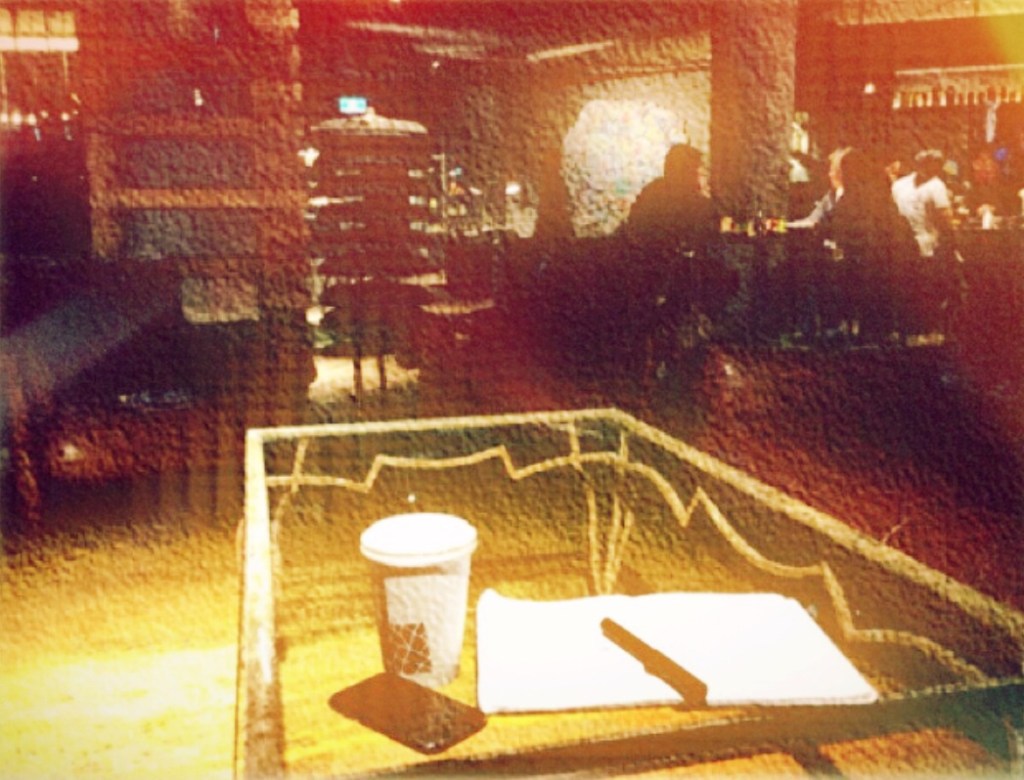
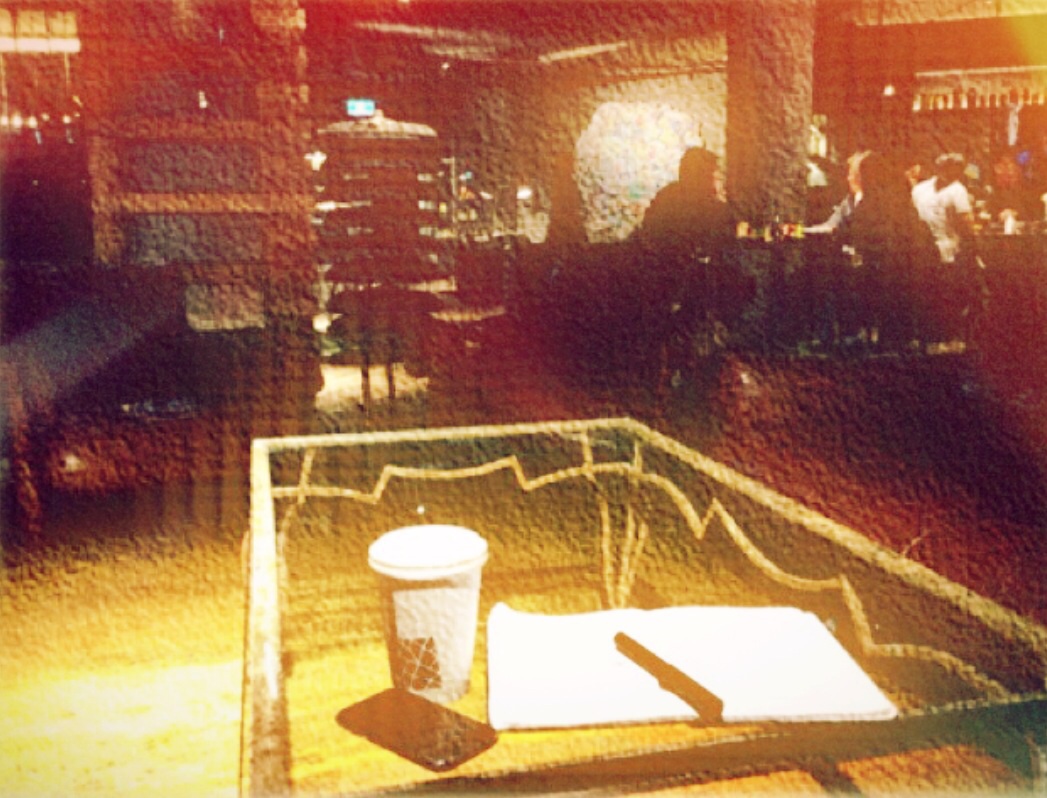
    This table is my point of view,
    Provides a horizontal plane,
    It’s the visual avenue,
    To the peculiar and mundane.
    It’s from where I watch the lives we live,
    Assemble then disperse
    It’s the single-point perspective
    That stimulates my verse
    It’s the in between scene
    Of a mental map
    Where my elbows lean
    and my fingers tap.
    . It’s where clutter finds coordination,
    . And ideas meet their destination.

    © Tim Grace, 17 October 2010


    To the reader: In literal terms a cafe represents an unpretentious coffee house. In practical terms it provides time-out; joins the break between two activities; starts and ends a day; brings together two minds; and as often as not relieves the bladder… and all this for the price of a coffee. The cafe offers a public/private interlude, perfect for introspection and contemplation; people watching.

    To the poet: The passing trade in a cafe forms a poet’s banquet. From the menu comes a feast of subjects including the urbane, the mundane and the insane. Occasionally, the setting not the people deserve attention and that’s how the over-looked table became the subject of this sonnet. A poet’s table is central to the writing process as it defines the angle of observation and locates the presence of mind; it positions the poet.


    this table this table