Tag: Time

  • All but done

    All but done

    In the end, when all is finished,
    And the task is all but done,
    When the burden is diminished,
    To what it was before begun.
    It’s then that we can savour,
    The taste of sweet success,
    Let linger long the flavour,
    And with confidence impress,
    Be not bothered by the critic,
    With his crooked rule of thumb,
    Be not worried by the cynic.
    With his surface level scum.
    . In the end, the real end, all things being equal,
    . What’s done is done … so deliver not the sequel.

    © Tim Grace, 27 December 2010


    To the reader: We begin, often with an end in mind. At end, we arrive at a moment of completeness. Completeness delivers finality and/or conclusion; possibly both. Conclusive moments ought to be rich with satisfaction and deserving of hiatus; time for a break. A self-satisfied pause should offer some protection from those who would wish to offer judgement… the artist steps back from the canvas.

    To the poet: No doubt there was a particular incident that created my need to express frustration with an ending too abruptly injected with criticism. Get used to that. Responses to art are pretty quick to condense and find expression; the first impression says it all. The trick, I find, is don’t declare the ending too soon. Prepare the finish carefully.


    all but done all but done
     

  • Square Reminder

    Square Reminder

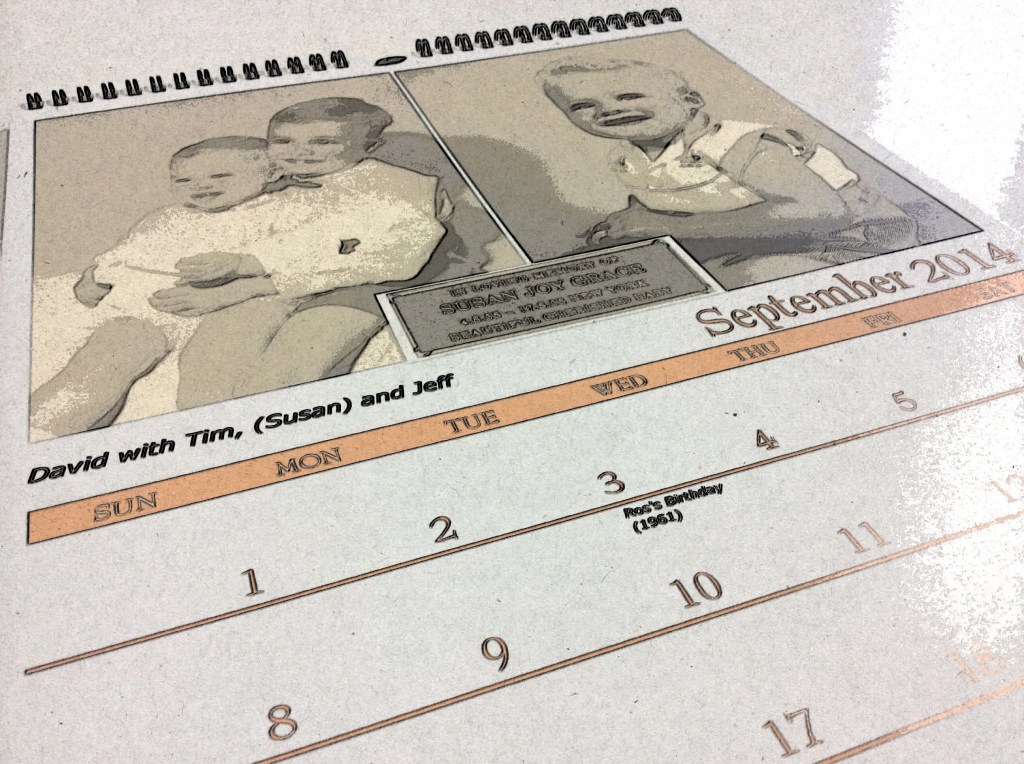
    A calendar, twelve pages long,
    A square reminder of yesteryear,
    Neither script nor song,
    It’s a sketch on a thin veneer.
    Snippets on a month long frame,
    Dates confirmed, appointments missed,
    It’s payday, it’s an insurance claim,
    It’s see the doctor, the vet, the therapist.
    A dozen pages in a sequence of sorts,
    A record of ‘there we go’ and ‘here we come’
    A date from which we anchor thoughts,
    It’s the come again compendium.
    . The hatchings, the matchings, the trouble and strife,
    . The meetings, the greetings, that chronicle life.

    © Tim Grace, 16 December 2010


    To the reader: It’s no mere coincidence that this sonnet was written in mid-December. The Southern Hemisphere’s end-of-year mayhem is compounded by heat and the celebration of Christmas… with not a snowflake in sight. Rather than sliding gracefully from one year to the next we transition with a thud; the continental plates collide, the ground swells, and something has to give. The break comes, and on we go … year after year.

    To the poet: A rapid succession, a concertina; a looming waterfall. This sonnet attempts to capture the compression of time as it careers to a halt. Slow at first, the opening stanza outlines the design of a calendar; beyond the start, the pace of description builds and the phrases shorten. (As an aside I like the rhyming of this sonnet).


    square reminder square reminder


  • Time Is

    Time Is

    Time is a passage, a tunnel,
    That seeds our maturation,
    Time is a direction, a funnel,
    That leads our transformation.
    Time is an altered state,
    Through which dimensions drift,
    Time is a storm that won’t abate,
    It’s the pressure that gives us lift,
    Time is the daily grind, the toil,
    That callouses our skin,
    Time is the fertile ground, the soil,
    Where we plant what we begin.
    . Time is speed over distance,
    . Time is change over difference.

    © Tim Grace, 14 December 2010


    To the reader: The importance of time’s connection with age dawns upon us early in life; an evident grip that strengthens year upon year. My two line poem (age is a barrier, time is its carrier) captures the tension and is well understood by children careering into the teenage years. At once, time is a lost opportunity and a gained potential. The instance of now is too fleeting to offer certainty; and so we become accustomed to change and frustration.

    To the poet: Upon reflection, the neatness to the start of each line is useful in anchoring this sonnet to its theme; referencing itself time after time. This is almost true; but not quite. Just a couple of lines break the rule and it was tempting to adjust them to fit. But, the ‘neatness rule’ (tidy as it is) can also strip a poem of natural character … so I left it as it was.


    time is time is


  • Faithful Reality

    Faithful Reality

    The reconstruction of reality,
    As captured in good prose,
    Is penned with credibility;
    So easily it flows.
    Natural to its bent,
    Truthful but not chained,
    Busy ‘yes’, but far from spent;
    Unstressed, and not constrained.
    With gently scripted phrases,
    That carve a natural course
    It’s generous with praises;
    And faithful to its source.
    .   Do what it takes, to make the words assemble,
    .   But if it shakes, let it shake … not tremble.

    © Tim Grace, 19 November 2010


    To the reader: A believable recollection if not fully true should at least be credible in its fabrication. The unpolished retell needs grit; not too processed, not too artificial. Reality needs to be plausible so that actions can be resolved through a logical sequence of reactions; consequential responses befitting a tale.

    To the poet: The fear of every poet should be false contrivance. Poems need to be designed and constructed. They need foundations and building blocks. They need to be braced and supported. What they don’t need is fabrication. They don’t need false imagery. They don’t need contrived comparison. They should need no force of will.


    faithful reality faithful reality


  • This date

    This date

    Is every day the same day
    As seen through different eyes?
    Is it my awakening, say,
    That shuffles then identifies?
    What’s the likelihood of this date
    Becoming itself discrete?
    Tumbling through the keeper’s gate
    On its way to complete:
    Re-assigned
    Re-vamped
    Re-aligned
    Re-stamped.
    . Different in name – but familiar,
    . If not the same – at least similar.

    19 October 2010


    To the reader: Ponderous thoughts demand no answer! They’re posed as playful, quizzical, metaphysical; far from pointless but vaguely meaningful. How different is one day from the next and does that difference mean much in the bigger scheme of things? Courtesy of a rotating planet, and our fixed location, diurnal patterns turn us on and off. Locally, we share the same day but globally we create billions of variations on that theme. Humanity has no day … humans do.

    To the poet: Three questions tumble to the page with the dynamics of dice; tossed and skittled. The order doesn’t matter. The shape and structure of poetry can be used to reinforce its message. In this case the theme is ‘familiar but similar’ (almost but not quite the same). And so, the last stanza does just that; plays with slight variation. When does a hyphen become a dash?


    this date this date


  • Parallel Dimension

    Parallel Dimension

    At the same time being and becoming,
    Letting go of now,
    It’s the whistle while you’re humming,
    With the puzzlement of how.
    To be the parent of tomorrow,
    And the child of today,
    With the sentiment of sorrow,
    That promises to stay.
    To be oneself and find contentment,
    But to know it won’t endure,
    To struggle with resentment,
    You’re safe but not secure.
    . In a parallel dimension do we still exist?
    . Do archived remnants of ourselves persist?

    © Tim Grace, 10 October 2010


    To the reader: The multi-layered dimensions of life are not neatly stacked into rows nor columns. In a physical sense most of what we did yesterday is irretrievably gone. Likewise, tomorrow’s organization is as much fantasy as it is fact. And so today becomes the main arena, the fleeting zone of action and influence. By necessity then, much of what is done is overlapped with conflicting pressures and contrasting roles; all at once occurring.

    To the poet: The subject of this sonnet is the conundrum. The persistent puzzle of being and becoming all at once. The challenge of writing a convincing argument about puzzlement is to end it still in wonder; and so the last two lines are questions. In this sonnet the rhyming structure (ABAB) could be split into two halves (AABB) and almost keep its sense of narrative.


    parallel dimension
    parallel dimension