Tag: sonnets

  • Failing Forward

    Failing Forward

    The young talk in terms of ‘failing forward’.
    They have swallowed an implausible pill.
    ‘Failure’s now an option’ – one they applaud:
    ‘Why fear failure? An innovator’s thrill!’
    Let’s stop, let’s pause, let’s think on this a bit.
    ‘To err is human’ let us grant them that.
    But ‘what’s broke is broke’ there’s no place for it.
    For it has dependencies: tit-for-tat
    consequences, poor measures of success.
    Poor excuses; a paucity of thought.
    Backroom mistakes, it’s those we can bless.
    But failure in practice is no good sport.
    . Discoveries by accident are rare,
    . not to be mistaken for failure’s flare.

    © Tim Grace, 3 October 2013


    To the reader: Playfulness has been appropriated, reduced to a game; and in this gamified world ‘failing forward’ is encouraged as a tactful strategy. This notion of risk-free failure suits a programmed environment where the variables have been given bounds of tolerance. Within set-bounds, the game itself looks after potential disaster; that pretended consequence has been programmatically eliminated. To game is not to play…

    To the poet: To learn from your mistakes was the maxim of my generation. Poetry is an open-ended puzzle, and as a playful pursuit it resists any ‘gamed solution’. A poet that plays ingenuous games with his reader will soon be discovered. There’s an expectation of meeting real-risk head-on; over-coming failure (outside the pretence of a game) with intrepid audacity.
    Failing Forward
    Failing Forward
  • Containment Lines

    Containment Lines

    Containment lines are none the worse for wear.
    Tide has turned and she was not washed to sea.
    Save for watermarks, she’s all in good repair.
    With the swell came contentment’s remedy.
    At tide’s turning the surge has been subdued.
    The rhythmic waves have left her satisfied.
    Diminishing ripples resolve her mood.
    She savours the last splash while things subside.
    There’ll be no rush of outward-tide; no haste.
    Embraced in slow-resolve, just as supposed.
    She awaits her resolution; slow-paced.
    She is reassembled; again composed.
    . As would appear, her pleasures come in waves;
    . for every pleasure spent, so too she saves.

    © Tim Grace, 1 October 20133


    To the reader: Mostly, her interests are absorbed by daily routine. The satisfaction of orderly progression keeps her occupied; and on the whole content. Once in a while, when momentum allows, she stops to pause; to recalibrate her sense of self. She loosens the fabric of her day. The touch of reconnection is slow and satisfying; emptiness is resolved.

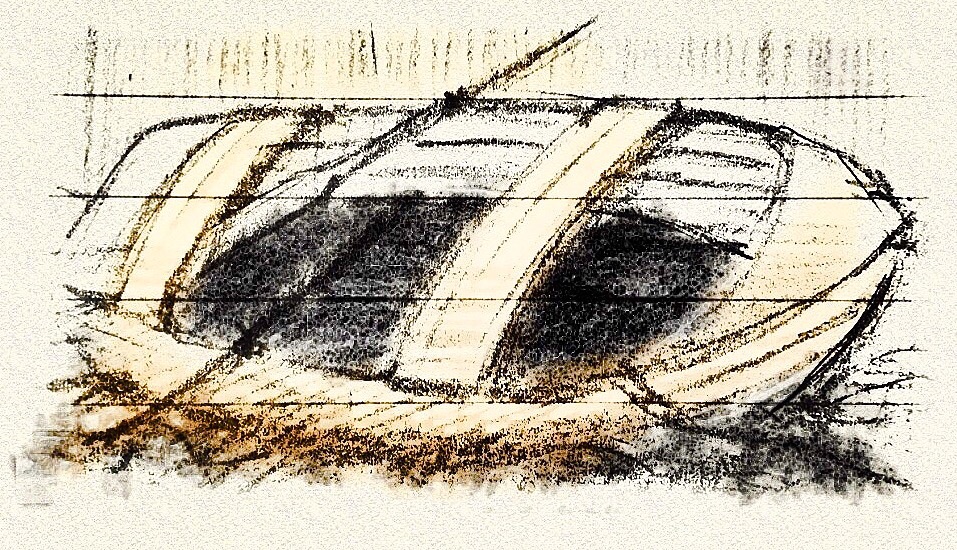
    To the poet: Of two minds, I was watching a small row-boat tugging on its rope by the shore; a ripple of waves repeatedly lapped at its sides. Short of giggling, the nicely-shaped boat did what it could to hold its dignity but every now and again, in shear delight, it shuddered with relief as the rhythm of waves washed away it tension. Art is a beautiful thing.


    Containment Lines
    Containment Lines
  • An Empty Chair

    An Empty Chair

    The objectified ‘that’ – too anonymous
    to hold the interest of a poet’s eye.
    Too without likeness to ever be ‘this’.
    Too void of character to qualify.
    The unsatisfied ‘that’ – ever restless,
    desperate for that substance, that gives it cause
    to be anything more than a congress
    of possibility; clutching at straws.
    That which is nothing in particular,
    in simplistic terms, featureless and vague,
    untitled portraits, coarse and granular,
    nothing in abundance; a poet’s plague.
    . That be a name without a pedigree,
    . all but a claim without veracity.

    © Tim Grace, 26 September 2013


    To the reader: An empty chair. Of itself, nothing more than a well-formed piece of furniture… an object in wait. On occasions it finds its functional fit and serves good purpose as a propositional place holder; a prop. For the most part, though, it signifies posterior potential and the possibility of congress; an invitational artefact… all but a claim without veracity.

    To the poet: That which is featureless lacks identity, it’s dull and anonymous; bland. To some extent a perfect backdrop from which a point of incidental interest can draw attention to itself. As an early morning poet, I often begin my day casting about for such characters of distinction. Often as not, they remain elusive and I’m left to make do with what lies before me … objects, too anonymous to hold the interest of a poet’s eye.


    An Empty Chair An Empty Chair
  • Loosely Applied

    Loosely Applied

    Concrete construction, designer’s despair:
    over-tended landscape, sharp and severe,
    too much exactness, preempted repair;
    nothing left to chance, exhausted idea.
    Made to resemble somewhere else but here:
    rectangled, circled, and ratio-ed square,
    hint of something made transparently clear,
    a misguided homage belongs elsewhere:
    ‘belongs’ – a possessive that’s made to adhere…
    ‘constrained’ – a caught-yard of rarified air…
    ‘suffocated’ – short of depth, too austere…
    ‘made to measure’ – overly shaped with care…
    . The golden rule, best considered a guide;
    . a general frame that’s loosely applied.

    © Tim Grace, 25 August 2013

    To the reader: Great garden designs have an inner quality, a core-strength, an integral thread of inspiration that leaves no doubt about intention. Design has to be a deliberate response to a problem; but more importantly, an authentic and appropriate remedy. The application of a fixed design solution (as in the golden ratio) provides some scaffolded security but overly applied strips away the virtue of design’s natural curiosity; design is an applied art – then a science of sorts.

    To the poet: A poet can fail his own test. As a sonnet written about the over-applied rule, this one goes near to proving the point. A truly responsive design will be so responsive to its context that a distinction of cause and effect will be hard to determine. The environmental need and its fix become one-and-the-same. Nature is the best of all ‘fixers’ it’s also the best of all ‘mimics’ – naturally!

    Loosely Applied
    Loosely Applied
    Picture Source:
    http://youtu.be/aRvzapleXJ4
  • Without Condition

    Without Condition

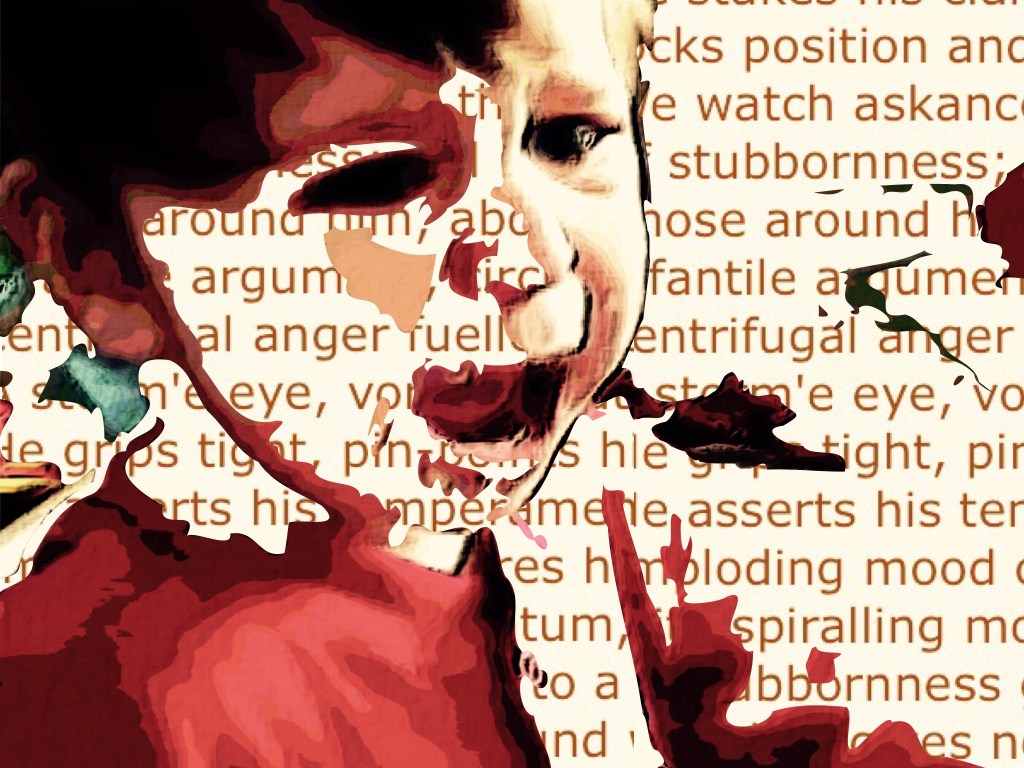
    He stakes his claim and demands position,
    stipulates his terms and fixes his spot.
    We watch askance, this crude exhibition
    of stubbornness; will he, or will he not?
    Those around him, about his axel spin,
    infantile argument, circular shape,
    centrifugal anger fuelled from within.
    A storm’s eye, vortex, that’s hard to escape.
    He grips tight, pin-points his agitation.
    He asserts his temperament; taciturn.
    Imploding mood centres his rotation.
    With spiralling momentum, so things churn.
    . Stubbornness grips to a fixed position,
    . and so gives no ground without condition.

    © Tim Grace, 24 August 2013

    To the reader: A child’s public tantrum makes an unpleasant scene; psycho-drama writ-large! With crudely-crafted powers of persuasion the toddler tests the strength of new-found tactics; claiming more independent territory with each event. The assertive-aggressive personality matures into an effective form of attention seeking; one that loses its stamp-of-approval with years beyond five or six. The storm quickly brews, tension builds; fury is released – damage is repaired and peace restored… the toddler is tamed!

    To the poet: The public tantrum is no rare occurrence. Little bundles of dynamite regularly ignite; catching those in close-proximity by surprise. With short-wicks these volatile miscreants can derail a train of thought with devastating effect. The passenger-poet is one of many hapless victims. As the wreckage is surveyed, for post-crash forensics, there’s often an unaccounted empty seat … a surrendered supposition.

    Without Condition
    Without Condition
    Picture Source:
    http://youtu.be/OZkRWnXo6YU
  • It was Jack

    It was Jack

    So it was Jack who took the photograph.
    So it was him behind the camera.
    Twas Jack who developed the contoured map.
    Twas him who squared the circles of Canberra.
    It’s through Jack’s lens our city came to light.
    It’s through his eyes our city was revealed.
    Jack of all trades who gave this city sight
    Jack himself citified an open field.
    May not have built the house, but he was there…
    May not have cut the stalks, but so he’d been…
    Jack was at the opening, Jack was at the fair…
    Jack be nimble, Jack be quick … to the scene.
    . What Jack saw yesterday, we see today;
    . Jack’s people at work, Jack’s children at play.

    © Tim Grace, 4 August 2013

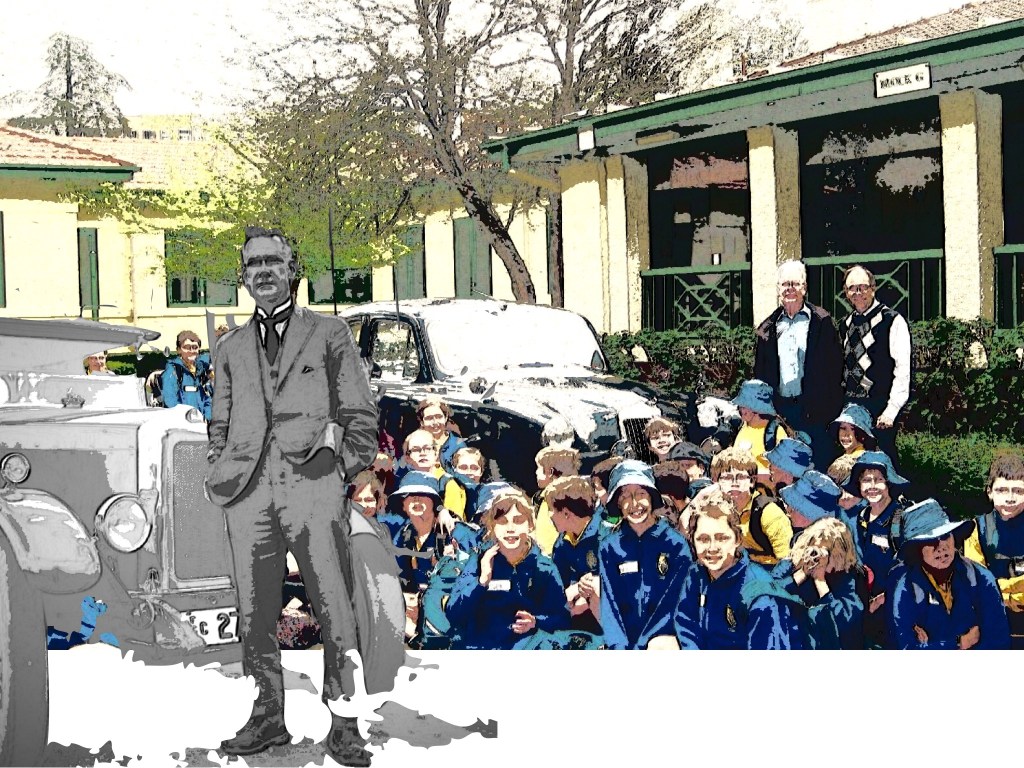
    To the reader: Jack Mildenhall was Canberra’s first official photographer. His active years (1920s and 1930s) captured our social and physical integration into the landscape. In 2013, his vast collection was digitised and put online as part of the city’s centenary activities. For young Canberrans, the Mildenhall Gallery is now an accessible treasure trove of archaic revelations; distantly familiar and curiously connected. The separation of decades has sharpened the contrast of these black and white images.

    To the poet: A teacher’s poem, an advertiser’s jingle…oh no! The temptation to make a story rhyme is sadly irresistible. The trouble is, people are kindly and encouraging; too polite to say stop. And so, with ‘vim and vigour’ we would-be-poets merrily sentence to death a perfectly good story; death by enthusiastic strangulation. With the next rhyme being paramount we lunge desperately to its match; overlooking all other creative courtesies and considerations… that’s nice, but unreadable.

    It was Jack
    It was Jack