Tag: sonnets

  • Act of Compare

    Act of Compare

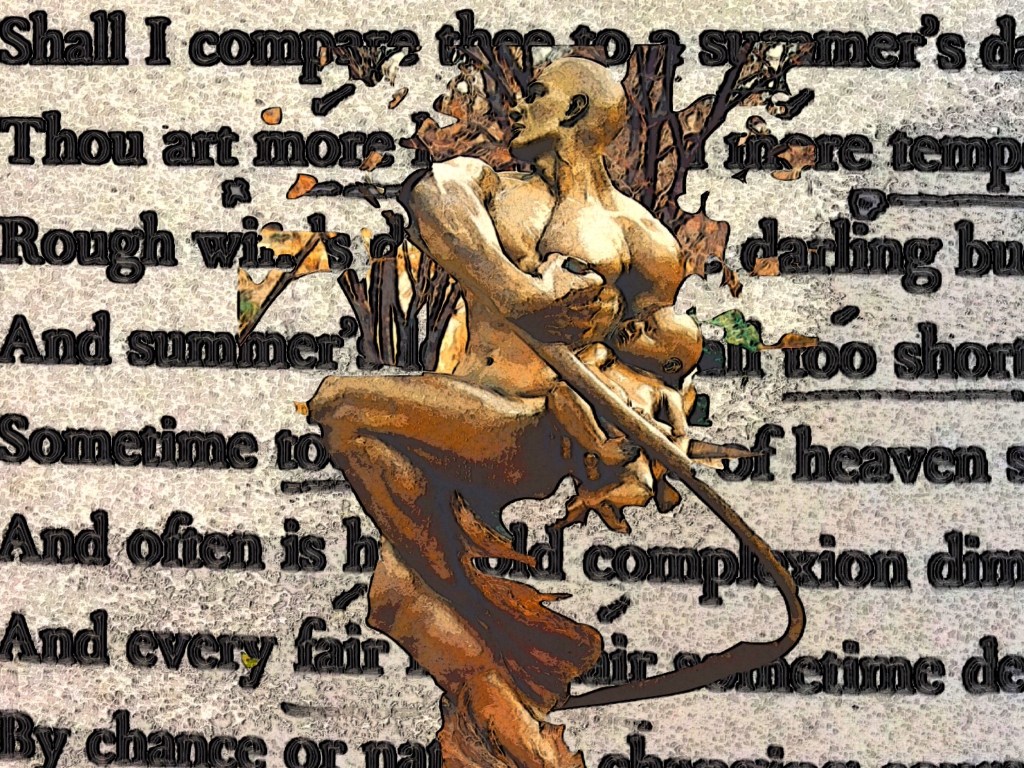
    Love writ more lovely than a summer’s day,
    less ruffled, less blemished, less deeply scarred,
    less the sullied victim of Time’s decay;
    alas, the figment of a love-bit bard.
    Dreamed far more perfect than is Nature’s deal,
    more radiant than any daisy’s blush,
    more precious than a gift from Fortune’s wheel;
    beyond the beauty of a painter’s brush.
    Love so beguiling, takes grip of each breath…
    Love so intriguing, bemuses his heart…
    Love so enduring, makes nonsense of death…
    Love so endearing, it tears him apart…
    . Contentment makes most of love’s sweet affair,
    . nothing is gained by the act of compare.

    © Tim Grace, 27 August 2011


    To the reader: We learn to measure through comparison and through this determine our tastes and preferences. We discriminate good from bad on the basis of quality; an intangible sense of excellence. That incomparable ‘youthful beauty’ might outlive the ravages of time, through ‘eternal lines’ is a romantic notion; an admirable claim: ‘Yet do thy worst, old Time; despite thy wrong, my love shall in my verse ever live young.’

    To the poet: Alas… the torment of describing Love’s beauteous youthful perfection, with skill enough to defeat the tyranny of Time is nothing less than torturous. Between Sonnet 18 and Sonnet 65, Shakespeare pens every word in beauty’s defence until distracted (sleepless and exhausted) he declares in Sonnet 66 his defeat: ‘Tired of all these, for restful, death I cry (from these would I be gone) … save that to die, I leave my love alone.


    act of compare act of compare


  • We Were There

    We Were There

    You asked of our location.
    You assumed we had control.
    With fear and trepidation,
    we stepped into this role.
    We did everything we could.
    When reason failed, we turned to hope.
    When overwhelmed, confused we stood.
    We did nothing more than cope.
    We had no map to chart a course.
    We too were badly lost.
    With every rescue came remorse.
    With every salvage came a cost.
    . If it’s comforting to know… we were there,
    . confused and bewildered … in poor repair.

    © Tim Grace, 30 June 2011


    To the reader: In the midst of emotional turmoil family relationships are tested. As chaos takes hold and threatens to undermine every sinew of collective strength we turn to old habits; tried and tested remedies. Then, when the family’s kit-bag is empty, we resort to new tricks; an escalation of counselling. In reality, some complications defy therapy… enter resilience: cope and hope; be there when it counts.

    To the poet: Struggle. Some poems behave like a troublesome child. Why won’t this one perform like all the rest? How could this one be so different? Why can’t this one just conform? If only this one would do as it’s told we’d all be happy? Not all poems right themselves; nor do they write themselves.


    we were there we were there
  • Streamlined

    Streamlined

    Those who struggle can not swim,
    They meet their own resistance,
    Suffer they from heavy limb,
    That will not last the distance.
    Those who swim in part submerged,
    With half their heart committed,
    They tire soon, as poorly served,
    By shallow breaths acquitted.
    Those who swim with buoyant ease,
    They suffer not fatigue,
    They ride the water’s gentle squeeze,
    And thus they swim in league.
    . Lapse not in to heavy thinking,
    . Burdened … to the point of sinking.

    © Tim Grace, 20 February 2011


    To the reader: The art of swimming. Going with the flow. Immersed in a liquid moment. At one with your surroundings. If you watch the experts, the trick seems to be a combination of style and technique; together, delivering a confident stamina. Swift buoyancy. There is no struggle. A great swimmer gives more meaning to ‘stroke’ than any dictionary could offer.

    To the poet: Loose in its sonnet structure this poem divides into three verse-like quatrains. As with lanes in a pool the quatrains mark out meaning. In this case, the first two sets of four define the struggle of a non-swimmer in competition with water. The next four lines refer to the swimmer in league with water. Natural swimmers work in partnership with water, they are fluid and streamlined; poetry in motion.


    streamlined streamlined


  • Manufractured

    Manufractured

    The world in pieces,
    Colours combining,
    Clarity increases,
    With distance defining.
    The world segmented,
    Kaleidoscopic split
    Patterns augmented,
    With nibbling fit,
    The field of view,
    The focal range,
    The tonal hue,
    With angles change.
    .    Impressed and enraptured,
    .    The mosaic is manufractured.

    © Tim Grace, 12 February 2011


    To the reader: Cathedral ceilings find counterbalance in floors of magnificent mosaic. The segmental nature of a mosaic adapts itself to undulating and odd-shaped perimeters. Tile by tile in decoration. A surface treatment deliberately fractured; pre-empting the impact of traffic and age. A strong and versatile solution. Suited to subtlety …impressionistic, geometric, kaleidoscopic. Betters with age.

    To the poet: Small pieces of text. Small phrases, reliant on each other for meaning. As with a mosaic, this sonnet begins with the micro-meaning of individual words. As the aperture widens the macro-meaning reveals itself as a play of words; built around the concept of ‘manufracturing’… to build from broken pieces. Meaningless becomes meaningful; fixed.


    manufractured
    manufractured