Tag: reading

  • Grain of Truth

    Grain of Truth

    There’s not a grain of truth in what they’ve claimed.
    They have cultivated a nonsense, so
    much so, the silo has been besmirched, defamed.
    It’s been compared to a Balkan State, no
    more so will I let this grievance pass
    untested, unquestioned; taken as read.
    What they have reasoned is simply a farce;
    a mischievous lie, it has to be said:
    The silo is nothing like a locked vault;
    has nothing to do with isolation.
    Through misinterpretation comes this fault:
    silos are hubs in communication.
    . Break not the silo, more strengthen its link.
    . It is through the silo that systems think.

    © Tim Grace, 18 January 2012


    To the reader: The history of grain-silos is interesting. They date back to storage pits in Greece around the 8th Century BC. In a modern sense, they took their vertical stance in the 1800s; significantly, attached to a transport system. Understood as critical components of flow in an agricultural system, their virtual counterparts are much maligned in dysfunctional bureaucracies. An office that stores but does not distribute its information is mistakenly labelled a silo; it does nothing to deserve that label.

    To the poet: Mounting a comprehensive argument in fourteen lines is problematic. Without much room for justification the point can be interpreted as a poke. Diatribes tend to be like that; one way polemics. In some ways a static container disconnected from further adaptation – a Balkan State! As much as you might disagree with my defence of the silo; there’s little likelihood of me responding to your rational alternative. You could, of course, leave a comment…


    grain of truth grain of truth


  • One More

    One More

    One more than many. One amongst the crowd.
    Of all amassed, of all assembled,
    you are the one of all who’s most endowed
    with the touch of difference; unresembled:
    uncopied, unmatched, unequalled; unique.
    You are the diamond in a crown of jewels.
    You are the highest mount; a lover’s peak.
    You are the exception that breaks all rules.
    You are the singular presence, where dwells
    perfection, where at one point all things meet.
    Within you perfect love is made, where swells
    affection; through your oneness all things complete.
    . At one with love you have tamed love’s thunder,
    . you have brought to heel cupid’s brand of wonder.

    © Tim Grace, 10 February 2012


    To the reader: Being the chosen one is flattering. It’s nice to be given attention; to be drawn out of the crowd as something special. But quite a perverse honour if you’re an admirer’s anonymous obsession. More so, if you are the one that through compare is beyond compare. Do you actually exist, or are you an imagined tool that consummates desire? Is the relationship unrequited? No matter, the infatuation delivers a brand of private climax. (WS – Sonnet 154)

    To the poet: Depending on emphasis, the meaning of “one more lovely” is quite different to “one more lover”. And there’s the invitation to play with words. In both senses the expressions are literal but have a figurative overlay that creates room for interpretation. So “one more – than many” can be a numerical statement offering infinite potential. Or, “one – more than many” can be a flattering statement offering distinction beyond the norm. Both interpretations are at one with my “one more” intent … (TG – Sonnet 155)


    image

  • Beyond Finished

    Beyond Finished

    To say that all is finished, all is spent,
    means nothing in the greater scheme of things.
    For in that scheme there is but one intent:
    “waste nothing” – as from compost new life springs.
    What of that old house that the ground recalls?
    What of that empire in its fallen state?
    What of that fashion that today appals?
    What of good reason wasted in debate?
    All of these might be finished, done with use,
    stripped of cause, drained of substance; as conceived
    they might be buried dead or dangling loose;
    but as time shall choose – they shall be retrieved.
    . Beyond finished there lies a new frontier,
    . furnished in the garb of a golden year.

    © Tim Grace, 14 March 2012


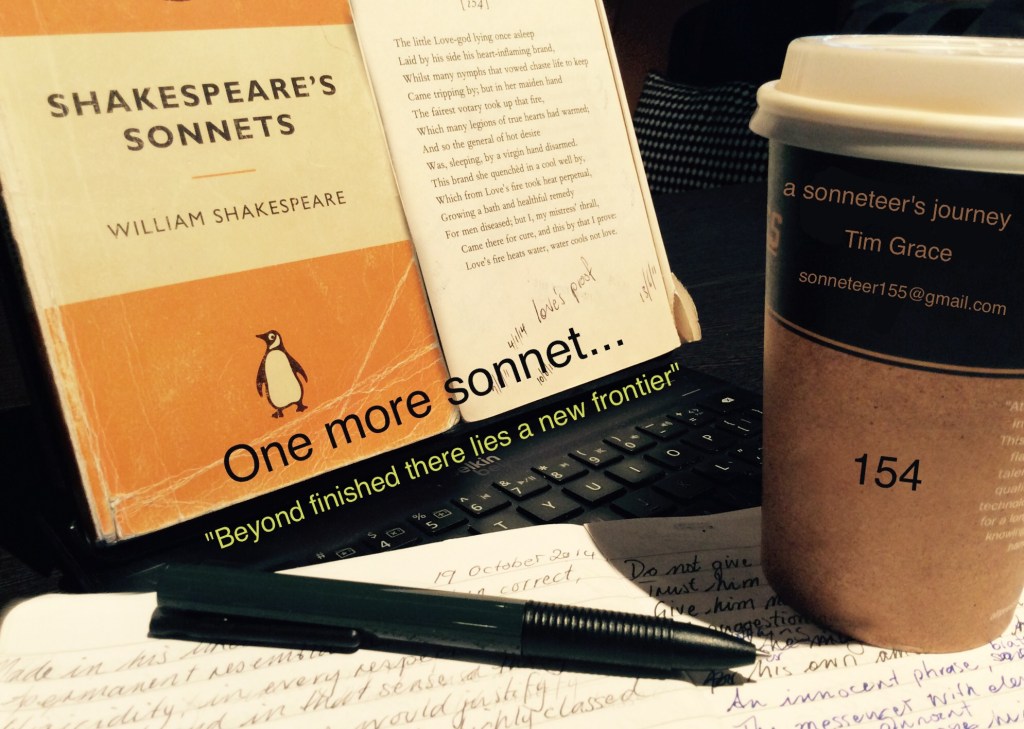
    To the reader: Mistakenly, finished can be considered a terminal point of arrival. A statement of completion that declares an ending. In reality, nothing ends its course; nothing is divorced from what’s to come. Next, is the consequence of an expanding universe; until Time contracts there shall always be a new beginning… a next time to come. And so, in conclusion, consider this sum … there’ll always be “one more sonnet” to come.

    To the poet: Almost done. I know what it’s like to write 154 sonnets; one more and I’ve achieved my goal; one more sonnet and I’m finished? The challenge was self-imposed and given a few rules the disciplined process was fairly painless. The two-year rule was gruelling but necessary. The minimal use of “like” as a tool for metaphor kept me anchored to a direct narrative. The sonnet is an endlessly adaptable form both generous and forgiving. The sonnet (and my readers) suffered some mutilation along the way but with considerable credit stayed the course.


    beyond finished
    beyond finished


  • Inspiration as Conviction

    Inspiration as Conviction

    Who do we look to for inspiration?
    What disposition does this soul possess?
    We seek not the brand of fame and station,
    nor the badge of battle; worn to impress.
    Instead, we seek the common seal, the touch
    of humanity both caring and kind.
    Instead, we seek the wisdom to best clutch
    a simple truth that’s often hard to find.
    Instead, we seek a clever wit, a skilled
    practitioner, both able and adept;
    an active soul with the power to build
    a cause from gifts given and treasures kept.
    . Look to the soul who’s prepared to stumble,
    . but has the conviction not to crumble.

    © Tim Grace, 4 February 2012


    To the reader: A defining feature of inspirational leaders (living or dead) is enthusiasm. In addition, those who inspire (humble or bold) do so with conviction. Together, enthusiasm and conviction make an impressive and powerful partnership. Our inspirational heroes (big or small) are energised by cause and blessed with effect. They have an impact and they get results. We look to inspirational heroes (young or old) for insight into how we might walk in their footsteps and climb on their shoulders.

    To the poet: A second attempt at defining inspiration. This time a little more descriptive and a little more sequenced; bearing a little more enthusiasm and conviction. The first two lines establish the point of enquiry and the next two lines refute a negative response. The remaining six lines of the sonnet’s body attend “instead” to positive terms of reference; as applied to inspiration. The final couplet arrives at a satisfying, if not inspirational, conclusion.


    image

  • Inspiration 1 – Enthusiasm

    Inspiration 1 – Enthusiasm

    We all seek that spark of inspiration.
    We crave its challenge, relish its rewards,
    welcome its trigger; its motivation;
    its promise of profit … as such affords.
    Inspiration is an essence; of sorts,
    an energy, a fine spirit at best.
    It’s a shapeless elixir that contorts
    the grip of reason with a dose of zest.
    It’s the will of conviction with fresh claim
    to a stale idea, it’s the modern twist,
    the contemporary spin; it’s the vim, the flame
    that fires-up passion … it’s stamina’s grist.
    . Inspiration is that breath of fresh air
    . that fuels a flicker to generate flare.

    © Tim Grace, 20 January 2012


    To the reader: Inspiration is something more than motivation. Both nouns describe an action. We can be motivated to do all manner of tasks that are hardly inspiring; the reverse is harder to imagine. Unlike motivation, inspiration finds its source beyond basic needs; and further more, is not dependent upon base rewards to maintain an interest. The mark of genuine inspiration is enthusiasm.

    To the poet: Another sonnet that took some stubborn shaping; thought pieces are like that. The poem’s theme is inspiration and should have been delivered through the guise of enthusiasm; instead, it reads like a cerebral exercise. The final couplet once read: “Welcome inspiration with open arms… it’s the antidote to worrisome qualms”. A nice couplet, but the sonnet wasn’t about worry’s antidote; it was about the spirit of inspiration.


    image.jpeg

  • The Watched

    The Watched

    If you watch with care there are things to note.
    Things aren’t necessarily the way they seem.
    Within plays there are plays that make remote
    our awareness of hidden plot and theme.
    The secret subtleties of which I speak
    are hard to notice in a moment’s glance;
    they do their utmost not to be unique;
    everything they can to minimise chance
    of being noticed or of standing proud.
    In their script there is no stage nor curtain;
    no theatre, no audience, just a crowd
    made blind to the subtleties of certain.
    . Motion provides a stable place to hide;
    . a refuge for those with disguise applied.

    © Tim Grace, 12 January 2012


    To the reader: In this period of writing, with resident status, I anonymously sat at the same table in a busy inner-city cafe. Daily, I had a vantage point that was unusual for its routine. And so, I began to notice patterns of behaviour that repeated themselves; in particular that of a plain-clothed policeman. His under-cover status relied on a steady flow of unobservant patrons buying “coffee-to-go”. My stability was his exposure… he became visible; he became the watched.

    To the poet: Some poems are stubborn; this is one of them. It’s been over-worked – laboured. As with a drawing that’s been repeatedly repaired, its problems are made all the more obvious. The idea was to locate the object (an under-cover policemen) in a fast flowing stream of subjects (cafe patrons). This stream became an indistinguishable rush of them and they and their; added to by a liberal dose of that.


    the watched the watched