Tag: Poetry

  • Smooth the Edge

    Smooth the Edge

    The edge, roughly cut and jagged;
    torn apart and broken;
    crudely split and ragged:
    ‘a scratch’ if plainly spoken.
    The rim, rounded-off and even;
    comfortable to grip;
    shaped to give good reason
    to the curvature of lip.
    On the edge, where fibres fray,
    the straight grain is splintered.
    On the rim, where fingers play,
    the subtle move is hinted.
    . Smooth the edge to a bevelled rim;
    . and be content with its levelled brim.

    © Tim Grace, 31 December 2010


    To the reader: The tactile sense, haptic in nature, is pleasured by the touch of a smooth and rounded edge. The sculptor, the chef, the luthier and the lover all recognise the appeal of a softly chamfered edge. A deliberately honed finish invites the caress of a curious finger-tip. The delicate rim of a china cup whets the lip. The family of stringed instruments nestle into the human form; they are eager to be strummed or stroked by a skilled and attentive hand.

    To the poet: The reading of a sonnet is a tricky thing. The performance of a sonnet exposes the inner tension between literal meaning and lyrical reading. Obviously, the poem’s metre is critical to simplifying the reader’s task, but too strong a metre runs the risk of delivering a ditty. An oddly placed pause, a quirky phrase are complicated but necessary if a poem is going to attract sophisticated interest. Sonnets are not written for the speed reader; not to be scanned or read once.


    smooth the rim smooth the rim
     

  • All but done

    All but done

    In the end, when all is finished,
    And the task is all but done,
    When the burden is diminished,
    To what it was before begun.
    It’s then that we can savour,
    The taste of sweet success,
    Let linger long the flavour,
    And with confidence impress,
    Be not bothered by the critic,
    With his crooked rule of thumb,
    Be not worried by the cynic.
    With his surface level scum.
    . In the end, the real end, all things being equal,
    . What’s done is done … so deliver not the sequel.

    © Tim Grace, 27 December 2010


    To the reader: We begin, often with an end in mind. At end, we arrive at a moment of completeness. Completeness delivers finality and/or conclusion; possibly both. Conclusive moments ought to be rich with satisfaction and deserving of hiatus; time for a break. A self-satisfied pause should offer some protection from those who would wish to offer judgement… the artist steps back from the canvas.

    To the poet: No doubt there was a particular incident that created my need to express frustration with an ending too abruptly injected with criticism. Get used to that. Responses to art are pretty quick to condense and find expression; the first impression says it all. The trick, I find, is don’t declare the ending too soon. Prepare the finish carefully.


    all but done all but done


  • Intensity

    Intensity

    Is intensity a frequency
    Scaled to a pitch?
    Has it got to do with density
    Is it triggered by a switch?
    Is the metaphor electrical,
    So the force is but a buzz,
    Maybe that’s too technical
    And far from what it does.
    Is it chemistry, that holds the key
    To bundling up our nerves?
    What’s the source of energy
    That taps in to reserves?
    . Things condense, and things increase,
    . As things in waves, and springs release.

    © Tim Grace, 18 December 2010


    To the reader: Pulling apart an idea, stripping it of meaning, testing its logic; all the stuff of lexical unpacking. It’s what’s done to clarify understanding and guide debate. For the teenage mind, with its ever expanding glossary, the discovery of wordplay is an absorbing pass-time; as driven by dark matter … it has a pervasive attraction.

    To the poet: Not a perfect sonnet, but snippets of it work. The word intensity has a nice syllabic percussion. The self-conscious question of ‘is it?’ (drawn from the letters of intensity) resounds. As a half-posed question ‘is it?’ deserves no answer and consequently receives a series of tentative possibilities. Interesting that the definitive ‘it’ is resolved by ‘things’ in the last couplet.


    intensity intensity


  • Square Reminder

    Square Reminder

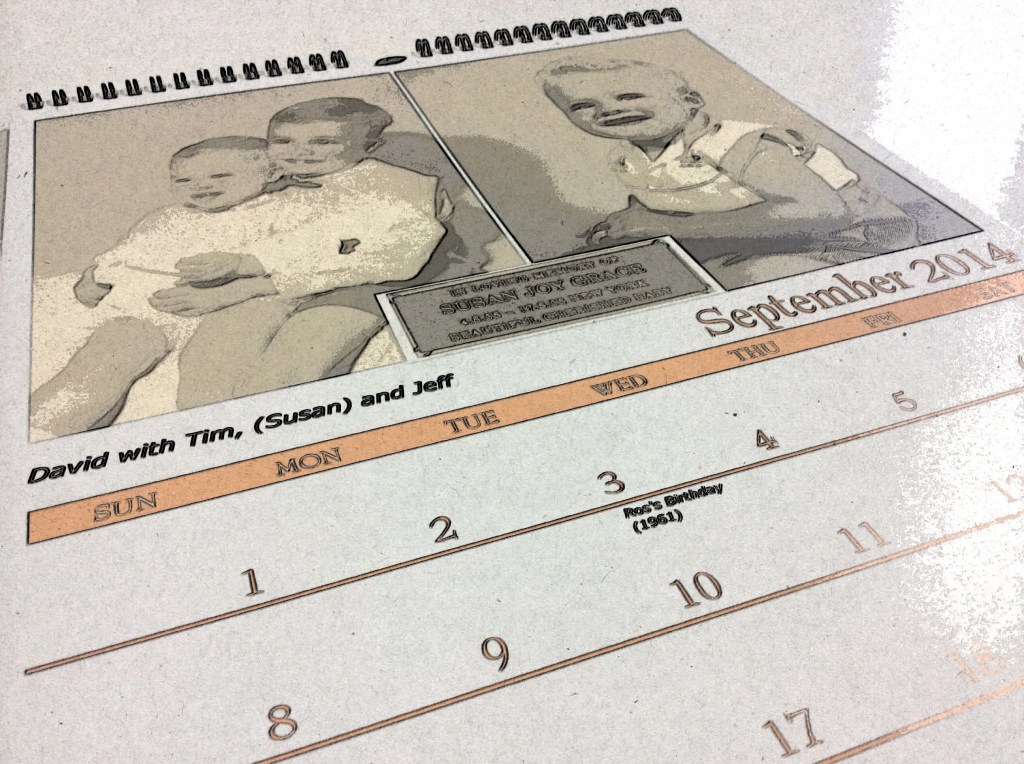
    A calendar, twelve pages long,
    A square reminder of yesteryear,
    Neither script nor song,
    It’s a sketch on a thin veneer.
    Snippets on a month long frame,
    Dates confirmed, appointments missed,
    It’s payday, it’s an insurance claim,
    It’s see the doctor, the vet, the therapist.
    A dozen pages in a sequence of sorts,
    A record of ‘there we go’ and ‘here we come’
    A date from which we anchor thoughts,
    It’s the come again compendium.
    . The hatchings, the matchings, the trouble and strife,
    . The meetings, the greetings, that chronicle life.

    © Tim Grace, 16 December 2010


    To the reader: It’s no mere coincidence that this sonnet was written in mid-December. The Southern Hemisphere’s end-of-year mayhem is compounded by heat and the celebration of Christmas… with not a snowflake in sight. Rather than sliding gracefully from one year to the next we transition with a thud; the continental plates collide, the ground swells, and something has to give. The break comes, and on we go … year after year.

    To the poet: A rapid succession, a concertina; a looming waterfall. This sonnet attempts to capture the compression of time as it careers to a halt. Slow at first, the opening stanza outlines the design of a calendar; beyond the start, the pace of description builds and the phrases shorten. (As an aside I like the rhyming of this sonnet).


    square reminder square reminder


  • Time Is

    Time Is

    Time is a passage, a tunnel,
    That seeds our maturation,
    Time is a direction, a funnel,
    That leads our transformation.
    Time is an altered state,
    Through which dimensions drift,
    Time is a storm that won’t abate,
    It’s the pressure that gives us lift,
    Time is the daily grind, the toil,
    That callouses our skin,
    Time is the fertile ground, the soil,
    Where we plant what we begin.
    . Time is speed over distance,
    . Time is change over difference.

    © Tim Grace, 14 December 2010


    To the reader: The importance of time’s connection with age dawns upon us early in life; an evident grip that strengthens year upon year. My two line poem (age is a barrier, time is its carrier) captures the tension and is well understood by children careering into the teenage years. At once, time is a lost opportunity and a gained potential. The instance of now is too fleeting to offer certainty; and so we become accustomed to change and frustration.

    To the poet: Upon reflection, the neatness to the start of each line is useful in anchoring this sonnet to its theme; referencing itself time after time. This is almost true; but not quite. Just a couple of lines break the rule and it was tempting to adjust them to fit. But, the ‘neatness rule’ (tidy as it is) can also strip a poem of natural character … so I left it as it was.


    time is time is


  • Prattle Scarred

    Prattle Scarred

    Why fight it? The cause is lost,
    They’ll talk until exhausted,
    An exchange of words, wires crossed,
    All reason has been thwarted.
    Empty thoughts spent of use,
    Incessantly dispersed,
    Canons of conversation let loose,
    Loaded barrels burst.
    Incenduries of scattered thought,
    collateral damage hits hard,
    What remains is the odd retort
    The word weary, and the prattle scarred.
    . It’s blood that’s shed, in fields of war,
    . It’s not what’s said, that yields the score.

    © Tim Grace, 10 December 2010


    To the reader: A barrage of words; an incessant round of scattered thoughts … prattle lines are drawn! As a prisoner of words it’s sometimes impossible to withdraw or retreat from the field of discussion; you’re good and captured – well snared. Escape is unlikely, outlasting the word attack is a matter or patience; it will pass but just not soon.

    To the poet:  The play of combative terms was the thrill of this kill. There’s an element of nonsense poetry in the technique. Twisted and contorted phrases are close enough to real to comfortably carry double-barrel meanings. When playing with words the ‘play’ needs to be convincing and controlled; so the aim is steady and the target sure.


    why fight it why fight it