Tag: Poetry

  • Rich with Joy

    Rich with Joy

    Raised on the red dust of the Western Plains,
    this unexpected child of farming stock
    brought with her the hope of September rains;
    the joy of one lamb to a larger flock.
    She weathered seasons of uncertainty,
    faced adversity with dignity and grace.
    She rode a swift horse into modernity.
    Brought new joy to another time and place.
    From new horizons she found much to see:
    a new world to paint, and new songs to sing;
    both she delivered with gusto and glee:
    as brings the flower the colour to Spring.
    . It is not wealth that makes us rich with joy.
    . Better love and grace be our life’s employ.

    © Tim Grace, 25 September 2011


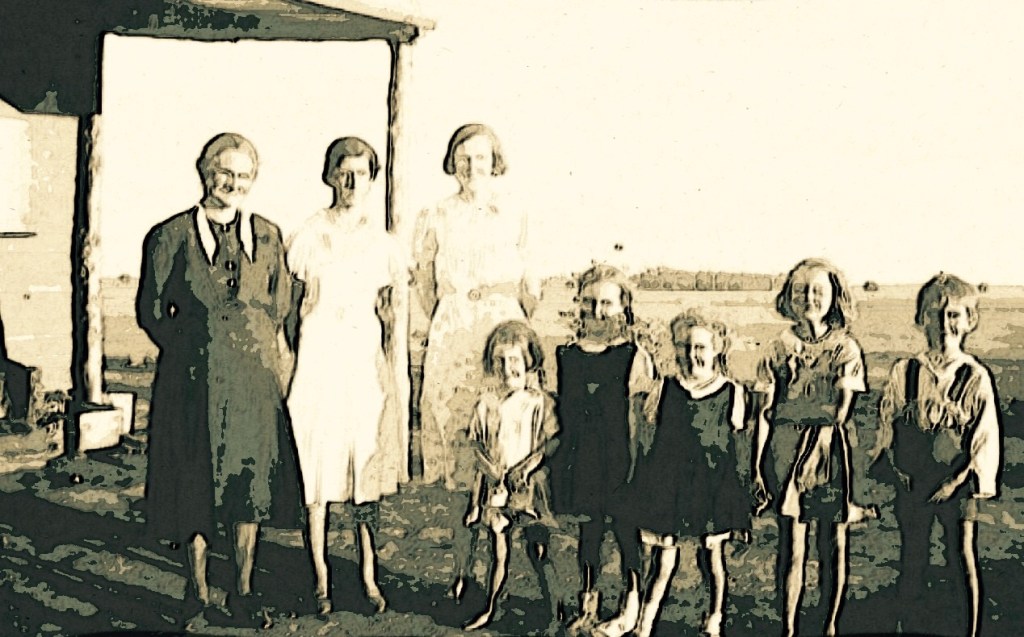
    To the reader: For my mother’s 80th Birthday I wrote this sonnet. Born in 1931, of farming stock she was a child of the depression and the product of subsistence. By war’s end, poorly schooled but well educated, she ventured beyond the strict fundamentals of country life and rode the affluent wave of post-war Australia. For many, not all, the Twentieth Century was lived in two contrasting halves: shadows lifted, chains unshackled, and opportunities arose. Decades on, having lived a full-life, she now looks back with a sense of wholeness; if not completeness.

    To the poet: For the most part we live a scripted existance. Life has a sequence that can be unpacked as history and understood through hindsight. As married to fourteen lines of a sonnet, history and hindsight make quite compatible partners. The trap, ever present, is sentimentality. This poem has an audience beyond my mother and so needs to be personally poignant but meaningful in a general sense. My mother’s name is Joy Grace – you don’t need to know that, but she’ll find herself in the final couplet – a referential trinket; a neat finale.


    rich with joy rich with joy
  • Cursed Pile of Dirt

    Cursed Pile of Dirt

    Oh! cursed pile of dirt, in crude repair,
    what reason dost thou have to be so cruel?
    Anchored firm with that cold and heavy stare,
    as would befit a cross and cranky mule.
    Has’t thou not some purpose of greater worth?
    Could thou not be a mound or grassy knoll?
    Could thou not be a monument on Earth?
    Has’t thou not some use, some virtue to extol?
    Give way to the dig of a shaping spade.
    Let go the stature of a mongrel beast.
    Let go the attitude as of now displayed.
    Be thus reduced; for purpose-sake increased.
    . Be not soiled or muddied with despair,
    . let thyself be moved as from here to there.

    © Tim Grace, 23 September 2011


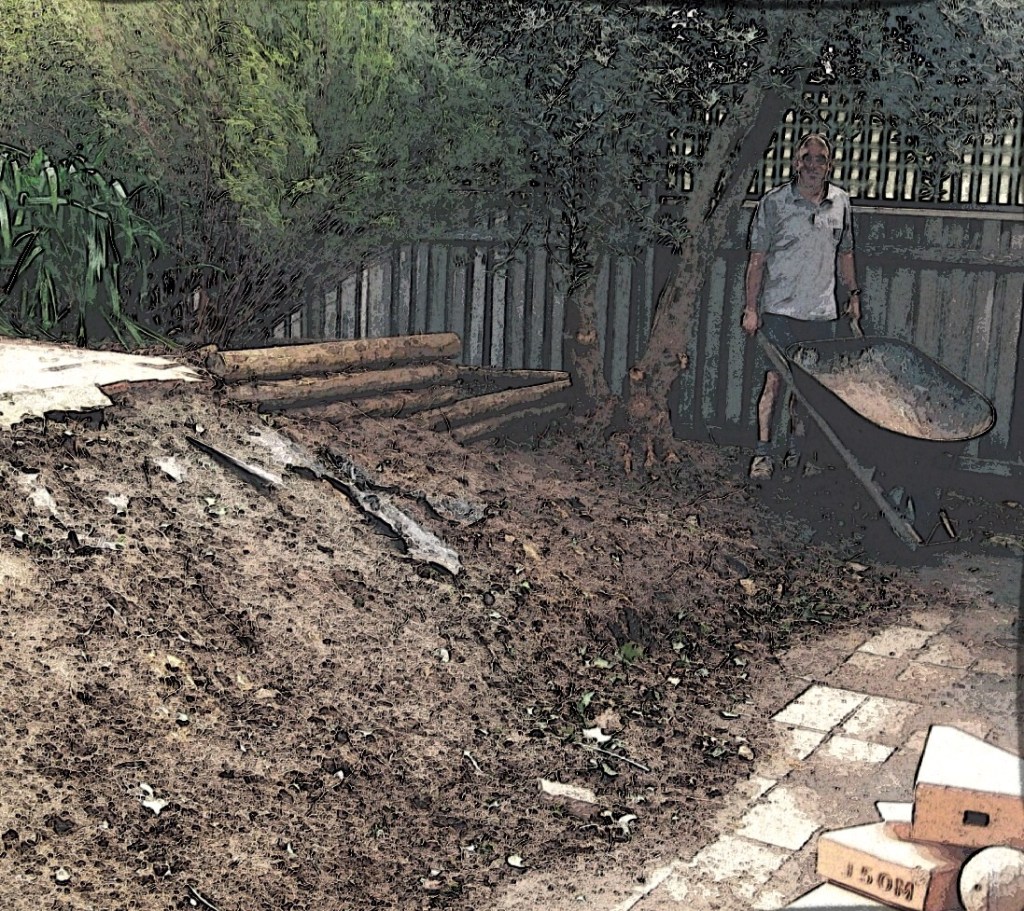
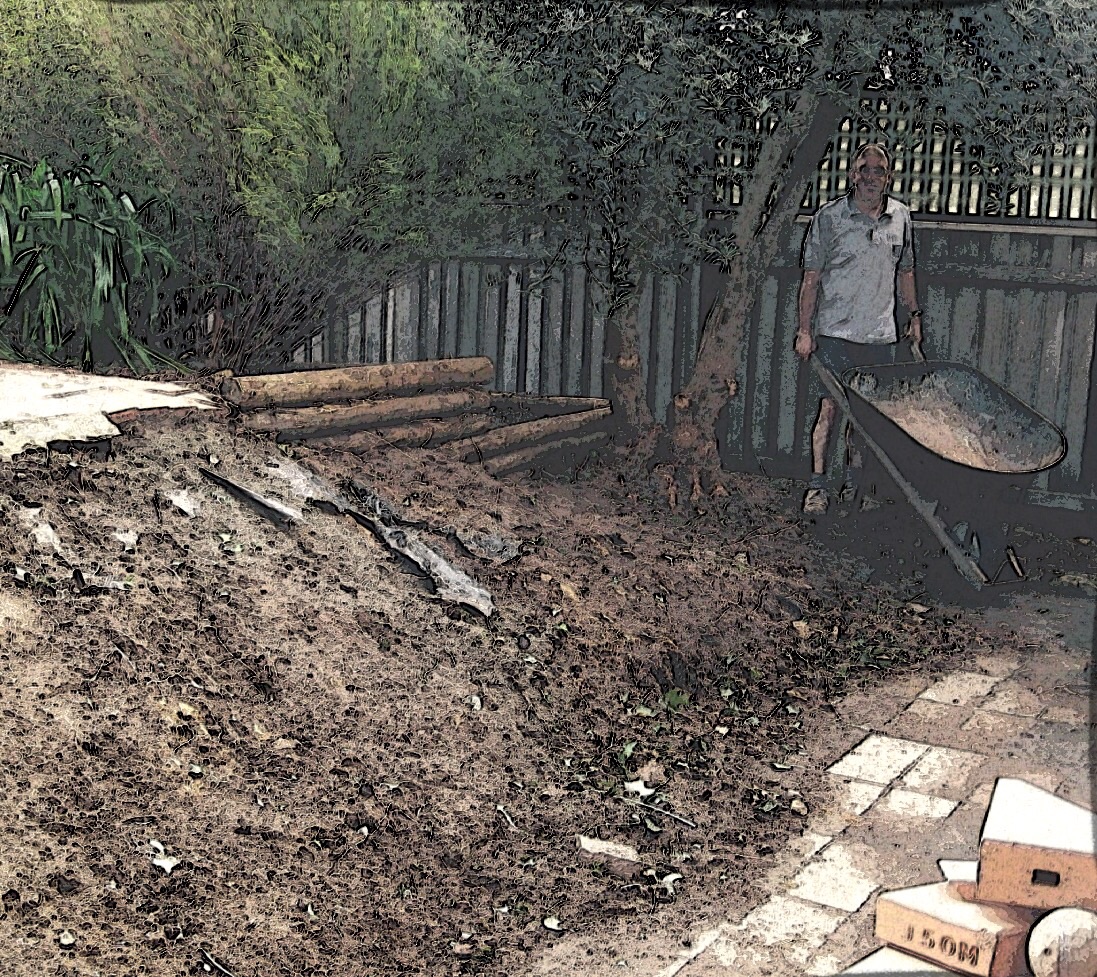
    To the reader: As a university student I earned a meagre income removing rubbish. I owned a small utility truck (known as a ‘ute’ in Australia). For seven-dollars a load I’d remove anything; mostly other peoples’ unwanted garden refuse. Occasionally a large pile of dirt would stare me down! With stoic fortitude I remember the words “Oh! cursed pile of dirt” thrusting deep into the core of my adversary. Slowly at first, with slight impact, the pile would respond seemingly none the worse for curse! But … as I was to learn … persistence beats resistance!

    To the poet: That “persistence beats resistance” is a truism; one that serves the poet well. The weight of stubborn words can take some shifting; some very heavy lifting. The original words to this sonnet were in the form of my own spiritual; in the face of adversity there is hope; the human spirit is well equipped to cope with hardship: “Oh! cursed pile of dirt, with thy cold and heavy stare, given time and shovel, thou shalt be moved from here to over there!”


    cursed pile of dirt cursed pile of dirt
  • New Wisdom

    New Wisdom

    What new wisdom has last night’s slumber brought
    to this “good morning” as of now untapped?
    How might the sun rise on a new thought
    and give ‘novelty’ power to adapt?
    With new thought comes the bud of inspiration,
    the compact remedy, as yet unpacked.
    It’s the starting point of contemplation,
    it’s the new idea that yesterday lacked.
    New wisdom much like a fresh flower blooms:
    not from old stock, not from a stem detached.
    Wisdom is but one bloom that newly grooms
    itself to best show a solution hatched.
    . Today refreshed is last night’s cameo,
    . As bud becomes bloom, so this day will grow.

    © Tim Grace, 21 September 2011


    To the reader: The sun rises, a new day dawns, and if the night was good to you there’s a fresh awakening. Over night, your niggles have been processed; disencumbered from yesterday’s tangles. And so, with fresh clarity you take a novel approach to loosening that stubborn knot. The tired solution, over-worked and fruitless, has been rested… retired to make room for this day’s innovation.

    To the poet: In construction, some poems are satisfying others wrestle with their maker. Those that satisfy, like this one, have a physical arrangement that scaffolds the poem’s structural sense. By design, a satisfying poem will have physical strength; a visible appearance that matches its message. A poem with look and feel has inner and outer strength, rhymes feel relaxed and resoundingly echo their way throughout the text; form and function tied with an evident but invisible thread.


    image


  • Woken Mind

    Woken Mind

    How so, that sleep undoes a tangled knot,
    and through darkness invents a grand design?
    What has sleep that my woken mind has not?
    From where dawns its brilliance, its clever shine?
    I imagine, or do at least suspect
    (for nothing more than thought can be my proof)
    that there must be a time, a time unchecked,
    when uprises sleep to begin its spoof;
    through a short-list of yesterday’s wonders,
    unsolved, given up to further thinking;
    given up to logic’s bin of blunders,
    for night to make right in just a blinking.
    . How so that sleep outwits my woken mind?
    . It lets go the bits that by day do grind.

    © Tim Grace, 17 September 2011


    To the reader: Sleep, far from an unconscious passage through darkened hours, is an active agent of the night. In sleep-mode, we switch our attention to sifting and sorting through snippets of past experience. In the ‘dark room’ (from an endless supply of stock) we develop our post-production sequences into lucid and surreal dreams. Hours of sleep provide space for re-interpretation of time and place; unrestricted by the physical constraints of a woken mind.

    To the poet: In writing this sonnet I wanted to create a sense of one-being in two-minds; pondering a perplexity. The over-riding order is a sequence of questions tentatively answered without confidence or surety; deliberately vague and suggestive of possibility. Speaking to yourself through a third-party narrator is a dream-like experience – sleep uncouples and derails the midnight express; the train is off its tracks.


    woken mind woken mind


  • Interminable Itch

    Interminable Itch

    I understand this niggling annoyance.
    The interminable itch that gives twitch
    to every grumpiness; groan and grievance.
    The useless bits of nonsense that won’t switch
    to off; won’t give reason to time-of-day;
    bits that go on and on ad nauseam;
    the incessant barking and raucous affray
    that underwrites this state of tedium.
    I understand, but can not comprehend
    what benefit from this a fool derives.
    Why promote stupidity, why defend
    a cause that surely craziness contrives?
    . Is there not some rule or code of practice
    . that might blunt the prick of thorn and cactus?

    © Tim Grace, 14 September 2011


    To the reader: An artefact of age is wisdom. Unfortunately, the suffering of fools is a patient art that gets no easier with age… and there lies the rub! That the grumpy old man becomes himself a fool is a cruel irony. As time progresses, our time on Earth compresses; and so, quite rightly, we become less tolerant of wastrels and their stupid contrivances. For a short while, after the heat of Summer has subdued, we reap with abundance Autumn’s harvest. In these years, before the permafrost of Winter sets us still, we protect our investments from ill-witted fools that cause us angst.

    To the poet: Spelling… all very clever, but don’t get me going. A check through my draft of this sonnet reveals my unique take on letter arrangements. First issue was interminable; far too many non-specific syllables. Then we came to ‘adnausium’ – obviously needed some Latin attention before arriving at ‘derives’ which in my draft possessed a second ‘r’ (don’t ask me why). Raucous began life without the unnecessary ‘o’ – as in caucus. “For those who can spell, it’s all very well…”


    intermibale itch interminable itch


  • A Lover’s Loss

    A Lover’s Loss

    When the rose of last year’s love was not replaced,
    she whispered “I loved you” and shed a tear.
    She closed her eyes and through her memory traced
    his pattern; she imagined he was near.
    Filled heavy with acceptance, her tear swelled,
    wet her lashes and rolled upon her cheek.
    This tear was not wept, this tear quelled
    the weeping worry; no mourning did it seek.
    There was no need for other tears to flow.
    Tenderly, and for just a moment brief,
    she held this tear and then she let him go…
    gone to soul; to find comfort and relief.
    . A lover’s loss is not for time to keep,
    . It’s far better kept where the soul is deep.

    © Tim Grace, 11 September 2011


    To the reader: I remember watching a Twin Towers documentary, describing remnant lives, a decade after the attack. It was clear that many emotional towers had taken devastating hits and were still struggling to rebuild any semblance of structural strength. Gradual resolution of the inexplicable loss of a loved-one, an intimate partner, is a torrid journey of repair; never complete … when the weeping is done, enduring, endearing Love is forever expressed in a single tear.

    To the poet: … and there ends my deliberate set of love poems; some about Love, others for Love, and a few in Love. Shakespeare wrote of Love as both spirit and soul. As spirit, Love is an attractive energy that fuels our motivation to intimately bond. As soul, Love is a figmented expression our passionate desires. Blessed with Love (spirit and soul) we are granted the human condition; ever challenged to balance on the one-hand energy and on the other passion; the humours: dispositions, preferences, propensities, and temperaments.


    image