Tag: People

  • Space to Crawl

    Space to Crawl

    Yesterday, I watched a boy crawling
    commando-style across a carpet-rug.
    Giggling and chortling, rising and falling,
    pushing and pulling with a hauling tug.
    In jungle-greens he scampered, head down low.
    He moved in spits and spurts. He paused a while.
    He reset direction, then off he’d go.
    With syncopated skim and cherub’s smile;
    through a forest of legs, he spied a light:
    a destination worthy of pursuit.
    But, when almost there, with his goal in sight,
    down came the arms of love: “Aren’t you cute!”
    . His mission is to walk, stand proud and tall;
    . give the boy some freedom, some space to crawl.

    © Tim Grace, 31 January 2012


    To the reader: The school-day is all but done. Here comes a troop of toddlers and their yet-to-walk entourage in pushers and prams. They are the freedom fighters, come to release their brothers and sisters from the tyranny of school. One in particular catches my eye; he’s a rug-rat, escaped surveillance and making good ground … but like so many before him, his noble pursuit is thwarted; he is lifted to higher ground by the doting arms of mum… another man down, or up as the case may be.

    To the poet: A photograph might have captured the scene more faithfully; but not the story. The story is in the poem which is a figment of my imagination. No-one else, on the day, had any idea of my interpretation. In a fleeting moment I captured a metaphor… two thoughts combined; and so began my sonnet. Metaphors, like butterflies, are at their best in flight; pressed to the page they may lose their colour.



    Space to Crawl Space to Crawl
    Picture Source:
    http://youtu.be/XGbfqM0ToM8


  • Angling

    Angling

    All I did was drop a line, nothing more
    than simply give you cause to contemplate.
    It was not my chin that dropped, not my jaw
    that took umbrage; not me who bit the bait.
    You could have let it go, let it dangle.
    Instead, you gave it a tug, you tested
    the line; turned what was slack into tangle.
    It was you who floundered, then protested.
    Nonetheless, you did nothing to resist
    it’s ascorbic tang; and so, there you hang,
    dangling from a string of words, a long list
    of ponderings that promulgated pang.
    . What lures fish from the safety of rocks?
    . It’s the slightly plausible paradox.

    © Tim Grace, 21 January 2012


    To the reader: It doesn’t take much to create a fuss over a line of words. Retracting that string of thought is difficult; it gets snagged so easily. On a good day a contentious thought might be openly aired; on a bad day it becomes a most enticing deep-water bait. As it sinks a small school of fish nibbles its edges; but then, along comes a shark with far bigger intentions. Discretion being the better part of valour decrees the warranted loss of hook, line and sinker… one should never angle for a fight.

    To the poet: This sonnet did follow an argument over the previous sonnet regarding silos. Why two people would choose to angrily debate the virtues of a silo I don’t know. Nonetheless, it spawned a good piece of purgative poetry. The poem has some satisfying sub-elements that I enjoyed merging into its deeper layers of construction; for later in depth analysis.


    angling Angling
    Picture Source: http://youtu.be/rG1xOUIykhY


  • Grain of Truth

    Grain of Truth

    There’s not a grain of truth in what they’ve claimed.
    They have cultivated a nonsense, so
    much so, the silo has been besmirched, defamed.
    It’s been compared to a Balkan State, no
    more so will I let this grievance pass
    untested, unquestioned; taken as read.
    What they have reasoned is simply a farce;
    a mischievous lie, it has to be said:
    The silo is nothing like a locked vault;
    has nothing to do with isolation.
    Through misinterpretation comes this fault:
    silos are hubs in communication.
    . Break not the silo, more strengthen its link.
    . It is through the silo that systems think.

    © Tim Grace, 18 January 2012


    To the reader: The history of grain-silos is interesting. They date back to storage pits in Greece around the 8th Century BC. In a modern sense, they took their vertical stance in the 1800s; significantly, attached to a transport system. Understood as critical components of flow in an agricultural system, their virtual counterparts are much maligned in dysfunctional bureaucracies. An office that stores but does not distribute its information is mistakenly labelled a silo; it does nothing to deserve that label.

    To the poet: Mounting a comprehensive argument in fourteen lines is problematic. Without much room for justification the point can be interpreted as a poke. Diatribes tend to be like that; one way polemics. In some ways a static container disconnected from further adaptation – a Balkan State! As much as you might disagree with my defence of the silo; there’s little likelihood of me responding to your rational alternative. You could, of course, leave a comment…


    grain of truth grain of truth


  • One More

    One More

    One more than many. One amongst the crowd.
    Of all amassed, of all assembled,
    you are the one of all who’s most endowed
    with the touch of difference; unresembled:
    uncopied, unmatched, unequalled; unique.
    You are the diamond in a crown of jewels.
    You are the highest mount; a lover’s peak.
    You are the exception that breaks all rules.
    You are the singular presence, where dwells
    perfection, where at one point all things meet.
    Within you perfect love is made, where swells
    affection; through your oneness all things complete.
    . At one with love you have tamed love’s thunder,
    . you have brought to heel cupid’s brand of wonder.

    © Tim Grace, 10 February 2012


    To the reader: Being the chosen one is flattering. It’s nice to be given attention; to be drawn out of the crowd as something special. But quite a perverse honour if you’re an admirer’s anonymous obsession. More so, if you are the one that through compare is beyond compare. Do you actually exist, or are you an imagined tool that consummates desire? Is the relationship unrequited? No matter, the infatuation delivers a brand of private climax. (WS – Sonnet 154)

    To the poet: Depending on emphasis, the meaning of “one more lovely” is quite different to “one more lover”. And there’s the invitation to play with words. In both senses the expressions are literal but have a figurative overlay that creates room for interpretation. So “one more – than many” can be a numerical statement offering infinite potential. Or, “one – more than many” can be a flattering statement offering distinction beyond the norm. Both interpretations are at one with my “one more” intent … (TG – Sonnet 155)


    image

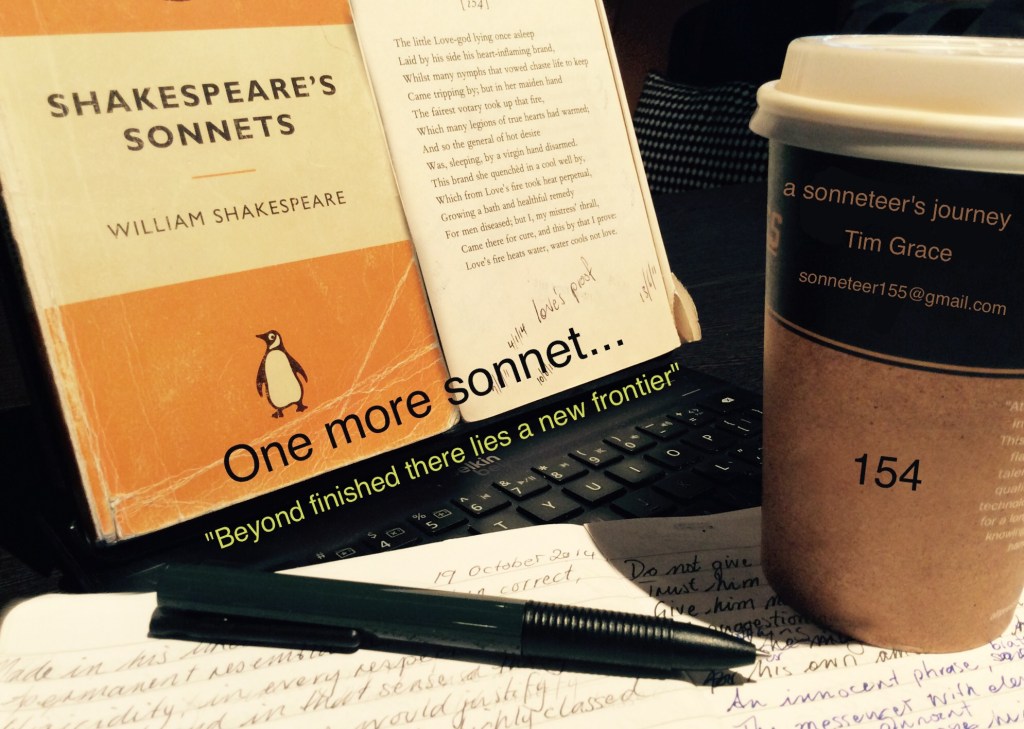
  • Beyond Finished

    Beyond Finished

    To say that all is finished, all is spent,
    means nothing in the greater scheme of things.
    For in that scheme there is but one intent:
    “waste nothing” – as from compost new life springs.
    What of that old house that the ground recalls?
    What of that empire in its fallen state?
    What of that fashion that today appals?
    What of good reason wasted in debate?
    All of these might be finished, done with use,
    stripped of cause, drained of substance; as conceived
    they might be buried dead or dangling loose;
    but as time shall choose – they shall be retrieved.
    . Beyond finished there lies a new frontier,
    . furnished in the garb of a golden year.

    © Tim Grace, 14 March 2012


    To the reader: Mistakenly, finished can be considered a terminal point of arrival. A statement of completion that declares an ending. In reality, nothing ends its course; nothing is divorced from what’s to come. Next, is the consequence of an expanding universe; until Time contracts there shall always be a new beginning… a next time to come. And so, in conclusion, consider this sum … there’ll always be “one more sonnet” to come.

    To the poet: Almost done. I know what it’s like to write 154 sonnets; one more and I’ve achieved my goal; one more sonnet and I’m finished? The challenge was self-imposed and given a few rules the disciplined process was fairly painless. The two-year rule was gruelling but necessary. The minimal use of “like” as a tool for metaphor kept me anchored to a direct narrative. The sonnet is an endlessly adaptable form both generous and forgiving. The sonnet (and my readers) suffered some mutilation along the way but with considerable credit stayed the course.


    beyond finished
    beyond finished


  • Inspiration as Conviction

    Inspiration as Conviction

    Who do we look to for inspiration?
    What disposition does this soul possess?
    We seek not the brand of fame and station,
    nor the badge of battle; worn to impress.
    Instead, we seek the common seal, the touch
    of humanity both caring and kind.
    Instead, we seek the wisdom to best clutch
    a simple truth that’s often hard to find.
    Instead, we seek a clever wit, a skilled
    practitioner, both able and adept;
    an active soul with the power to build
    a cause from gifts given and treasures kept.
    . Look to the soul who’s prepared to stumble,
    . but has the conviction not to crumble.

    © Tim Grace, 4 February 2012


    To the reader: A defining feature of inspirational leaders (living or dead) is enthusiasm. In addition, those who inspire (humble or bold) do so with conviction. Together, enthusiasm and conviction make an impressive and powerful partnership. Our inspirational heroes (big or small) are energised by cause and blessed with effect. They have an impact and they get results. We look to inspirational heroes (young or old) for insight into how we might walk in their footsteps and climb on their shoulders.

    To the poet: A second attempt at defining inspiration. This time a little more descriptive and a little more sequenced; bearing a little more enthusiasm and conviction. The first two lines establish the point of enquiry and the next two lines refute a negative response. The remaining six lines of the sonnet’s body attend “instead” to positive terms of reference; as applied to inspiration. The final couplet arrives at a satisfying, if not inspirational, conclusion.


    image