Tag: Events

  • Bright Source

    Bright Source

    By light of day he sees her twice;
    with truth and beauty she does shine.
    Together so, his two eyes splice
    what love does well combine.
    Truth with all its honours bound
    glows best when bathed in light.
    Beauty too, is likewise found
    where shines the sun most bright.
    Light reveals her sights unseen
    and brings to fore her vision;
    shines on spaces in between
    to uncover what is hidden.
    . The bright source of genuine affection:
    . illuminated love; delight in its projection.

    © Tim Grace, 16 June 2011


    To the reader: Delight; illuminated love… a revelation! Beauty and truth are tested through exposure and upon illumination become a vision. Truth without beauty casts a shadow of doubt. Beauty without truth shines dimly. Honesty has nothing to hide, seeks no dark retreat. As Dylan Thomas wrote: “Do not go gentle into that good night. Rage, rage against the dying of the light”.

    To the poet: Using the strictest of interpretations not a perfect sonnet. Yet, it works in many ways as a sonnet was meant. A compact, neat carriage of verse; internally strong with structure and substance. Truth and beauty, revealed in the first two lines, are separately expanded in the following six lines. The next four lines add a touch intrigue… is the poem erotic; surely not? And then, for summary’s sake, the final couplet draws together a lasting glimpse, a concluding essence that invites a second read.


    bright source bright source


  • Through Contemplation

    Through Contemplation

    It’s through contemplation that one sees
    behind the quick attraction,
    beyond the chic events that tease
    and taunt us to distraction.
    It’s the day-dream that delivers respite
    from the constant nag, the relentless pull
    of the trivial, the transient and trite;
    in this void there is no full;
    nor is there emptiness;
    nor is there substance (dried or set).
    There’s no position of fixed address,
    nothing to remember, nothing to forget.
    . It’s through contemplation that one reveals
    . the everything that sight conceals.

    © Tim Grace, 9 June 2011


    To the reader: Sight and light are complementary themes; together, they deliver vision in a physical sense. Seeing behind and beyond vision, delving into contemplation, is a metaphysical experience. Middle-grounded thought processes that deceptively avoid the optic nerve’s careful watch. It’s through contemplation, eyes off-guard, that the world is transfigured; broken from its matrix to form the poetry of mental images.

    To the poet: In poetry, the repetition of sounds adds emphasis and certainty of voice; provides an aural structure. In this poem alliteration, assonance and consonance are given free reign. Not too much. For too liberally applied, these devices become laboured and tiresome; having the opposite effect to that intended. Used wisely, these tools of the trade define the quality of writing. When used as ornamentation the poet slides a slippery slope.


    through contemplation through contemplation
  • Nothing of Extent

    Nothing of Extent

    For over an hour I have sat,
    Writing nothing on this page,
    I’ve watched people doing this and that,
    As they’ve walked across my stage.
    In some respects a waste of time.
    An indulgence poorly spent.
    I haven’t paired a single rhyme,
    I’ve done nothing of extent.
    I’ve pondered nothing too absurd,
    Nor tackled the contorted.
    I’ve cast myself in roles preferred,
    As here I’ve seen assorted.
    . The absent-minded hour has its worth,
    . It helps explain our time on Earth.

    © Tim Grace, 4 June 2011


    To the reader: Just before harvest time I presume a farmer contemplates; spends time thinking about the task ahead. Is my next poem a crop unreaped? According to Wittgenstein my desire to speak is to test a paradox. I propose relationships to explain my representation of the world; as a thought. No essence of language, no one truth in language, meaning is use, linguistic differences. Private language, thought precedes language. the language of thought … if you know what I mean!?

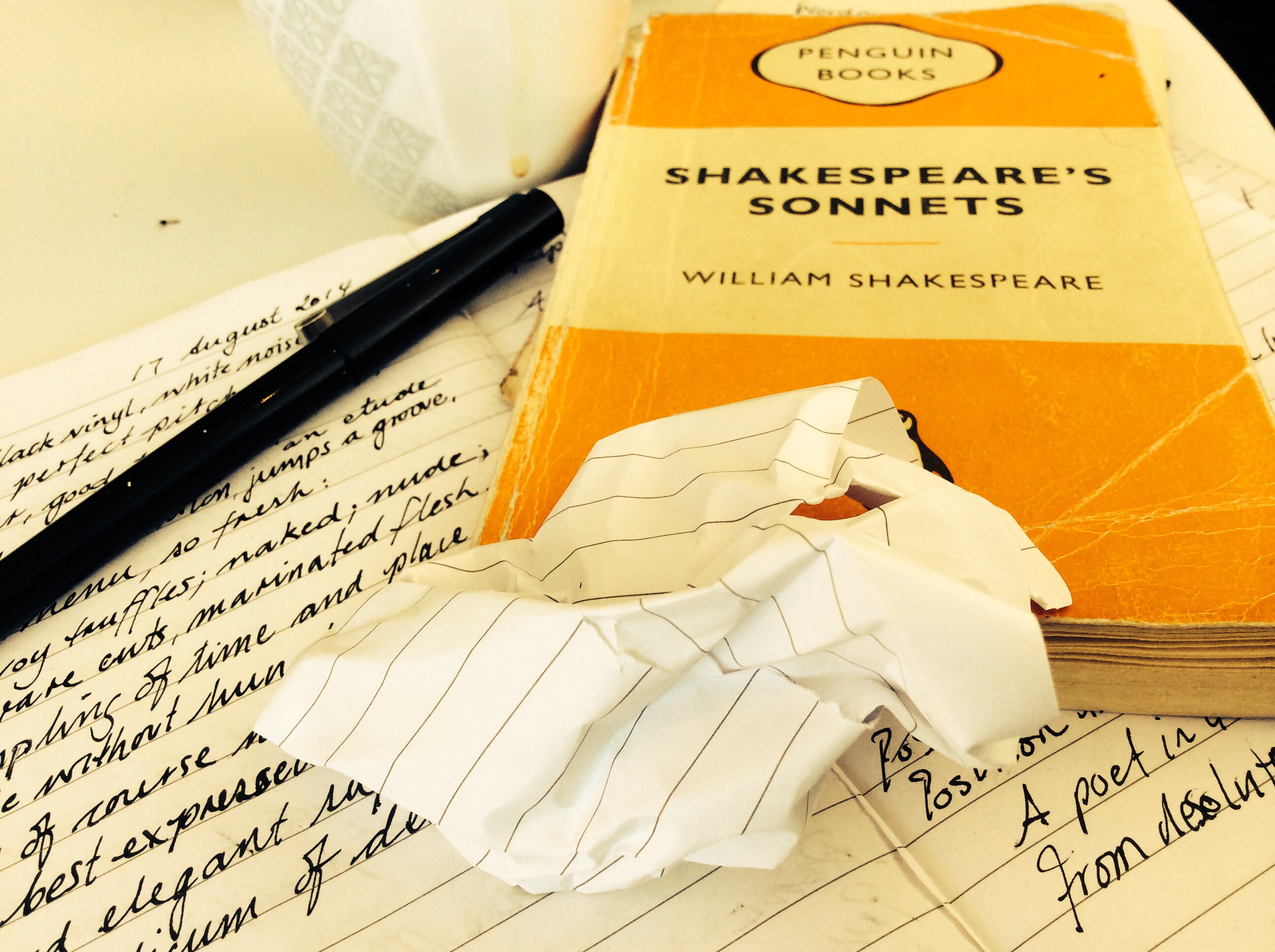
    To the poet: Words – they don’t come easy. The translation of thought into ink on a page is a physical struggle that I enjoy. The scripting of ink, not pencil or key board, adds a permanency to the drafting process. From the first touch of ink, my poems are under construction; every discarded phrase leaves a record of my mental meanderings. Word-smithing wrought with wonder!


    nothing of extent nothing of extent
  • No Good Can Come

    No Good Can Come

    No good can come of this … surely.
    In the end truth will out,
    to reveal just how poorly
    our captains, our leaders, go about…
    Surely, we are not prisoners to this
    misdirected manipulation of good.
    It can not be that we are captives,
    confined to the limits of must and should.
    Surely, it is through free will (not ill),
    that goodness finds itself expressed.
    Surely then, only then, and not until,
    as free … we will see good’s best.
    . When shackled, good can get no better;
    . set it free from chains and fetter.

    © Tim Grace, (WS-Sonnet 66: line 12) 14 May 2011


    To the reader: Goodness is a quality, a state of being attributed to anything that makes a worthwhile contribution. For those wielding power the branding of ‘good’ is a priceless claim. Unfortunately, goodness is open to manipulation by those with nefarious intent. Often the claim of betterment, for a good cause, has a self-serving purpose only revealed when deception is post-hoc revealed; after the fact is known… what good is that?

    To the poet: Surely… is the anchor-point of this sonnet which responds to Shakespeare’s frustration with the corruption of good. Incredulous… he shakes his head ‘how could this be so?’ Placing ‘surely’ at the end of the first line and then repeating it at the beginning of each quatrain gives it emphasis; surely enough to ease frustration… some good may come of that!


    no good can come no good can come
  • Authority

    Authority

    Authority, as per regulation,
    will justify suppression,
    will authorise translation
    and standardise expression.
    It will stamp approvals, make decrees,
    issue fines and warnings.
    But when it comes to birds and bees,
    and the beauty of good mornings,
    what use is there in forms to sign;
    what good is that affording?
    It doesn’t help the sun to shine,
    nor the crowd in its applauding.
    . Art made tongue-tied by authority,
    . gives voice to no majority.

    © Tim Grace, (WS-Sonnet 66: line 9) 27 April 2011


    To the reader: To wield authority is an art-form not easily crafted into institutional practice. As institutions grow in size and status they instinctively adopt self-protective procedures that distance themselves from face-to-face exposure. The protective force-field is governance; more or less the rules of engagement. To be satisfying, our interaction with authority needs to bare some resemblance to the flow of natural order… if not creative then at least flexible; adaptive to change.

    To the poet: Without structure sonnets easily wander off track. Conversely, they can’t bear too much heavy engineering. Through natural rhythms, the mechanical hardware of a sonnet is disguised as rhyme and reason. As with authority, a bureaucratic approach to poetry can over-govern its artistic bent; a tongue-tied sonnet results.


    authority authority


  • Missing Sonnet

    Missing Sonnet

    The case of the missing sonnet unfolds,
    Layers of intrigue yet to be revealed:
    One, the sonneteer vehemently upholds
    That crucial evidence has been concealed;
    Two, he claims the sonnet (to date his best)
    Was finished and the draft had gone to print;
    And three, as aggrieved plaintiff, he’d suggest
    The weight of evidence does more than hint
    That the crime was payback, a vendetta,
    A deliberate and well executed
    Act of retribution; Every letter,
    Every word, in every way disputed.
    . Why take possession of what causes grief?
    . What’s the obsession… it beggars belief?

    © Tim Grace, 29 September 2011


    To the reader: A lost object has the potential to be found; it’s not yet fully gone. Retrieval is usually a simple matter of retracing steps; upturning the obvious. Annoyingly, in the lost-zone, while it lasts, there dwells frustration and self-doubt. But, having acquitted yourself of simple misplacement there comes the temptation to attribute blame to others. They become the culprits.

    To the poet: This is the first sonnet, sequentially but not chronologically, to have fourteen lines loaded with ten syllables each. The first line also adheres to the pattern of iambic-pentameter with paired emphasis bouncing from heel to toe. It’s also a sonnet that, for my pleasure, reads across the lines as a single passage of thought. As structured, this sonnet works well as a self-contained package.


    missing sonnet missing sonnet