Blog

  • Through Contemplation

    Through Contemplation

    It’s through contemplation that one sees
    behind the quick attraction,
    beyond the chic events that tease
    and taunt us to distraction.
    It’s the day-dream that delivers respite
    from the constant nag, the relentless pull
    of the trivial, the transient and trite;
    in this void there is no full;
    nor is there emptiness;
    nor is there substance (dried or set).
    There’s no position of fixed address,
    nothing to remember, nothing to forget.
    . It’s through contemplation that one reveals
    . the everything that sight conceals.

    © Tim Grace, 9 June 2011


    To the reader: Sight and light are complementary themes; together, they deliver vision in a physical sense. Seeing behind and beyond vision, delving into contemplation, is a metaphysical experience. Middle-grounded thought processes that deceptively avoid the optic nerve’s careful watch. It’s through contemplation, eyes off-guard, that the world is transfigured; broken from its matrix to form the poetry of mental images.

    To the poet: In poetry, the repetition of sounds adds emphasis and certainty of voice; provides an aural structure. In this poem alliteration, assonance and consonance are given free reign. Not too much. For too liberally applied, these devices become laboured and tiresome; having the opposite effect to that intended. Used wisely, these tools of the trade define the quality of writing. When used as ornamentation the poet slides a slippery slope.


    through contemplation through contemplation
  • With Such Precision

    With Such Precision

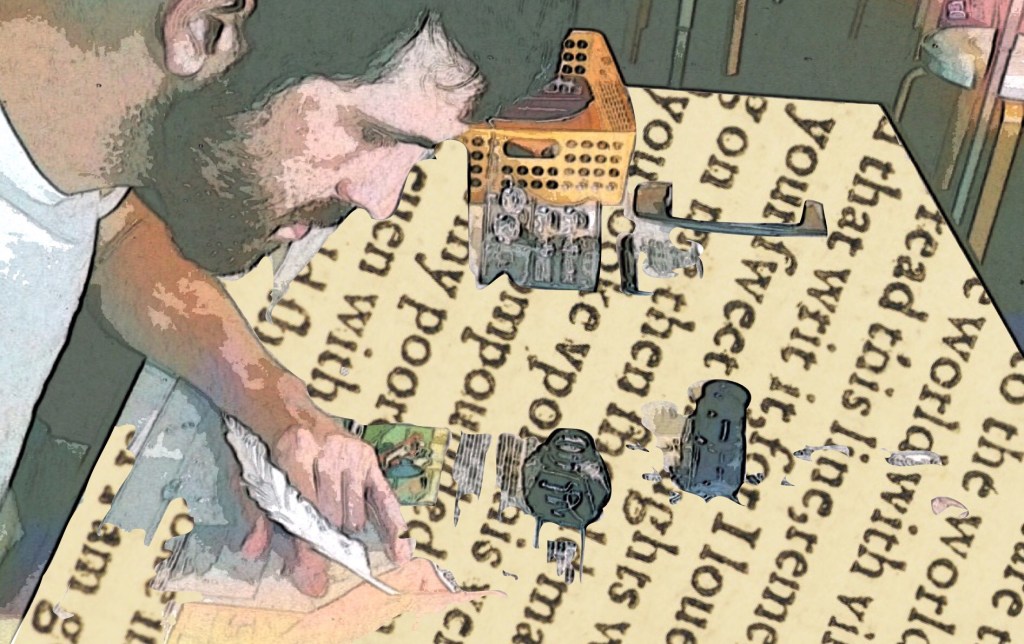
    You write with such precision.
    You bemoan your broken quill.
    You complain of love’s condition.
    You would have the world stand still.
    The more you force contentment,
    as would appear your goal,
    the more you’ll meet resentment:
    … you’re a prisoner on parole.
    Let go the restless musings
    that cripple future dreams,
    accept the harmless bruisings:
    … be at peace with how it seems.
    . Take the best of your convictions,
    . make the least of your restrictions.

    © Tim Grace, 5 June 2011


    To the reader: Shakespeare was a ‘grumpy old man’ when it came to his relationship with time; frustrated to say the least. Time, whether past, present or yet to come, caused him angst. He riled against its ravages, scoffed at its seasons, and bemoaned its brevity. He proposed solutions (the womb, the word, eternal love) and then realised their futility… “ruin hath taught me thus to ruminate, that Time will come and take my love away.” (sonnet 64)

    To the poet: Ellipsis… threepence for your thoughts; or was that just a penny. In the absence of any other form of punctuation the ellipsis often suffices. In an informal sense, the shortening of a sentence is a convenient starting point… maybe a soft ending. For a poet, supposedly a wordsmith, over use of the ellipsis might be considered lazy…


    with such precision
    with such precision
  • Skewed Perspective

    Skewed Perspective

    This painter’s point of reference is a frame.
    That being so, the view portrays a scene:
    a pictured scene, that forms a likeness; same
    or similar images sit between
    vertical and horizontal axes.
    Colour-saturated canvas with scrapes
    of land and sea, clouds and sky in patches;
    an ornamental arrangement of shapes
    drawn together; intermingled, condensed,
    poised in proportion. Constrained it would seem,
    fixedly, to the one common bound: fenced,
    measured and matched to a spatial theme.
    . When frames of reference are viewed selective,
    . they’re often squared to a skewed perspective.

    © Tim Grace, 6 July 2011


    To the reader: Frames of reference hold the contents of a picture in place and establish the dynamics of a visual arrangement; as perceived. Whether a visual artist can claim to have captured what is beyond their canvas or lens is an interesting point. Is deliberate omission part of the viewing experience? To paint or photograph a scene without its protagonist, without its feature, gives the viewer the ‘power of suggestion’ to answer what’s missing. Frames are not borders.

    To the poet: Constraints are at the centre of this poetic piece. Its theme argues a contrivance; that being: any captured picture is a selectively squared-off visual arrangement. A poem, on the other hand, is boundless in its suggestive use of imagery. In making reference to a poetic landscape I have relied upon the reader’s visual interpretation of “scrapes of land and sea” … to be conjured at will.


    skewed perspective skewed perspective
  • Nothing of Extent

    Nothing of Extent

    For over an hour I have sat,
    Writing nothing on this page,
    I’ve watched people doing this and that,
    As they’ve walked across my stage.
    In some respects a waste of time.
    An indulgence poorly spent.
    I haven’t paired a single rhyme,
    I’ve done nothing of extent.
    I’ve pondered nothing too absurd,
    Nor tackled the contorted.
    I’ve cast myself in roles preferred,
    As here I’ve seen assorted.
    . The absent-minded hour has its worth,
    . It helps explain our time on Earth.

    © Tim Grace, 4 June 2011


    To the reader: Just before harvest time I presume a farmer contemplates; spends time thinking about the task ahead. Is my next poem a crop unreaped? According to Wittgenstein my desire to speak is to test a paradox. I propose relationships to explain my representation of the world; as a thought. No essence of language, no one truth in language, meaning is use, linguistic differences. Private language, thought precedes language. the language of thought … if you know what I mean!?

    To the poet: Words – they don’t come easy. The translation of thought into ink on a page is a physical struggle that I enjoy. The scripting of ink, not pencil or key board, adds a permanency to the drafting process. From the first touch of ink, my poems are under construction; every discarded phrase leaves a record of my mental meanderings. Word-smithing wrought with wonder!


    nothing of extent nothing of extent
  • Hyde Park (Sydney)

    Hyde Park (Sydney)

    Welcome to Hyde Park, home of the wombat,
    the fleet footed xylophone,
    the inverted umbrella and the feral cat.
    Where the ingenious mind casts in stone
    its love of country and the park bench.
    Where jet-lag creates chaos on the streets,
    and “Look Right” is meaningless in French.
    Where traffic lights play endless repeats
    of Jeckyl and Hyde – the amusement park
    open all hours, street theatre,
    spontaneously triggered by a spark;
    where strange ways just get weirder!
    . We all need somewhere to park ideas,
    . to ponder thoughts and tackle fears.

    © Tim Grace, 2 June 2011


    To the reader: Sydney’s Hyde Park is surrounded by buildings and squared by traffic; within these confines it provides the city with quintessential greenery. The incidental visitor has no attachment to its physical features and so explores the park with gormless wit. Broad sweeps of lawn intersect at a war memorial swallowed by a pool of remembrance. An assortment of locals define the park’s character as miscellaneous.

    To the poet: Without ridiculing Hyde Park, its history is an oddity, its placement a curiosity; and so, a nonsense poem pays it fitting tribute. The playful and suggestive references are obscure; hopefully not too self-indulgent. How far a poet can stretch a reader’s interest in nonsense is dependent on curiosity. The curiosity factor gives to nothing its substance… and there you have the value of a park.


    hyde park hyde park
  • Time is Tense

    Time is Tense

    Expansive time will not be caught,
    put on pause to cause delay.
    Expensive time will not be bought;
    beg nor borrow tomorrow’s day.
    Time has not the nature to be still,
    it’s too erratic to be framed.
    It matters not your strength of will,
    time will not be tamed.
    Evasive time will not be gripped,
    not be chained, with lock and bolt.
    Elusive time will not be clipped;
    not contained within a vault.
    . Elapsed time has no recompense,
    . it’s this regret that makes it tense.

    © Tim Grace, 27 May 2011


    To the reader: Time, as Shakespeare discovered, is most cruel on the living. We who age, suffer the ravages of time; have stolen our youthful prime. In the end, acceptance is our best defence. Once resigned to the impact of time, this beast ceases to be our enemy; never a friend, more an acquaintance. And as an acquaintance, time offers legacy; the past is an archive; a fathomless vault. Love lives, until the death of time, in a Shakespeare sonnet.

    To the poet: Four blocks of verse related to a common theme; a coarsely sewn thread of thought about time. While not rhythmically satisfying, this sonnet achieves its interest through internal word-similarities (expansive and expensive; elusive and evasive). In a poem’s writing phase, the interest of word features is ever-present. As one word suggests another by sight or sound they both enter the realm of possible inclusion; a fusion of sorts.

    time is tense time is tense