Category: Uncategorized

  • Correct and True

    Correct and True

    Half right; is correct in fact.
    It’s free from error’s damage.
    It’s twice been checked and so exact.
    It’s the best that we can manage.
    Half right is true and so ideal.
    It’s there in a lover’s kiss.
    It’s passionate and full of zeal.
    It’s perfect as it is.
    Right is then a two-faced coin,
    as would carry yang and ying.
    Principles that we can join
    to make a good and proper thing.
    . Good reason often comes to plight,
    . for rarely does it prove twice right.

    © Tim Grace, (WS-Sonnet 66: line 7) 21 April 2011


    To the reader: To be completely right a solution must be both correct and true. Correctness requires abidance with the facts. To be true requires loyalty despite false attraction. Half-right solutions are not, therefore, wrong; they’re just not completely right. According to circumstance, the half-right solution (being correct or true but not both) is all that’s needed. In love be true, otherwise correct.

    To the poet: Semantics and pedantry are to be handled with care. Splitting meaning for no good purpose can be perceived as mischievous; spoiling for a fight. Exploring the difference between two words (correct and true) in light of a common theme (rightness) was hopefully revealing; more so than troublesome. The choice of one word over another is a qualitative decision.


    good reason good reason


  • So Welcome

    So Welcome

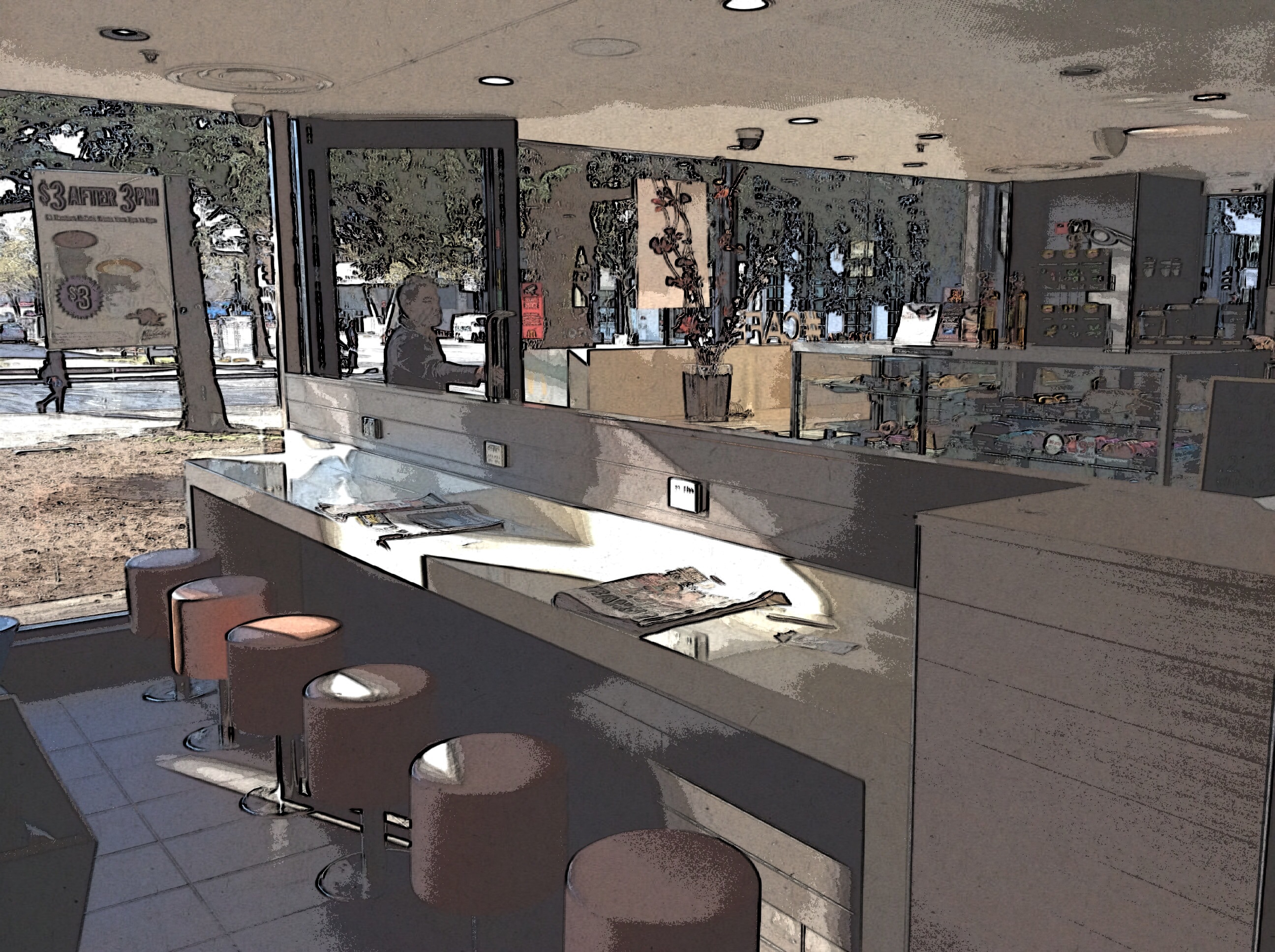
    From this seat, a small window
    frames the street; a door swings
    on its hinges. Who’s to know
    what its welcome brings?
    Here comes a backpack with a laptop
    looking for a what-not.
    Is it be-bop, is it hip-hop?
    … it’s a cool cat at a hot spot.
    Here comes a white shirt with dark glasses
    collared by a black tie.
    It’s the business look that passes,
    as a brief case of who am I?
    … Doors are trained in etiquette,
    … so welcome those they’ve not yet met.

    © Tim Grace, 8 April 2011


    To the reader: With the opening of a door comes the expectation of new arrival. Door swings, or slides, and for a moment frames a fresh character. The first impression is squared-off, measured-up; allotted to its fit. A nameless no-one becomes someone given presence. That someone’s arrival bears the mark of carriage; deportment. The doorway delivers another entrance.

    To the poet: In my poetry, the thematic presence of ‘this seat’ is recurring. It’s not always the same ‘this seat’ but as a place-holder it’s a common anchor point. Observing the world requires an authentic perspective; ‘this seat’ is its vantage point. Not all poems need a sense of location but occasionally it helps to give the reader a reference point; so the poet-observer is placed within the narrative – passively evident.


    so welcome so welcome


  • One Truth Remains

    One Truth Remains

    What we know can be deceptive,
    Exact, but not complete.
    It’s the fool who is receptive,
    To the charlatan and cheat.
    The truth is far more subtle,
    And difficult to grasp.
    It’s open to rebuttal,
    It’s the bastard of a rasp.
    What’s real through comprehension,
    (as absurd or somewhat strange)
    Is worthy of a mention…
    But sensitive to change.
    . Throughout our lives one truth remains,
    . Wisdom thrives where confusion reigns.

    © Tim Grace, 23 February 2011


    To the reader: Lack of knowledge begets assumption. Doubt accommodates the leap of faith, the jumping to conclusion; the guess. It also makes room for curiosity and wonder. For better or worse doubt provides a vacant opportunity. The cheat makes good use of doubt by cleverly distorting what seems to be a plausible reality. The charlatan, a cheat on steroids, makes vacancy a marketplace for the gullible; more fool us.

    To the poet: Although written in three quatrains, this sonnet for the most part reads well in double-lined sentences. The even lines tend to echo the sentiment of the preceding odd-line. With this odd/even progression the poem builds its logical form and structure. Treating the two lines as a single sentence reduces the number of free standing elements and tightens the message; through fewer inserted thoughts.


    one truth remains one truth remains


  • Four Strings

    Four Strings

    To the strains of a string quartet,
    The classics claim the night,
    With four strings and not one fret,
    The chords are sheer delight.
    Feel the warmth of Vivaldi’s Spring,
    The late harvest, reaping scores,
    The crescendo, hanging on a string,
    The fertile note, the pregnant pause,
    Brahm’s in accompaniment, mellow,
    As the sound of water over stones,
    To finish (with yiddish temperament) the cello,
    Draws a long bow; in sombre tones.
    . The living sounds are beautifully matched,
    . They often come with strings attached.

    © Tim Grace, 18 February 2011


    To the reader: The soft sounds of a string quartet float with reassurance; buoyant. The four piece band with full emphasis on melodic harmonies; tuneful. The result, a beautifully balanced accompaniment to a night on the rolling waves; far from all at sea. Nervous introductions, delivered in broken English, were translated into masterful renditions of music’s classical best.

    To the poet: Nothing like being there. Nonetheless, a good poem extends the moment; outlasts the experience and aids retrieval. Ditties, like snapshots or snippets, are framed with little purpose beyond a statement of ‘I was here…”. Through deeper recollection, the experience can’t be surpassed, magnified or replicated; it can be synthesised. The poem, for just a moment, can make sense of all things at once.


    four strings four strings


  • She is the Ocean

    She is the Ocean

    How do we know the sea deeply,
    This vast accompaniment to shore?
    In truth … never so completely,
    By acquaintance; nothing more.
    In her shallows, at water’s edge,
    Where lapping waves decay,
    Her ripples sound a common pledge,
    Her splash has much to say.
    At deeper depths, in rougher seas,
    Where waves compound their force,
    Fathom not her vagaries,
    Nor delve her inner source.
    . She is the ocean, of seven seas construed,
    . To each apply the notion of independent mood.

    © Tim Grace, 16 February 2011


    To the reader: Surges of emotion modify our moods. In the shallows we enjoy the ripples that tickle us out of tedium. We take pleasure in the tease of a dying wave. But with a rising tide there comes a wash of new temperament. Playfulness retreats. An ankle deep sensation casts us into deeper thought. The seaward message is relentless with warning and alarm… take care.

    To the poet: Marshall McLuhan coined ‘the medium is the message’ to illustrate that content is transformed through the process of communication. The context of content influences interpretation. The written word is a poet’s content, the medium is speech. Through speech a poem is unpacked, given emphasis; made sharp, made blunt, given gloss or dulled.


    she is the ocean she is the ocean


  • Manufractured

    Manufractured

    The world in pieces,
    Colours combining,
    Clarity increases,
    With distance defining.
    The world segmented,
    Kaleidoscopic split
    Patterns augmented,
    With nibbling fit,
    The field of view,
    The focal range,
    The tonal hue,
    With angles change.
    .    Impressed and enraptured,
    .    The mosaic is manufractured.

    © Tim Grace, 12 February 2011


    To the reader: Cathedral ceilings find counterbalance in floors of magnificent mosaic. The segmental nature of a mosaic adapts itself to undulating and odd-shaped perimeters. Tile by tile in decoration. A surface treatment deliberately fractured; pre-empting the impact of traffic and age. A strong and versatile solution. Suited to subtlety …impressionistic, geometric, kaleidoscopic. Betters with age.

    To the poet: Small pieces of text. Small phrases, reliant on each other for meaning. As with a mosaic, this sonnet begins with the micro-meaning of individual words. As the aperture widens the macro-meaning reveals itself as a play of words; built around the concept of ‘manufracturing’… to build from broken pieces. Meaningless becomes meaningful; fixed.


    manufractured
    manufractured