Category: People

  • All Too Difficult

    All Too Difficult

    We’ve made it all too difficult,
    … what’s good is out of reach.
    Where’s the truth, where’s the fault?
    It’s there … with those that preach.
    The simple act of give and take,
    Be kind to those who bleed,
    All of this, for goodness sake,
    A sermon does not need!
    The simple choice of right from wrong,
    And treat your neighbours well,
    Shouldn’t lead to ‘I belong’
    So protected ‘I’ can dwell.
    . Good is not a destiny, to contemplate,
    . Nor is it a key, to a closed estate..

    © Tim Grace, 9 January 2011


    To the reader: The quality of ‘goodness’ has been branded. Much like any commodity it’s been thrown to the markets. On the basis of supply and demand ‘goodness’ fluctuates in value. When poorly packaged ‘goodness’ loses its edge in the market place and recedes to a back-shelf option. In limited supply ‘goodness’ is only available through selected outlets; who for their own gain distort its features and in so doing marginalise its agency; compromise its potency… for goodness sake!

    To the poet: The first stanza establishes the problem; the second and third do their best to respond. But in the end, it’s the final couplet that dutifully fulfils its role in offering a succinct and convincing summary. Exposition and argument need a logical sequence of propositions to be worthy of pen and ink on page. A good poem, like a good sermon, needs to be plausible not dogmatic; open to all.


    all too difficult all too difficult
     

  • Remnants

    Remnants

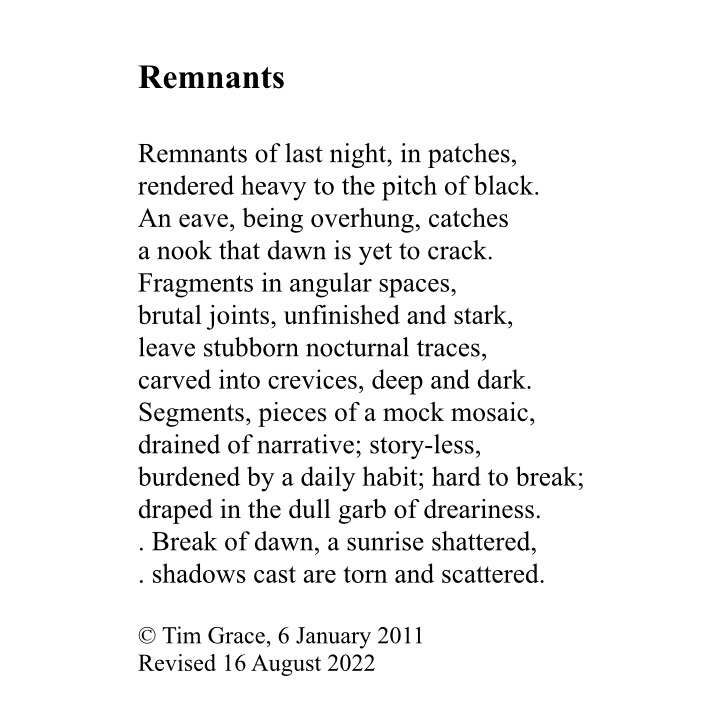
    Remnants of last night, in patches,
    Rendered heavy to the pitch of black.
    An eave, being overhung, catches
    A nook that dawn is yet to crack.
    Fragments in angular spaces,
    Brutal joints, unfinished and stark,
    Stubborn nocturnal traces,
    Carved into crevices, deep and dark.
    Segments, pieces of a mute mosaic,
    Drained of narrative; story-less,
    Burdened by a daily habit; hard to break,
    Draped in the dull garb of dreariness.
    . Through a broken dawn, comes a sunrise shattered.
    . Shadows born, then torn and scattered.

    © Tim Grace, 6 January 2011


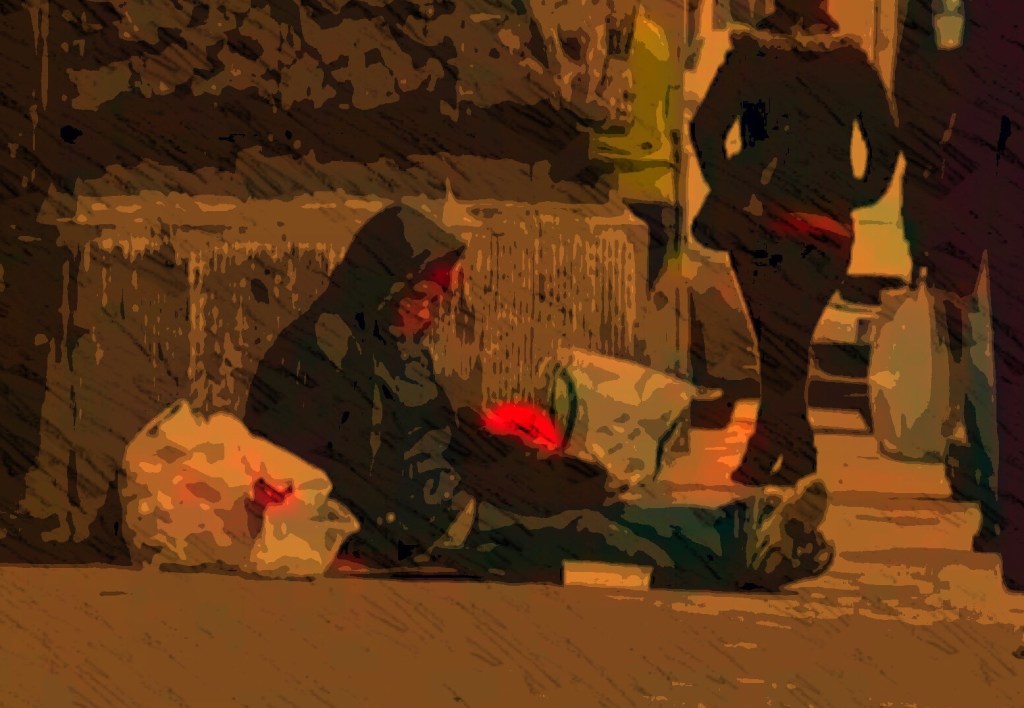
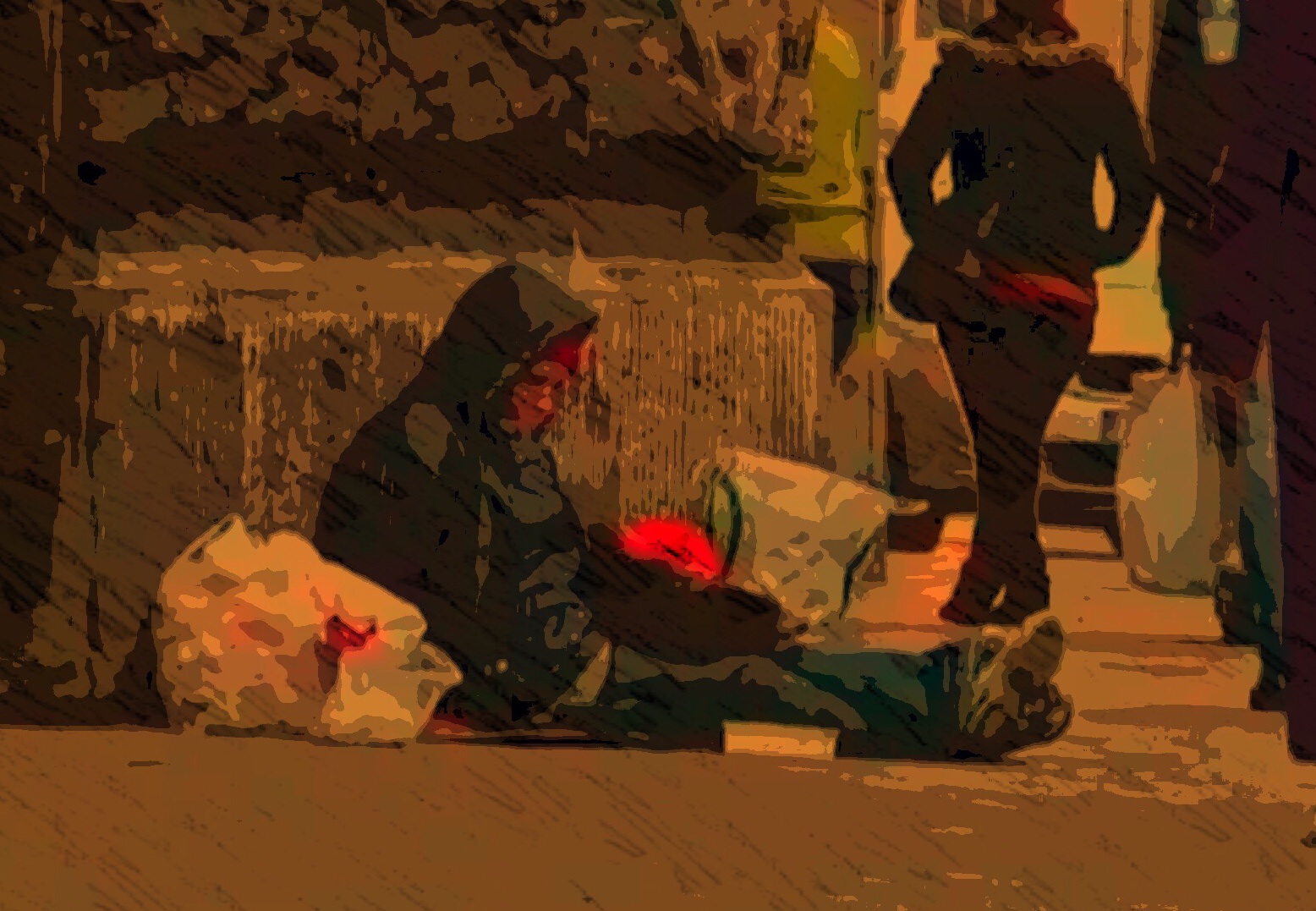
    To the reader: With dawn comes the realisation of what remains of last night; the shroud of darkness has been lifted. The homeless, cramped in corners and nestled in nooks, are slow to rise. Around them the city stirs into action. Sunlight nudges its way into cavities. And so breaks the day. The heaviness of night grips the vagrant who with reluctance shadows another day … awaiting a new night to fall.

    To the poet: This poem holds strong to its form of three distinct stanzas; blocked out as remnants, fragments, and segments of a shared theme. The continuous lines of verse ignore those breaks and seamlessly roll into a single thread of thought. It’s also a poem that plays confidently with the literary features of alliteration, assonance and consonance. While inspired by a short visual moment, I remember this poem took considerable working; days.


    remnants remnants


  • Smooth the Edge

    Smooth the Edge

    The edge, roughly cut and jagged;
    torn apart and broken;
    crudely split and ragged:
    ‘a scratch’ if plainly spoken.
    The rim, rounded-off and even;
    comfortable to grip;
    shaped to give good reason
    to the curvature of lip.
    On the edge, where fibres fray,
    the straight grain is splintered.
    On the rim, where fingers play,
    the subtle move is hinted.
    . Smooth the edge to a bevelled rim;
    . and be content with its levelled brim.

    © Tim Grace, 31 December 2010


    To the reader: The tactile sense, haptic in nature, is pleasured by the touch of a smooth and rounded edge. The sculptor, the chef, the luthier and the lover all recognise the appeal of a softly chamfered edge. A deliberately honed finish invites the caress of a curious finger-tip. The delicate rim of a china cup whets the lip. The family of stringed instruments nestle into the human form; they are eager to be strummed or stroked by a skilled and attentive hand.

    To the poet: The reading of a sonnet is a tricky thing. The performance of a sonnet exposes the inner tension between literal meaning and lyrical reading. Obviously, the poem’s metre is critical to simplifying the reader’s task, but too strong a metre runs the risk of delivering a ditty. An oddly placed pause, a quirky phrase are complicated but necessary if a poem is going to attract sophisticated interest. Sonnets are not written for the speed reader; not to be scanned or read once.


    smooth the rim smooth the rim


  • Prattle Scarred

    Prattle Scarred

    Why fight it? The cause is lost,
    They’ll talk until exhausted,
    An exchange of words, wires crossed,
    All reason has been thwarted.
    Empty thoughts spent of use,
    Incessantly dispersed,
    Canons of conversation let loose,
    Loaded barrels burst.
    Incenduries of scattered thought,
    collateral damage hits hard,
    What remains is the odd retort
    The word weary, and the prattle scarred.
    . It’s blood that’s shed, in fields of war,
    . It’s not what’s said, that yields the score.

    © Tim Grace, 10 December 2010


    To the reader: A barrage of words; an incessant round of scattered thoughts … prattle lines are drawn! As a prisoner of words it’s sometimes impossible to withdraw or retreat from the field of discussion; you’re good and captured – well snared. Escape is unlikely, outlasting the word attack is a matter or patience; it will pass but just not soon.

    To the poet:  The play of combative terms was the thrill of this kill. There’s an element of nonsense poetry in the technique. Twisted and contorted phrases are close enough to real to comfortably carry double-barrel meanings. When playing with words the ‘play’ needs to be convincing and controlled; so the aim is steady and the target sure.


    why fight it why fight it


  • Not Incredible

    Not Incredible

    Don’t make of me a case in point
    Or define me as a jewel,
    I’m not a thing you need anoint
    As an exception to the rule.
    I’m not a one-off centre piece,
    Or a brightly shining star,
    Compare me not to say Matisse
    Or call me objet d’art
    Give me not your accolades,
    I need them not to shine,
    Send me not on escapades
    That to a hero you’d assign.
    .    I’m a pillar not a pedestal,
    .    I’m good but not incredible.

    © Tim Grace, 26 November 2010


    To the reader: The burden of expectation is a heavy weight. The mild-mannered super hero is a case in point. Encumbered with a sense of conviction, the archetypal hero bares the load of over-whelming duty. When released of expectation the hero, as centre-piece, is freed of others’ expectations. It’s the pillar not the pedestal that bares weight and distributes the load.

    To the poet: Pulling apart a poem reveals a poet’s word play. Throughout this poem, rhythm falls heavily on the word ‘not’; as repeated in alternating lines. The opening word is ‘don’t’ and from this point on the emphasis is clear: ‘I’m good but not incredible’. The words might say ‘don’t’ but they are expressed with determination and conviction; heroic traits indeed.


    not incredible
    not incredible
  • No Certain Gift

    No Certain Gift

    From high anticipation
    Swells a reservoir of need,
    In relentless expectation
    Dwells avarice and greed.
    With accumulated envy
    In sediments of must,
    There’s fear of what might empty
    And desiccate to dust,
    The certainty of emphasis
    Undelivered cuts a rift,
    And from this pool of promises
    There is no certain gift.
    . The hope of all wishes, is a dream come true.
    . Real or capricious, you can not make it due.

    © Tim Grace, 7 November 2010


    To the reader: Hope is not built upon a promise. That which springs eternal carries no guarantee of service or delivery. When ladened with expectation hope is prone to sour and curdle into a frustrated yearn; a nagging desire. Expectation stretches forward and as with rope can not be pushed.

    To the poet: Sometimes confidence overrides technical issues. The sheer force of short rhythmical phrases ignores a dubious rhyme; and to some extent, makes it all the more interesting. Each pair of lines, within the quatrains, works as one structure of meaning. And then, the meaningful pairs are tied together with conjunctives to form a single, and united, sonnet. A single piece of rope.


    no certain gift no certain gift