Category: People

  • With Such Precision

    With Such Precision

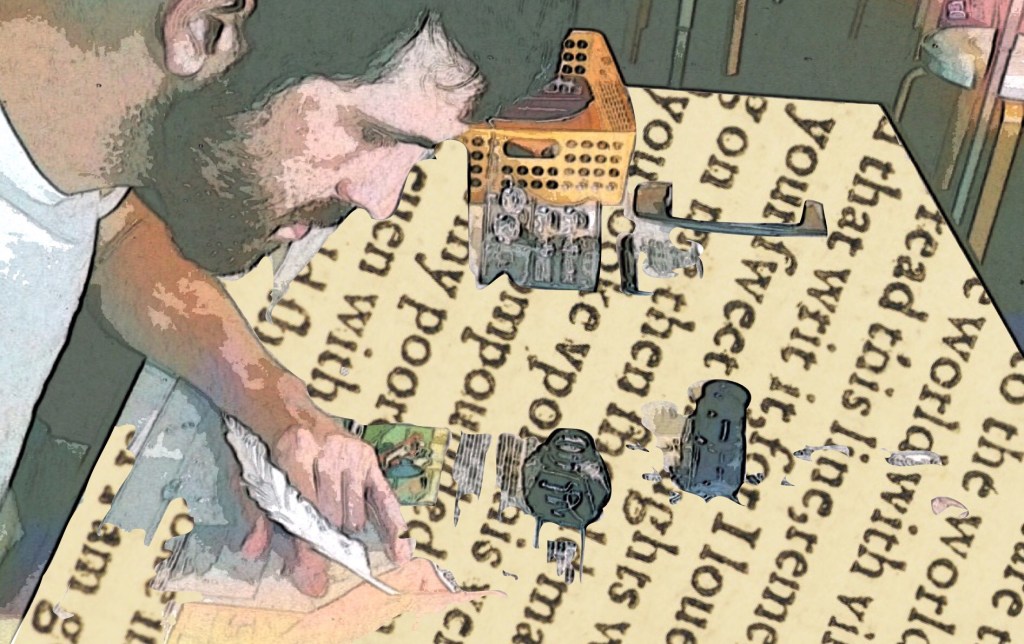
    You write with such precision.
    You bemoan your broken quill.
    You complain of love’s condition.
    You would have the world stand still.
    The more you force contentment,
    as would appear your goal,
    the more you’ll meet resentment:
    … you’re a prisoner on parole.
    Let go the restless musings
    that cripple future dreams,
    accept the harmless bruisings:
    … be at peace with how it seems.
    . Take the best of your convictions,
    . make the least of your restrictions.

    © Tim Grace, 5 June 2011


    To the reader: Shakespeare was a ‘grumpy old man’ when it came to his relationship with time; frustrated to say the least. Time, whether past, present or yet to come, caused him angst. He riled against its ravages, scoffed at its seasons, and bemoaned its brevity. He proposed solutions (the womb, the word, eternal love) and then realised their futility… “ruin hath taught me thus to ruminate, that Time will come and take my love away.” (sonnet 64)

    To the poet: Ellipsis… threepence for your thoughts; or was that just a penny. In the absence of any other form of punctuation the ellipsis often suffices. In an informal sense, the shortening of a sentence is a convenient starting point… maybe a soft ending. For a poet, supposedly a wordsmith, over use of the ellipsis might be considered lazy…


    with such precision
    with such precision
  • Count not the Clown

    Count not the Clown

    It’s the full deck that makes us sure
    we’re not the house of cards that trembled.
    With thirteen runs in sets of four
    as luck would have assembled.
    It’s the full pack (red and black)
    that finds trump in awkward shuffle.
    It’s the bold attack, from humble stack,
    that best will cause kerfuffle.
    It’s the full set that serves us best;
    That most completely deals our hand:
    To cope with what might manifest,
    To make good from what is bland.
    .   Count not the clown, not that foolish stoker;
    .   As by name, he’s nothing more than joker.

    © Tim Grace, 22 May, 2011


    To the reader: The history of playing cards dates back to the Tang Dynasty (618-907), when members of the Chinese royal house entertained themselves with courtly pass-times. My notion of a full deck is inherited from a European tradition of 52 cards arranged in four suits of 13 cards. The mathematical versatility of 52 cards is convenient and probably accounts for its widespread use. A full-deck has symmetry and sequence; pattern and probability; traits that appeal to someone of corresponding age!

    To the poet: Punctuation of a poem is part of the puzzle. Keeping it simple is one approach. Alternatively, a liberal smattering of syntactic signage is very helpful in ensuring adherence to the poet’s preferred phrasing. For some poems punctuation is a secondary matter that suggests its own logical placement. In this sonnet, punctuation is placed to be an obvious obstruction; and an intended instruction.


    count not the clown count not the clown
  • Gift of gifts

    Gift of gifts

    There is no child who from its mother
    did not receive the gift of life.
    This gift of gifts is like no other:
    given as incomplete. It’s rife
    with possibility, ripe with potential,
    it’s a gift that will grow and change,
    it shares her likeness; referential.
    With generous scope to range
    this gift gives all but eternity,
    this gift gives all it has to give,
    this is the gift of maternity,
    this is the gift of life we live.
    . Of all the gifts, it’s the one that ranks,
    . as worthy-most of life-long thanks.

    © Tim Grace, 11 May 2011


    To the reader: Put aside posterity, and a mother’s gift of life is an expression of generosity. Her gift offers nothing more than potential; it comes with no guarantee. More so, her gift is wrapped with love and good wishes; high hopes for health and happiness. As a gift it comes with no service contract; instead, it’s a social contract, an expectation of life-long commitment and care.

    To the poet: Although not a classic iambic pentameter, in the Shakespearian sense, this poem’s rhythm burdens every other syllable with a weighted grip. In particular, the last quatrain is repetitive and rhythmical with its emphasis baring on the ‘gift’. And so, through technique an emphatic message is given voice.


    gift of gifts gift of gifts


  • Suited or Not

    Suited or Not

    They can draft a man to suit a plan,
    give him wage and compensation.
    They can craft a man ’til spic’n’span,
    prepare him for occasion.
    Surely then, it’s fair that we assume
    he’s qualified; and suitably recruited.
    But soon, too soon, his costume
    slips. A facade’s been executed!
    Any fool can dress the part,
    and for some time play his bluff.
    But neither is this good nor smart,
    for through polish shows his scruff.
    . Beware the quack with phony bill,
    . so too folly, doctor-like, controlling skill.

    © Tim Grace, (WS-Sonnet 66: line 10) 1 May 2011


    To the reader: So it is supposed to go… as we carve out our individual career paths the route develops a logic which is matched to our particular talents. And so we become suited, recruited, to our work. Frustratingly, not all career paths follow this dictum; this pattern of logical progression. For some, opportunity defies logic and lays down a highway devoid of devotion. Rapid rise; rapid fall … careers to a crash!

    To the poet: In lengthening the lines of a poem we create space to internally reinforce points of expressions. An incidental phrase (not always necessary) can soften the direct impact of hurried line. The inserted clause, the bracketed thought, offers an adjustment: a tweak; a checkpoint; a clarification of sorts. The longer line is reassuring, less punchy; more reader friendly.


    suited or not suited or not


  • Authority

    Authority

    Authority, as per regulation,
    will justify suppression,
    will authorise translation
    and standardise expression.
    It will stamp approvals, make decrees,
    issue fines and warnings.
    But when it comes to birds and bees,
    and the beauty of good mornings,
    what use is there in forms to sign;
    what good is that affording?
    It doesn’t help the sun to shine,
    nor the crowd in its applauding.
    . Art made tongue-tied by authority,
    . gives voice to no majority.

    © Tim Grace, (WS-Sonnet 66: line 9) 27 April 2011


    To the reader: To wield authority is an art-form not easily crafted into institutional practice. As institutions grow in size and status they instinctively adopt self-protective procedures that distance themselves from face-to-face exposure. The protective force-field is governance; more or less the rules of engagement. To be satisfying, our interaction with authority needs to bare some resemblance to the flow of natural order… if not creative then at least flexible; adaptive to change.

    To the poet: Without structure sonnets easily wander off track. Conversely, they can’t bear too much heavy engineering. Through natural rhythms, the mechanical hardware of a sonnet is disguised as rhyme and reason. As with authority, a bureaucratic approach to poetry can over-govern its artistic bent; a tongue-tied sonnet results.


    authority authority


  • Bell and Trumpet

    Bell and Trumpet

    It’s not that she was pure of heart
    and this was crudely broken.
    Nor was it that she played no part
    in how rudely she was woken.
    It wasn’t that her heart had died
    through a lover’s cruel neglect.
    Rarely were her thoughts applied
    to a life she should respect.
    This maiden in a sense secured
    a self-imposed displacement.
    With ravenous greed she so procured
    a deal that bought debasement.
    . Take not the heart inside – as would sell a strumpet.
    . When virtue is commodified – sound the bell and trumpet.

    © Tim Grace, (WS-Sonnet 66: line 6) 21 April 2011


    To the reader: Virtue and grace are beautiful qualities; so easily tarnished. The corruption of beauty is mostly defiled by an external influence. An ugly and crude influence with no respect for nature’s dignified design. Occasionally, the corruption is an internal fester that sullies from within. Sadly, self-corruption destroys the heart and soul and dims the shine of inner-beauty.

    To the poet: To be labelled a strumpet is no good thing. The word’s etymology describes a crude pedigree: a hussy, a harlot; in short a shameless prostitute. Seems the word travelled through time accruing a coterie of associated meanings. From its notion of crudeness came ‘to strum’. To strum, as in to play coarsely, ineptly, on a stringed instrument.


    bell and trumpet bell and trumpet