Category: sonnets

  • Ten Times Over

    Ten Times Over

    In pursuit of perfection’s guarantee
    we chase that which is better than the best.
    Nothing could not “ten times the better be”
    as steadied, then readied, for Time’s cruel test.
    All the world’s treasuries do not stand still;
    those with gold glint, with crystals shimmer.
    Those animated vaults of potential
    are the genesis of hopeful glimmer.
    Flushed with abundance, they lack not any
    of the comforts that come with fortune’s care.
    That which is ‘one’ finds itself with ‘many’
    and so on, ten times, produces an heir.
    . Ten times the merrier, ten times the wealth.
    . Ten times the better, through sickness and health.

    © Tim Grace, 20 April 2013


    To the reader: The idea of abundance sounds agrarian to an urban ear. As a man of his time, Shakespeare was an advocate of reap and harvest, stack and store; his reference was a time of uncertainty. Ten times the better be… seems his ideal solution to a number of problems. The simple model derives sufficient resources from a stash of plenty. It’s about making the most of what’s available, to ensure today’s waste or laziness is not tomorrow’s sorrowful regret.

    To the poet: In a few of Shakespeare’s sonnets he refers to ‘ten’ as a number of good use and satisfaction. Ten times the better be for all manner of circumstances; from procreation (WS-S6) to imagination (WS-S38) for happiness (WS-S37) and amusement. And so began my sonnet (TG-S217)) about over-reaching for the sake of abundance; ever the need for surplus … just in case.


    Ten Times Over
    Ten Times Over
    Picture Source:
    http://youtu.be/XWumLIZZaYc
  • Enough of Words

    Enough of Words

    Not all that I write is to be read, you see.
    Lift your eyes from this page. Enough of words.
    They talk of freedom; speak of liberty.
    They are tethered, tarred and feathered. As birds,
    these words are clipped; pressed into pagination.
    Nothing more than flightless words, all a-flap
    with instinct; pinions of agitation.
    Unwitting conscripts with wings under wrap;
    press-ganged, enlisted into servitude,
    perched on parchment and anchored to the page;
    gripped too tight, stripped of height and altitude,
    flattened, compressed of colour, dressed in beige.
    . Heavied with the weight of purpose words die,
    . They can not sing, they can not dance; nor fly.

    © Tim Grace, 14 April 2013


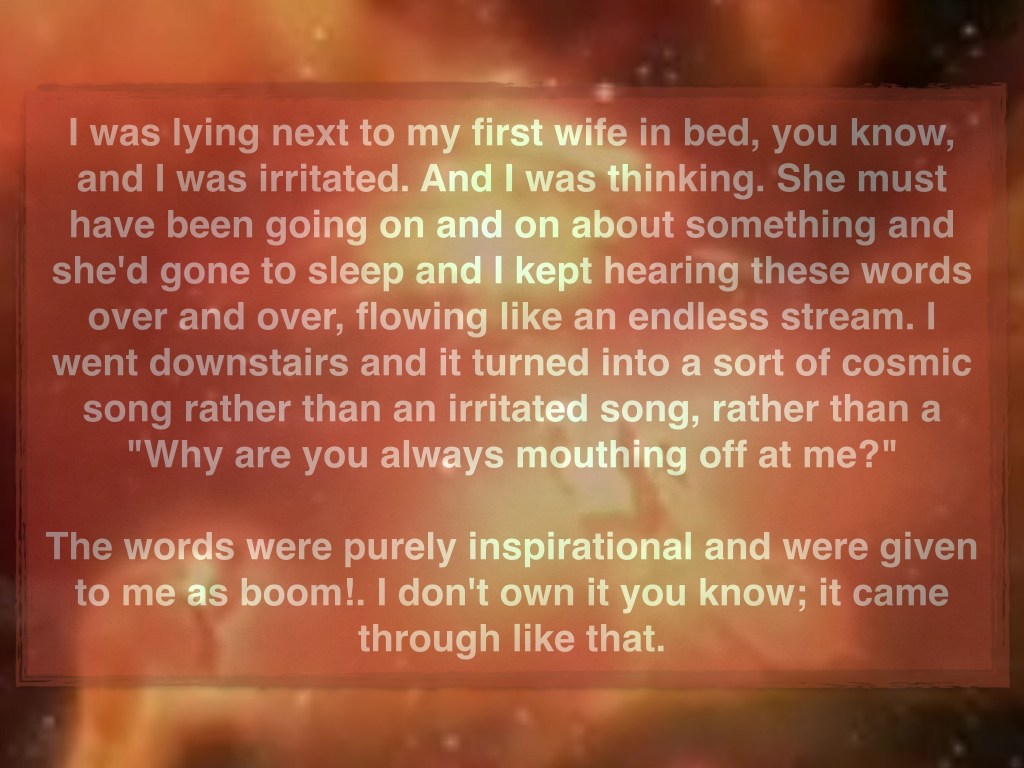
    To the reader: The beautiful lyrics of John Lennon’s ‘Across The Universe’ relate to transcendental expression. The lyrics’ relationship to meaning is through soaring imagery not literal comprehension. The song has been crafted to fly. As an aerodynamic masterpiece the internal arrangements are light with adherence to rules that overcome gravity with blissful ease.

    To the poet: John Lennon’s recollection of writing ‘Across The Universe’ is instructive in understanding the uplifting power of poetry. The song began as a grounded response to being caged; captured and contained. Through a meditative process, it seems the lyrics became cathartic; they transcended his pent-up anger and delivered instead a peaceful state of mind.  Until his next rant, at least…


    Enough of Words Enough of Words
    Picture Source:
    1.

    2. http://en.m.wikipedia.org/wiki/Across_the_Universe#Composition

  • Open Book

    Open Book

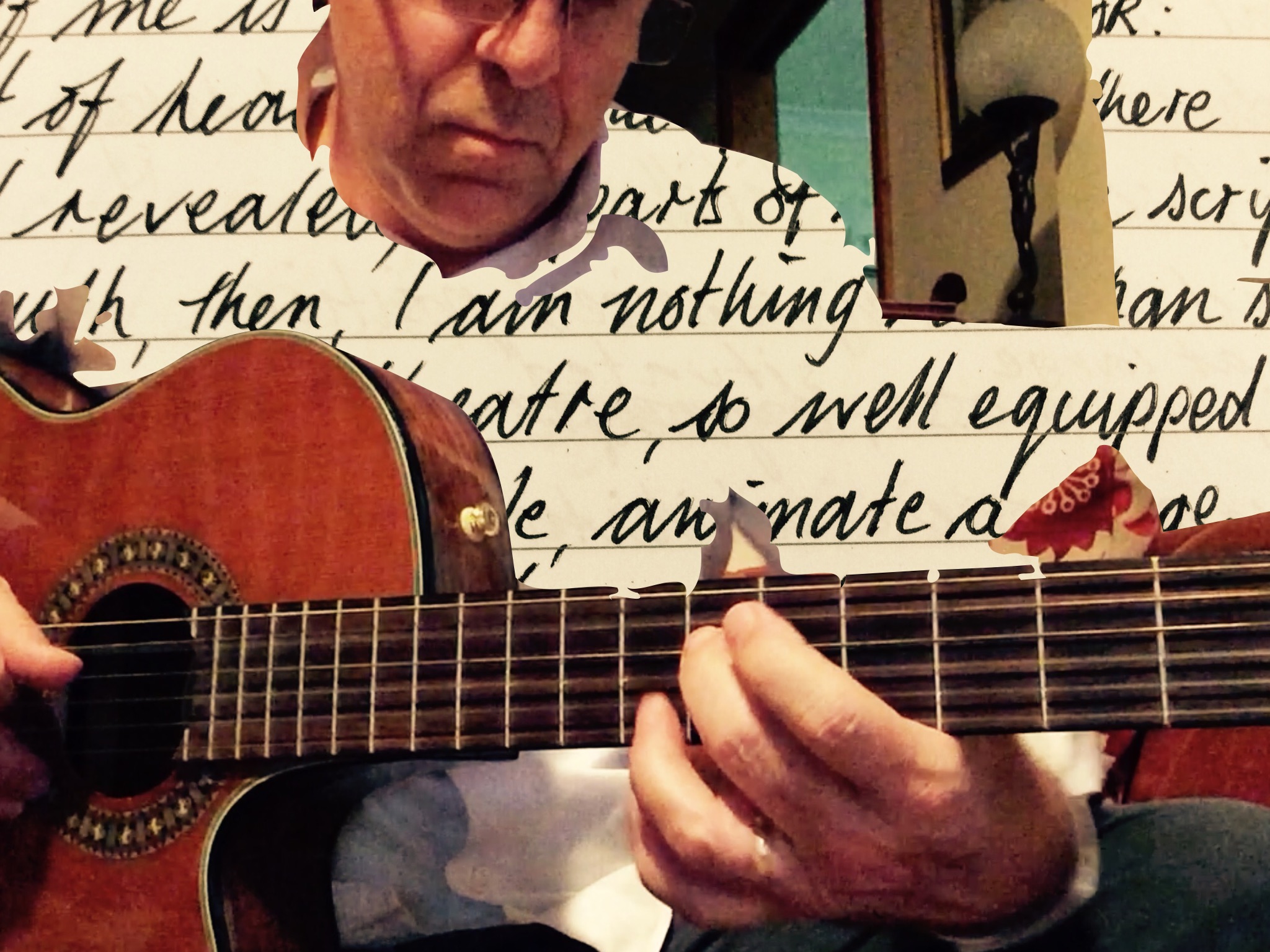
    It’s clear to you, I am an open book;
    an easy read with all my plot laid bear.
    All of me is gesture, betrayed by look:
    a tilt of head, a glance of eye, and there
    am I revealed… all parts of me are script.
    In truth, then, I am nothing more than stage;
    all of me is theatre, so well equipped
    to assume a role, animate a page
    with action, to be read by likes of thee.
    So well trained in delivery of lines
    I believe myself impromptu; falsely,
    to be playwright of my own designs.
    . Every thought is preceded by an act.
    . It’s from gesture that meaning we extract.

    © Tim Grace, 23 March 2013


    To the reader: At the sub-conscious level, we have social receptors that monitor the quality of our relationships. Our senses collect an array of information; this quantum undergoes neural processing before translation into an appropriate response. Our brains filter out what’s unnecessary and appropriate what remains as useful to the circumstance. That filtering process isn’t invisible. There are many cues that provide evidence of subtle subterfuge… to the astute, we are an open book.

    To the poet: The success of this sonnet relies on how well it portrays an impromptu script. The poem’s plot sits (more rightly flits) between two layers of consciousness. The reader (you) is encouraged to scrutinise the writer (me) for signs of ingenuous intention. I am betrayed by give-away gestures that make me nothing more than a scripted actor; a fake, from an open-book masquerade.

    Open Book Open Book

  • Victory Entombed

    Victory Entombed

    Once again, death rejoices a new grave,
    a soiled-over body, a buried soul;
    welcomes The Dead (Le Mort) to Hades’ cave;
    adds a fresh bag of bones to its countless toll.
    The spoils of victory entombed, encased
    in a casket of clay, in wet mud drenched,
    dispirited, disposed of, laid to waste,
    laid to rest in pieces; so long entrenched.
    ‘So Long’ farewelled, given back; dust to dust…
    But listen, through the dirge, the Angels sing.
    ‘Hark’ the Angels sing (as so the Angels must)
    “Where, Oh Death, is your victory, your sting?”
    . Through nothingness Death must surrender all,
    . beyond nothingness – Eternity’s call.

    © Tim Grace, 22 March 2013


    To the reader: He was 94 at death. An Uncle. An only son. An alcoholic… a troubled soul… a widower with children… a mechanic… a reformed alcoholic… a preacher; a man who found redemption. At life’s end, a man who had travelled a long and arduous journey of self-discovery. An adored father… a revered brother… a soul at rest; freed of Death’s sting, for “I am the resurrection and the life. Whoever believes in me, though he die, yet shall he live, and everyone who lives and believes in me shall never die” (John 11: 25-26).

    To the poet: This sonnet is a layered interpretation of one man’s passage through, and beyond, the doors of death towards eternal peace. To begin with, words rattle with visual references, “but listen” (at line 10) calls upon a new register of interpretation: “Hark the Angels sing”. The dismissal of Death as an ending in itself (1 Corinthians 15:55) takes the sting out of life’s terminal destination. At Death we join the countless dead and become at last united with one collective spirit… so the story goes.


    Victory Entombed
    Victory Entombed
    Picture Source: http://youtu.be/EOga0vsuC6Q
  • Those Who Frown

    Those Who Frown

    What to make of those with humourless wit,
    of those who frown, those who grumble and growl;
    of those who bemoan joy; awkwardly sit
    upon a light-hearted jest with a scowl?
    What to make of those who by nature rile
    against the frivolous; heavily mark
    the wistful as trite and in sombre style
    dismiss the chortle as an errant lark?
    What to make of those with dark demeanour,
    those who do nothing but darken the sky,
    casting shadows on polished patina;
    those who take a dim view of all they spy?
    . These are they who chain good-fun to a cage,
    . and for laughter’s sake, will a smirk engage.

    © Tim Grace, 17 March 2013


    To the reader: Some adults unlearn everything they once knew about fun and laughter; they become morose and sullen. No doubt they have good-reason for such stern reproach of light-hearted follies. Chronic absence of a smile response robs these grumpy souls of the happiness surge delivered by endorphins and triggered by something as simple as a genuine smile. The health benefits of smiling are impressive; so too the social impact of this friendly gesture.

    To the poet: We can take the pursuit of happiness too seriously; drain it of fun and become disheartened. Writing a sonnet can suffer the same chain of events. In its original form this sonnet had an unintelligible middle stanza that was lost in its own search for meaning. The ‘editorial rescue’ ripped out the guts and inserted a verse. The final structure of three verses and a chorus brings me no great joy!


    Those Who Frown Those Who Frown
    Picture Source:
    http://undergroundhealthreporter.com/duchenne-smile-benefits/#axzz3YvMx8Okk
  • Amplified Invasion

    Amplified Invasion

    An amplified invasion so disturbs
    the peace; a cavalcade of decibels
    on drill: marching the streets, pounding the kerbs.
    Exploding sound-grenades and mortar shells.
    A wall of sound, invisible to touch,
    yet so capable of prickling the skin.
    Audible ferocity; far too much
    to absorb – loud and deafening din.
    A relentless, raucous calamity;
    no definition, a cacophony;
    no room for nuance, blunt audacity;
    no conduct befitting a symphony.
    . To turn down the volume is sound advice,
    . Those who cannot hear pay a heavy price.

    © Tim Grace, 4 March 2013


    To the reader: Walked past a bar in Bondi… note to self triggers idea for sonnet: “Loud defines itself as big and bold; amplified beyond a normal range of tolerance. And that’s the point – tolerance. Loudness has a relative setting calibrated to a social context. There is no right or wrong volume but there is an appropriate volume. Big and bold is admirable to a point; beyond that point it becomes demanding and intrusive.

    To the poet: Walked past a bar in Bondi… loud noise obliterated social exchange. There’s a pleasure in writing from experience. The non-contrived foundation establishes a convincing script. Chances are an authentic narrative attached to a real reaction will resonate with others. And so it was, that evening in Bondi, I was ambushed by an amplified invasion of noise; grabbed without consent.


    Amplified Invasion
    Amplified Invasion
    Picture Source:
    http://youtu.be/eXJo83oHs4M