Author: sonneteer155

  • Break of Day

    Break of Day

    This new morning plays a still symphony.
    A soft blue haze gives the sun its fresh start.
    ‘Kookaburra sings in the old gum tree’
    Birds of the woodwind harmonise in part.
    Sounds of colour, yellow-tipped greenery.
    A black crow caws, disturbs the wafting lilt.
    ‘Morning has broken’ splits the scenery.
    The shadow of a cat’s meow casts its tilt.
    The full-bloomed sun begins its daily chores.
    Instruments of song re-billed to forage;
    to business; the sound-track of sliding doors,
    ‘Good morning’ and the day’s gone to porridge.
    . The morning’s pleasure is to softly seize;
    . so handled with care and treated with ease.

    © Tim Grace, 5 October 2013


    To the reader: There are ‘good mornings’ … they come with suggestive pleasantry. The suggestive component provides for just a touch of the unexpected; ‘good mornings’ must be interesting affairs. And as for pleasantry, that’s a collective measure of surrounding comforts. Although simple, ‘good mornings’ are also very fragile events; easily damaged by the squawk of overt rudeness; the cat’s claw and the crow’s caw both shaft and cut in one fell-swoop.

    To the poet: The creative zone is bound to time and place. For me, this temporal location is at its best in the couple of golden hours that launch the sun into its full ascent. That lifting can be strenuous if not approached in the right frame of mind; and made all the more difficult if disrupted by an intrusive influence. The frustration of a shattered morning is creatively crippling; truly the break of day!


    Break of Day Break of Day
  • Five Starlings

    Five Starlings

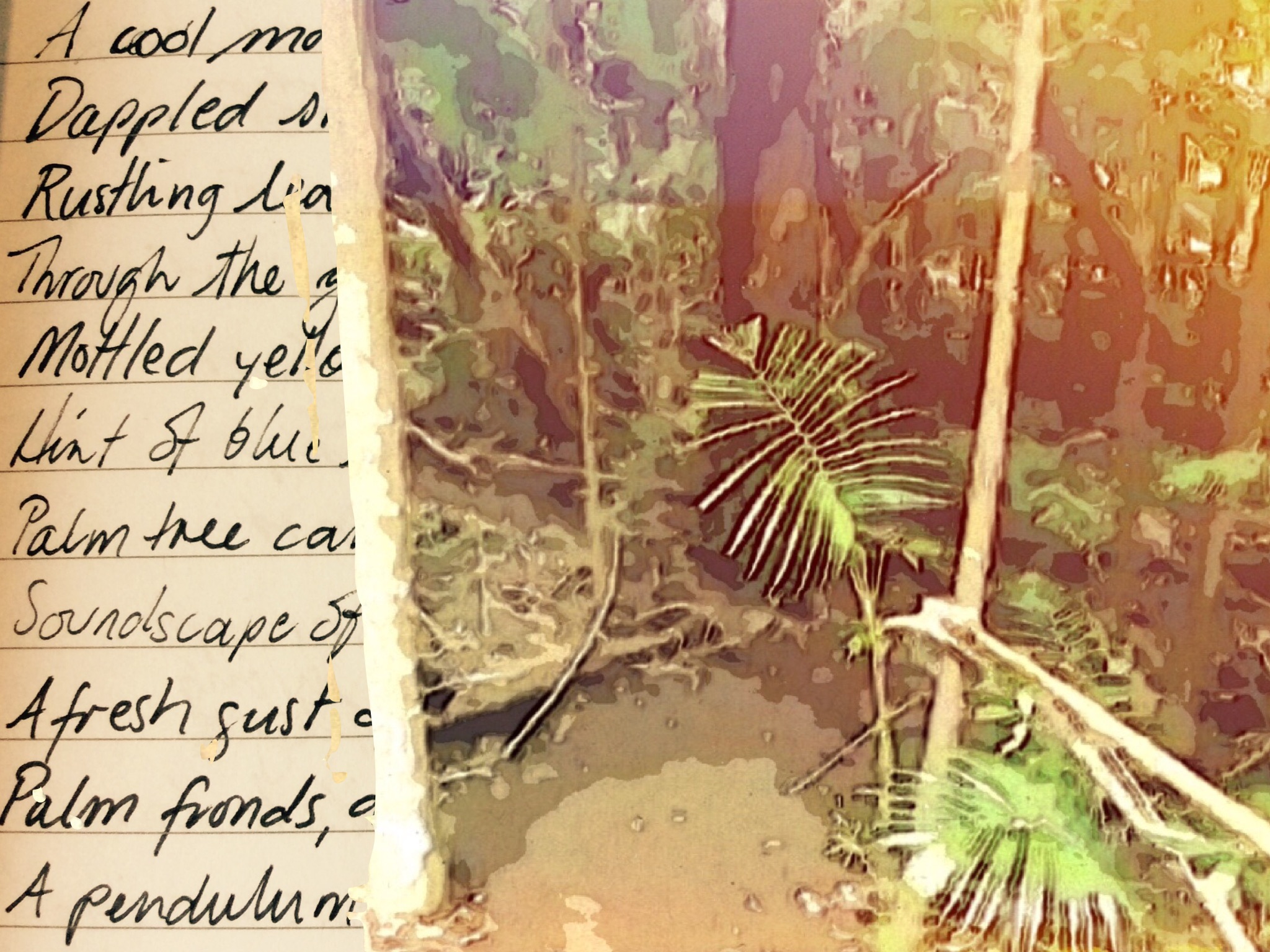
    A cool morning breeze, whispers crisp and sharp.
    Dappled shadows scattered in commotion.
    Rustling leaves give voice to a scratching harp.
    Splash of mauve begins the day’s devotion.
    Mottled yellow, wattled gold, rusted bark.
    The hint of blue horizon, just a glimpse.
    Canopied layers flicker; light and dark.
    A symphony of birds in soundscape scrimps.
    A fresh gust agitates a squawk of wing.
    Palm fronds, dry with age, hang-glide to landing.
    Metronome branches in pendulum swing.
    . Five starlings make an oddly mark in time.
    . Give cause for notice of the sun in climb.

    © Tim Grace, 4 October 2013


    To the reader: A fresh scene triggers interest. And so with heightened sensitivity, the watchful mind becomes alert to novel observations. The play of light and colour, along with the sound of movement interact to become a new definition of time and place. Small characters emerge from the static scene; branches swing and swish; birds flit and flirt; a mauve cloud is tickled by a golden ray of morning light; the sun lifts the curtain on a new day.

    To the poet: If you listen, visual landscapes are also aural soundscapes. Together, sight and sound form the focal points of this situational sonnet. Considered as one layer, the visual element has been receded to bring forward the sounds of nature waking to a new dawn. The first version of this sonnet was simply a list of of fourteen observations, which I later over-dubbed with rhythm and rhyme; to satisfying effect. I like this sonnet.


    Five Starlings
    Five Starlings
    Picture Source:
    http://youtu.be/dcyzz-UKg4I
  • Failing Forward

    Failing Forward

    The young talk in terms of ‘failing forward’.
    They have swallowed an implausible pill.
    ‘Failure’s now an option’ – one they applaud:
    ‘Why fear failure? An innovator’s thrill!’
    Let’s stop, let’s pause, let’s think on this a bit.
    ‘To err is human’ let us grant them that.
    But ‘what’s broke is broke’ there’s no place for it.
    For it has dependencies: tit-for-tat
    consequences, poor measures of success.
    Poor excuses; a paucity of thought.
    Backroom mistakes, it’s those we can bless.
    But failure in practice is no good sport.
    . Discoveries by accident are rare,
    . not to be mistaken for failure’s flare.

    © Tim Grace, 3 October 2013


    To the reader: Playfulness has been appropriated, reduced to a game; and in this gamified world ‘failing forward’ is encouraged as a tactful strategy. This notion of risk-free failure suits a programmed environment where the variables have been given bounds of tolerance. Within set-bounds, the game itself looks after potential disaster; that pretended consequence has been programmatically eliminated. To game is not to play…

    To the poet: To learn from your mistakes was the maxim of my generation. Poetry is an open-ended puzzle, and as a playful pursuit it resists any ‘gamed solution’. A poet that plays ingenuous games with his reader will soon be discovered. There’s an expectation of meeting real-risk head-on; over-coming failure (outside the pretence of a game) with intrepid audacity.


    Failing Forward
    Failing Forward
  • Containment Lines

    Containment Lines

    Containment lines are none the worse for wear.
    Tide has turned and she was not washed to sea.
    Save for watermarks, she’s all in good repair.
    With the swell came contentment’s remedy.
    At tide’s turning the surge has been subdued.
    The rhythmic waves have left her satisfied.
    Diminishing ripples resolve her mood.
    She savours the last splash while things subside.
    There’ll be no rush of outward-tide; no haste.
    Embraced in slow-resolve, just as supposed.
    She awaits her resolution; slow-paced.
    She is reassembled; again composed.
    . As would appear, her pleasures come in waves;
    . for every pleasure spent, so too she saves.

    © Tim Grace, 1 October 20133


    To the reader: Mostly, her interests are absorbed by daily routine. The satisfaction of orderly progression keeps her occupied; and on the whole content. Once in a while, when momentum allows, she stops to pause; to recalibrate her sense of self. She loosens the fabric of her day. The touch of reconnection is slow and satisfying; emptiness is resolved.

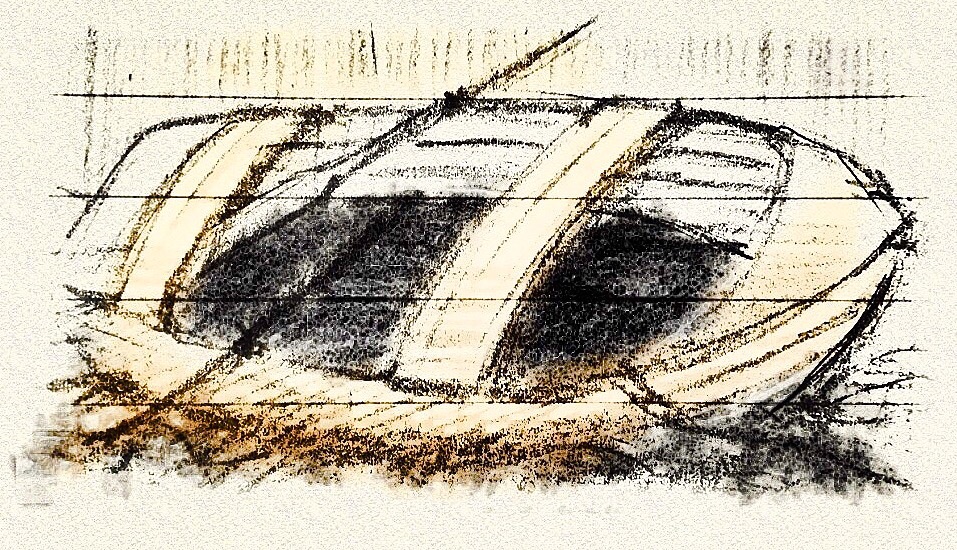
    To the poet: Of two minds, I was watching a small row-boat tugging on its rope by the shore; a ripple of waves repeatedly lapped at its sides. Short of giggling, the nicely-shaped boat did what it could to hold its dignity but every now and again, in shear delight, it shuddered with relief as the rhythm of waves washed away it tension. Art is a beautiful thing.


    Containment Lines
    Containment Lines
  • An Empty Chair

    An Empty Chair

    The objectified ‘that’ – too anonymous
    to hold the interest of a poet’s eye.
    Too without likeness to ever be ‘this’.
    Too void of character to qualify.
    The unsatisfied ‘that’ – ever restless,
    desperate for that substance, that gives it cause
    to be anything more than a congress
    of possibility; clutching at straws.
    That which is nothing in particular,
    in simplistic terms, featureless and vague,
    untitled portraits, coarse and granular,
    nothing in abundance; a poet’s plague.
    . That be a name without a pedigree,
    . all but a claim without veracity.

    © Tim Grace, 26 September 2013


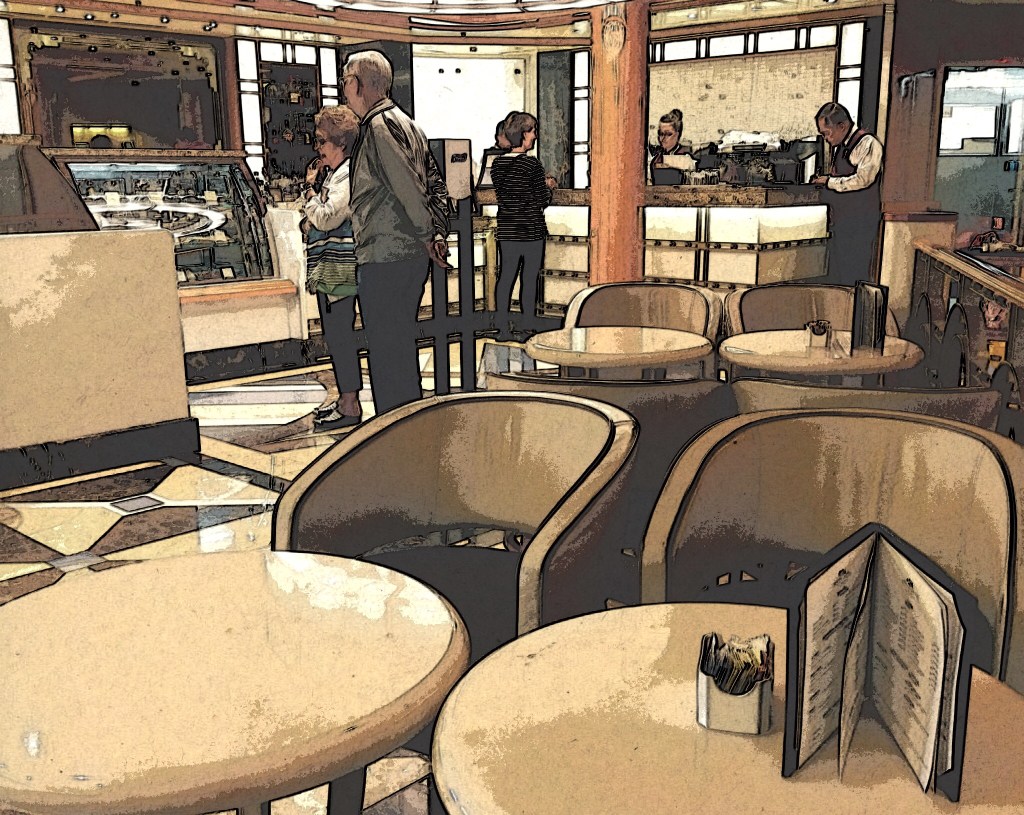
    To the reader: An empty chair. Of itself, nothing more than a well-formed piece of furniture… an object in wait. On occasions it finds its functional fit and serves good purpose as a propositional place holder; a prop. For the most part, though, it signifies posterior potential and the possibility of congress; an invitational artefact… all but a claim without veracity.

    To the poet: That which is featureless lacks identity, it’s dull and anonymous; bland. To some extent a perfect backdrop from which a point of incidental interest can draw attention to itself. As an early morning poet, I often begin my day casting about for such characters of distinction. Often as not, they remain elusive and I’m left to make do with what lies before me … objects, too anonymous to hold the interest of a poet’s eye.


    An Empty Chair An Empty Chair
  • Loosely Applied

    Loosely Applied

    Concrete construction, designer’s despair:
    over-tended landscape, sharp and severe,
    too much exactness, preempted repair;
    nothing left to chance, exhausted idea.
    Made to resemble somewhere else but here:
    rectangled, circled, and ratio-ed square,
    hint of something made transparently clear,
    a misguided homage belongs elsewhere:
    ‘belongs’ – a possessive that’s made to adhere…
    ‘constrained’ – a caught-yard of rarified air…
    ‘suffocated’ – short of depth, too austere…
    ‘made to measure’ – overly shaped with care…
    . The golden rule, best considered a guide;
    . a general frame that’s loosely applied.

    © Tim Grace, 25 August 2013

    To the reader: Great garden designs have an inner quality, a core-strength, an integral thread of inspiration that leaves no doubt about intention. Design has to be a deliberate response to a problem; but more importantly, an authentic and appropriate remedy. The application of a fixed design solution (as in the golden ratio) provides some scaffolded security but overly applied strips away the virtue of design’s natural curiosity; design is an applied art – then a science of sorts.

    To the poet: A poet can fail his own test. As a sonnet written about the over-applied rule, this one goes near to proving the point. A truly responsive design will be so responsive to its context that a distinction of cause and effect will be hard to determine. The environmental need and its fix become one-and-the-same. Nature is the best of all ‘fixers’ it’s also the best of all ‘mimics’ – naturally!

    Loosely Applied
    Loosely Applied
    Picture Source:
    http://youtu.be/aRvzapleXJ4