Tag: writing

  • He Left

    He Left

    He came, he went, he left her with the baby.
    Then (as though hardly-done) he moped his lot.
    The burden of self-pity said: “save me,
    I am lost – stripped of cause and future plot”.
    And what of the mother with child in arms?
    In receipt of half the chattels, just things
    stuffed in a bag: no niceties, no charms.
    A bag full of feathers, nothing like wings.
    Who knows what the child was thinking. He smiled
    from beneath an Easter bonnet; no blame,
    no shame; a child’s forgiveness reconciled
    to bear the burden of his parents’ frame.
    . Children – forgive them for they do not know;
    . forsaken of the gifts that you bestow.

    © Tim Grace, 21 April 2012


    To the reader: It had obviously been a long day of angry disputation. This was the moment of uncoupling. A dreadful determination to unpack the family. She had taken their child to a family restaurant and was awaiting the father’s arrival. He arrived with a plastic bag of bare essentials. With remnants exchanged, the child (from beneath an Easter Bonnet) glanced between the two… later … the father sat alone; weeping in a pool of self-pity.

    To the poet: The second of two sonnets that reference arrival and departure. “He came, he went” with no conclusion. His legacies include an onerous gift in wrappings of self-pity. And so it is we often feel confused and bereft… the victims of choice. The April message of Father and Son was an influence on both sonnets. But neither makes extended reference to Easter; just enough to draw upon its key themes of forsaken and forgiven love.


    He Left He Left
    Picture Source:
    http://youtu.be/5sOqy_A01Kw


  • Free Will

    Free Will

    He came, he went, left me none the wiser.
    More or less, it seems, this was his intent.
    I am, through him, left the improviser.
    It’s mine: mine to wonder, mine to invent,
    mine to discover; with free-will to dream.
    I am, myself, an independent soul.
    And so it was. He left me here to redeem
    from his departure – that gift – a morsel
    of truth so simple, so perfect, so brief;
    and yet so difficult to comprehend.
    I am free to doubt and state disbelief:
    to question his way to my journey’s end.
    . This then is the gift of my father’s breath,
    . I need no longer fear the time of death.

    © Tim Grace, 8 April 2012
    (Revised: 20 August 2023)


    To the reader: The perfect gift is free-will. What a clever deception. It’s like a kite; useless without string. Hand a child a beautiful kite and after days of frustration he or she will soon ask for the attachment. Upon receiving the greatest gift of all we are burdened with responsibility; we are chained to free-will’s insatiable curiosity; indebted to its reciprocal loop of expectation. The moral burden of free-will is unforgiving; ultimately, I must account for my transgressions … for the choice was mine.

    To the poet: A bundle of tangled thoughts about parenting and the delegation of authority through moral expectation. Religious overtones abound… capitalise the ‘H’ in ‘he’ and you have a sermon; without, it’s a son’s contemplation of his father’s developmental influences: distantly demanding, vaguely judgemental and omnipotently present… your choice; but have you thought about the consequences and can you afford the cost? They are yours alone to bear.


    free will Free Will
    Picture Source:
    http://youtu.be/jOXyvo2ID_o


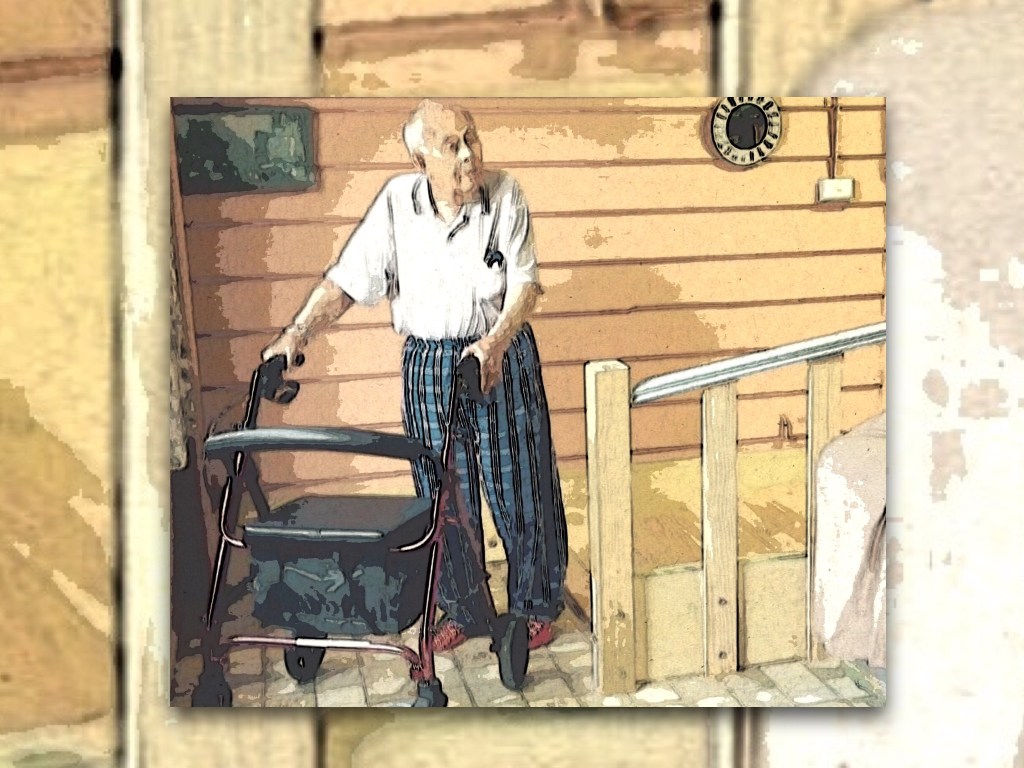
  • Strides Into Steps

    Strides Into Steps

    Once upon a time I presume he danced,
    for there was rhythm in his shuffling gait.
    I suppose there was a time when he chanced
    to skip the pavement, to jump the fence, skate
    upon thin ice; I presume this was so.
    I suppose that once upon a time he
    could run like the wind and swivel on snow.
    May be once, this was how he used to be?
    How he used to be, before age took hold
    and shortened his strides into steps; weathered
    then withered his reach; proceeded to fold
    him into segments… with all parts severed.
    . In this man there are vestiges of truth.
    . Hidden in his shuffle is this man’s youth.

    © Tim Grace, 1 April 2012


    To the reader: The shuffle of elderly folk is rooted in the tentative first steps of childhood. Without momentum the ageing-frame hasn’t the balance to sustain a full-stride between steps; it’s lost the confidence to fall forward. In our prime the ability to walk is translated into the rhythm of life; through dance we skip; through sport we skate; as through time we scurry. Without stretch, and  pace to match, we compensate … we walk with two feet not one, we shuffle.

    To the poet: The strong structure of this sonnet descends into an awkward shuffle. It begins with stride and then falters. Beyond the first stanza, short-repeats struggle to complete a full line. Temporary anchors are scattered throughout. Stop-start phrases need backward attention. Through heavy compensation the sonnet’s rhythm is lost. In poetry, physical structure is as much a tool as any other literary technique; a poem is built as much as it is written.


    steps into strides steps into strides


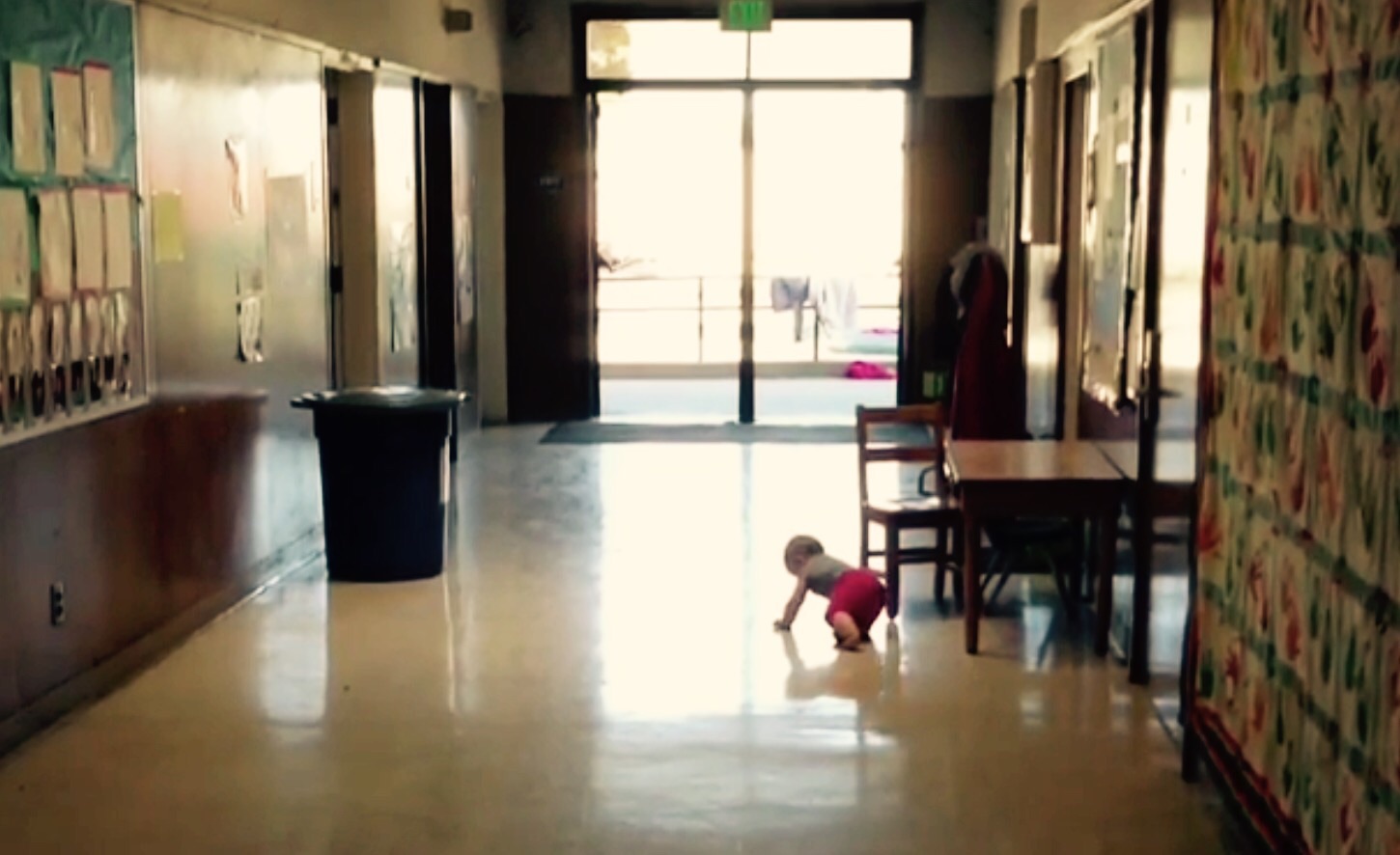
  • Space to Crawl

    Space to Crawl

    Yesterday, I watched a boy crawling
    commando-style across a carpet-rug.
    Giggling and chortling, rising and falling,
    pushing and pulling with a hauling tug.
    In jungle-greens he scampered, head down low.
    He moved in spits and spurts. He paused a while.
    He reset direction, then off he’d go.
    With syncopated skim and cherub’s smile;
    through a forest of legs, he spied a light:
    a destination worthy of pursuit.
    But, when almost there, with his goal in sight,
    down came the arms of love: “Aren’t you cute!”
    . His mission is to walk, stand proud and tall;
    . give the boy some freedom, some space to crawl.

    © Tim Grace, 31 January 2012


    To the reader: The school-day is all but done. Here comes a troop of toddlers and their yet-to-walk entourage in pushers and prams. They are the freedom fighters, come to release their brothers and sisters from the tyranny of school. One in particular catches my eye; he’s a rug-rat, escaped surveillance and making good ground … but like so many before him, his noble pursuit is thwarted; he is lifted to higher ground by the doting arms of mum… another man down, or up as the case may be.

    To the poet: A photograph might have captured the scene more faithfully; but not the story. The story is in the poem which is a figment of my imagination. No-one else, on the day, had any idea of my interpretation. In a fleeting moment I captured a metaphor… two thoughts combined; and so began my sonnet. Metaphors, like butterflies, are at their best in flight; pressed to the page they may lose their colour.


    Space to Crawl Space to Crawl
    Picture Source:
    http://youtu.be/XGbfqM0ToM8


  • Angling

    Angling

    All I did was drop a line, nothing more
    than simply give you cause to contemplate.
    It was not my chin that dropped, not my jaw
    that took umbrage; not me who bit the bait.
    You could have let it go, let it dangle.
    Instead, you gave it a tug, you tested
    the line; turned what was slack into tangle.
    It was you who floundered, then protested.
    Nonetheless, you did nothing to resist
    it’s ascorbic tang; and so, there you hang,
    dangling from a string of words, a long list
    of ponderings that promulgated pang.
    . What lures fish from the safety of rocks?
    . It’s the slightly plausible paradox.

    © Tim Grace, 21 January 2012


    To the reader: It doesn’t take much to create a fuss over a line of words. Retracting that string of thought is difficult; it gets snagged so easily. On a good day a contentious thought might be openly aired; on a bad day it becomes a most enticing deep-water bait. As it sinks a small school of fish nibbles its edges; but then, along comes a shark with far bigger intentions. Discretion being the better part of valour decrees the warranted loss of hook, line and sinker… one should never angle for a fight.

    To the poet: This sonnet did follow an argument over the previous sonnet regarding silos. Why two people would choose to angrily debate the virtues of a silo I don’t know. Nonetheless, it spawned a good piece of purgative poetry. The poem has some satisfying sub-elements that I enjoyed merging into its deeper layers of construction; for later in depth analysis.


    angling Angling
    Picture Source: http://youtu.be/rG1xOUIykhY


  • Grain of Truth

    Grain of Truth

    There’s not a grain of truth in what they’ve claimed.
    They have cultivated a nonsense, so
    much so, the silo has been besmirched, defamed.
    It’s been compared to a Balkan State, no
    more so will I let this grievance pass
    untested, unquestioned; taken as read.
    What they have reasoned is simply a farce;
    a mischievous lie, it has to be said:
    The silo is nothing like a locked vault;
    has nothing to do with isolation.
    Through misinterpretation comes this fault:
    silos are hubs in communication.
    . Break not the silo, more strengthen its link.
    . It is through the silo that systems think.

    © Tim Grace, 18 January 2012


    To the reader: The history of grain-silos is interesting. They date back to storage pits in Greece around the 8th Century BC. In a modern sense, they took their vertical stance in the 1800s; significantly, attached to a transport system. Understood as critical components of flow in an agricultural system, their virtual counterparts are much maligned in dysfunctional bureaucracies. An office that stores but does not distribute its information is mistakenly labelled a silo; it does nothing to deserve that label.

    To the poet: Mounting a comprehensive argument in fourteen lines is problematic. Without much room for justification the point can be interpreted as a poke. Diatribes tend to be like that; one way polemics. In some ways a static container disconnected from further adaptation – a Balkan State! As much as you might disagree with my defence of the silo; there’s little likelihood of me responding to your rational alternative. You could, of course, leave a comment…


    grain of truth grain of truth