Tag: sonnet

  • Invisible Thread

    Invisible Thread

    As attached to an invisible thread,
    We are bound to all humanity,
    Through this communion we are wed,
    To a common sense of sanity.
    When round about our strings combine,
    Care should be enlisted,
    For as with any rope or twine,
    Our threads are easily twisted.
    The unravelling reel, the looping lash,
    Beware the rope that’s rotted,
    The curling cord, the whirling sash,
    Are never far from knotted.
    . This string is neither noose nor tether,
    . It’s the thing that holds us all together.

    © Tim Grace, 14 January 2011


    To the reader: Our bond to others is invisible; thread-like. We imagine threads as social ‘ties’. Family ties are life-long; others are short-lived and useful for just a moment of interaction. Regardless of strength and character the invisible threads can tangle to a mighty mess. Attending to the health of our invisible threads is important. Frayed and worn-out threads lose their flexibility and stretch; become difficult to manage, and are far from dependable. In rope we trust.

    To the poet: The neatness of each four-lined verse helps to ‘tie’ this sonnet together; it’s well packaged, well bundled… well versed. In a later sonnet, the invisible thread is again used as the main reference-point. As an invisible subject, a thread has endless possibility for metaphorical word-play. Whether rope string or cord; it ravels, loops and twists obligingly around your topic of choice. Money for rope.


    invisible thread invisible thread
     

  • All Too Difficult

    All Too Difficult

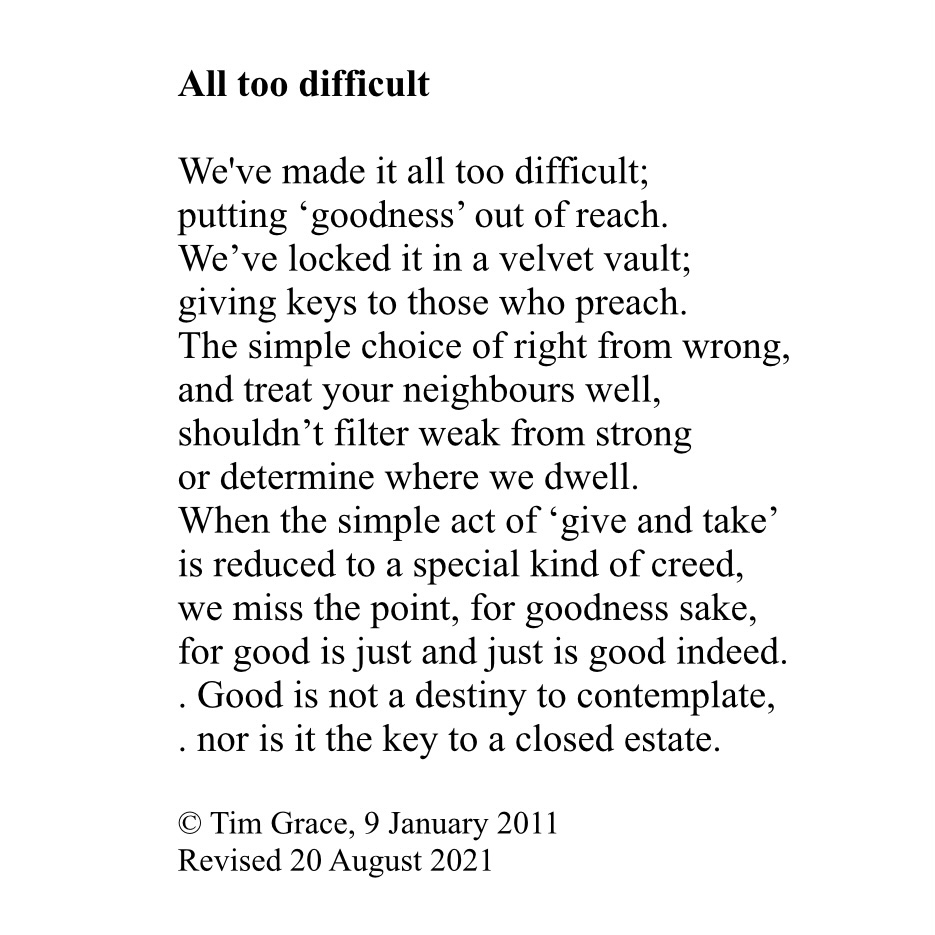
    We’ve made it all too difficult,
    … what’s good is out of reach.
    Where’s the truth, where’s the fault?
    It’s there … with those that preach.
    The simple act of give and take,
    Be kind to those who bleed,
    All of this, for goodness sake,
    A sermon does not need!
    The simple choice of right from wrong,
    And treat your neighbours well,
    Shouldn’t lead to ‘I belong’
    So protected ‘I’ can dwell.
    . Good is not a destiny, to contemplate,
    . Nor is it a key, to a closed estate..

    © Tim Grace, 9 January 2011


    To the reader: The quality of ‘goodness’ has been branded. Much like any commodity it’s been thrown to the markets. On the basis of supply and demand ‘goodness’ fluctuates in value. When poorly packaged ‘goodness’ loses its edge in the market place and recedes to a back-shelf option. In limited supply ‘goodness’ is only available through selected outlets; who for their own gain distort its features and in so doing marginalise its agency; compromise its potency… for goodness sake!

    To the poet: The first stanza establishes the problem; the second and third do their best to respond. But in the end, it’s the final couplet that dutifully fulfils its role in offering a succinct and convincing summary. Exposition and argument need a logical sequence of propositions to be worthy of pen and ink on page. A good poem, like a good sermon, needs to be plausible not dogmatic; open to all.


    all too difficult all too difficult


  • Remnants

    Remnants

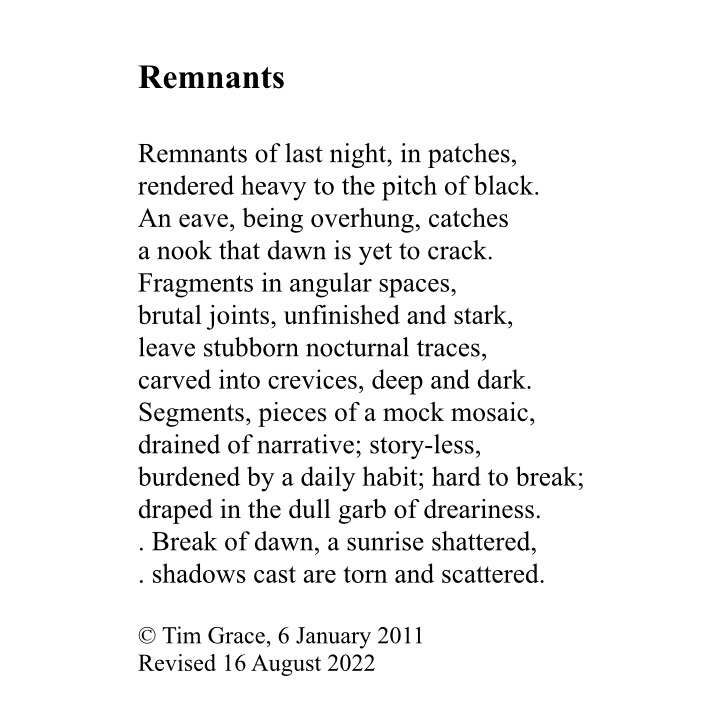
    Remnants of last night, in patches,
    Rendered heavy to the pitch of black.
    An eave, being overhung, catches
    A nook that dawn is yet to crack.
    Fragments in angular spaces,
    Brutal joints, unfinished and stark,
    Stubborn nocturnal traces,
    Carved into crevices, deep and dark.
    Segments, pieces of a mute mosaic,
    Drained of narrative; story-less,
    Burdened by a daily habit; hard to break,
    Draped in the dull garb of dreariness.
    . Through a broken dawn, comes a sunrise shattered.
    . Shadows born, then torn and scattered.

    © Tim Grace, 6 January 2011


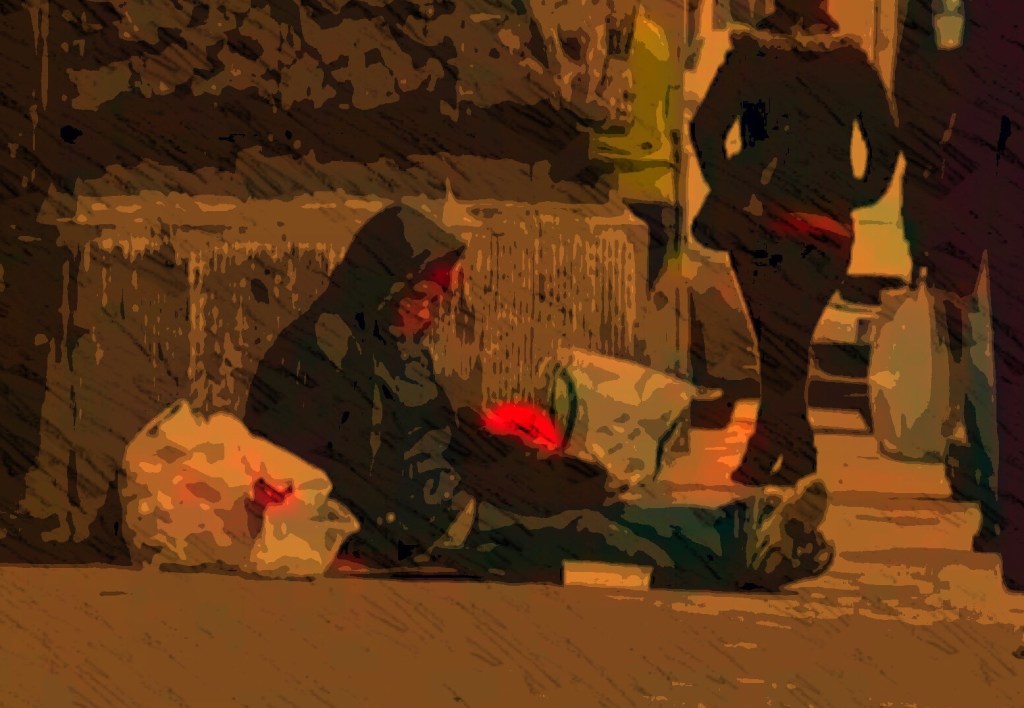
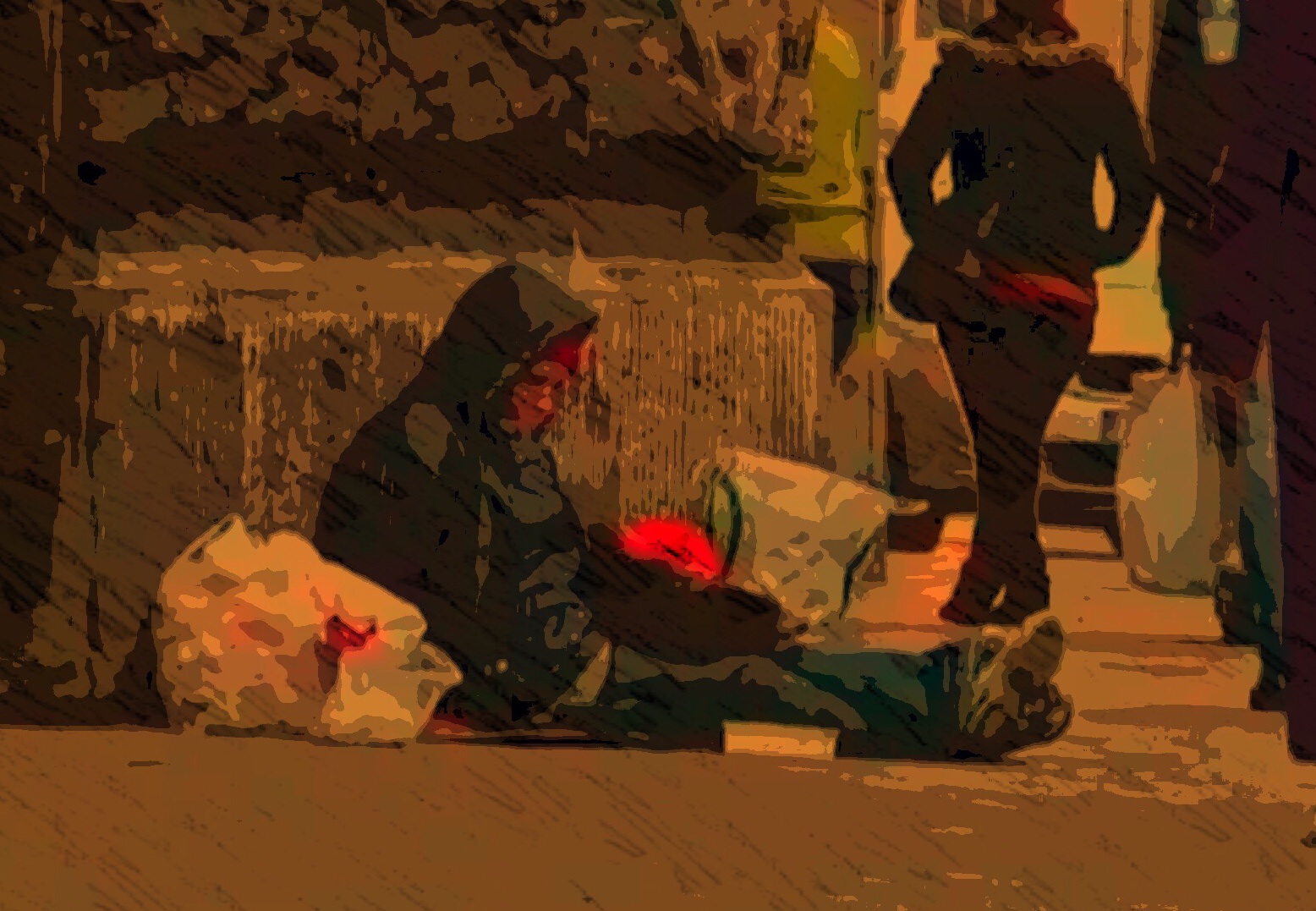
    To the reader: With dawn comes the realisation of what remains of last night; the shroud of darkness has been lifted. The homeless, cramped in corners and nestled in nooks, are slow to rise. Around them the city stirs into action. Sunlight nudges its way into cavities. And so breaks the day. The heaviness of night grips the vagrant who with reluctance shadows another day … awaiting a new night to fall.

    To the poet: This poem holds strong to its form of three distinct stanzas; blocked out as remnants, fragments, and segments of a shared theme. The continuous lines of verse ignore those breaks and seamlessly roll into a single thread of thought. It’s also a poem that plays confidently with the literary features of alliteration, assonance and consonance. While inspired by a short visual moment, I remember this poem took considerable working; days.


    remnants remnants


  • Becomes Today

    Becomes Today

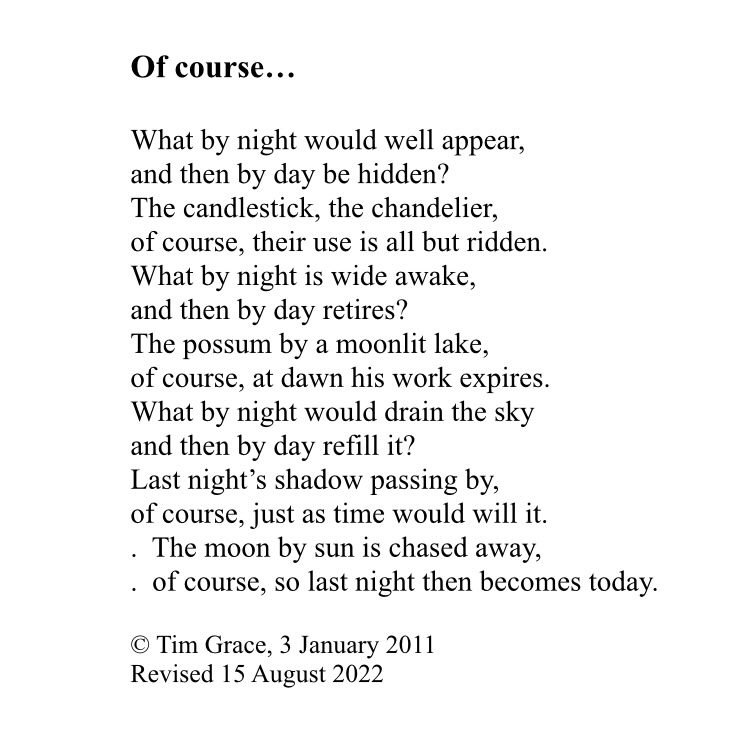
    What by night would seem adept,
    And then, by day become a blur?
    Last night’s shadows, over slept,
    Reluctantly they stir.
    What by night would well appear,
    And by day be all but hidden?
    The candlestick, the chandelier,
    Of use the two are ridden.
    What by night is wide awake,
    And then by day retires?
    The possum by a moonlit lake,
    With sun its scene expires.
    . The moon by sun is chased away,
    . And so last night becomes today.

    © Tim Grace, 3 January 2011


    To the reader: We live in a riddle; a reasonable muddle. A right answer is often so lame with correctness it needs a little adjustment. Some creative correction is what makes good things better; and better things great. From bland to grand takes an obscure course. At arrival, having passed through the riddle, a good answer is adorned with the crazy sparkle of unexpected discovery… aha!

    To the poet: The familiar form of the riddle, with its question/answer format, frames this sonnet. The phrase “What by night?” established the seek and find enquiry. Two problems followed. Firstly, contrivance. The thought of ‘what happened over-night while I was sleeping?’ is easily outstretched; laboured to a tedious length. Secondly, miscellany. There’s little achievement in reaching into a grab-bag of ideas. Lucky-dips may write lists but not poems. What rescued this sonnet is its final couplet… an answer worthy of the question.


    becomes today becomes today


  • Smooth the Edge

    Smooth the Edge

    The edge, roughly cut and jagged;
    torn apart and broken;
    crudely split and ragged:
    ‘a scratch’ if plainly spoken.
    The rim, rounded-off and even;
    comfortable to grip;
    shaped to give good reason
    to the curvature of lip.
    On the edge, where fibres fray,
    the straight grain is splintered.
    On the rim, where fingers play,
    the subtle move is hinted.
    . Smooth the edge to a bevelled rim;
    . and be content with its levelled brim.

    © Tim Grace, 31 December 2010


    To the reader: The tactile sense, haptic in nature, is pleasured by the touch of a smooth and rounded edge. The sculptor, the chef, the luthier and the lover all recognise the appeal of a softly chamfered edge. A deliberately honed finish invites the caress of a curious finger-tip. The delicate rim of a china cup whets the lip. The family of stringed instruments nestle into the human form; they are eager to be strummed or stroked by a skilled and attentive hand.

    To the poet: The reading of a sonnet is a tricky thing. The performance of a sonnet exposes the inner tension between literal meaning and lyrical reading. Obviously, the poem’s metre is critical to simplifying the reader’s task, but too strong a metre runs the risk of delivering a ditty. An oddly placed pause, a quirky phrase are complicated but necessary if a poem is going to attract sophisticated interest. Sonnets are not written for the speed reader; not to be scanned or read once.


    smooth the rim smooth the rim


  • All but done

    All but done

    In the end, when all is finished,
    And the task is all but done,
    When the burden is diminished,
    To what it was before begun.
    It’s then that we can savour,
    The taste of sweet success,
    Let linger long the flavour,
    And with confidence impress,
    Be not bothered by the critic,
    With his crooked rule of thumb,
    Be not worried by the cynic.
    With his surface level scum.
    . In the end, the real end, all things being equal,
    . What’s done is done … so deliver not the sequel.

    © Tim Grace, 27 December 2010


    To the reader: We begin, often with an end in mind. At end, we arrive at a moment of completeness. Completeness delivers finality and/or conclusion; possibly both. Conclusive moments ought to be rich with satisfaction and deserving of hiatus; time for a break. A self-satisfied pause should offer some protection from those who would wish to offer judgement… the artist steps back from the canvas.

    To the poet: No doubt there was a particular incident that created my need to express frustration with an ending too abruptly injected with criticism. Get used to that. Responses to art are pretty quick to condense and find expression; the first impression says it all. The trick, I find, is don’t declare the ending too soon. Prepare the finish carefully.


    all but done all but done