Tag: shakespeare

  • Twelve Questions

    Twelve Questions

    What about the drawing of distinctions?
    Should they be blurred to favour tolerance?
    Is the line concise on contradictions?
    What advice does logic bring to difference?
    How are we to judge without conclusion?
    How so is ‘that from this’ to be defined?
    Is ‘to know’ a hoax, a grand delusion?
    Are all things to be boldly underlined?
    What of two-minds that claim a single-thought?
    What of the question that has no answer?
    What’s nothing but the invention of naught?
    What’s more static than a statued dancer?
    . It’s not the answer that in truth divides,
    . More so the question that in doubt resides.

    © Tim Grace, 3 October 2012


    To the reader: The tolerant society is a highly abstracted notion. Those who thrive in liberal communities put aside rigid structures and tolerate difference. In this relaxed and generous environment customs and codes of practice can be questioned and answers refined; ethics evolve. Social contracts are loose and forgiving with cultures flourishing side-by-side. In this social order we prefer the question (process) resist the answer (product) as we crave the experience… all lines are blurred.

    To the poet: Earlier, I broke Shakespeare’s sixty-sixth sonnet into a series of twelve sonnets; expanding on his list of grumpy grievances. Likewise, in this sonnet (of mine) I lay down the foundation for a longer exploration of ‘difference and distinction’; again, in twelve parts. The project took a couple of months to complete with other themes and interests put on hold… to what end, I’ll let you judge.


    Twelve Questions Twelve Questions
     

  • Under the Sonnet

    Under the Sonnet

    With its ten gangly legs, and five long feet,
    it hobbles the cobbles – a diddle-dee-dum:
    pedals the rhythm of a Roman street;
    travels to Britain – a fiddling strum;
    espouses rules but allows them broken;
    copes with rejection and hopes of the heart;
    in moments of need it’s quite outspoken;
    a smitten attachment to Cupid’s dart.
    Many a muse has become its focus:
    blushed at the poet’s devotional praise:
    In love sings the rose; in Spring sings the crocus.
    In time comes a couplet, as sentence or phrase.
    . Lovers of the word think more upon it,
    . through chapter and verse … none beats the sonnet.

    © Tim Grace, 11 July 2012


    To the reader: A routine day needs a dose of character; an element of surprise; a sprinkling of unexpected pleasure and discovery. Zeus, in union with Mnemosyne, fathered nine amusements. With breadth and reach his daughters (the Muses) tantalised his curiosities. As sources of inspiration, their “hearts are set upon song and their spirit free from care”. Through the Muses we discover the beauty of art, the wisdom of science and the splendour of life.

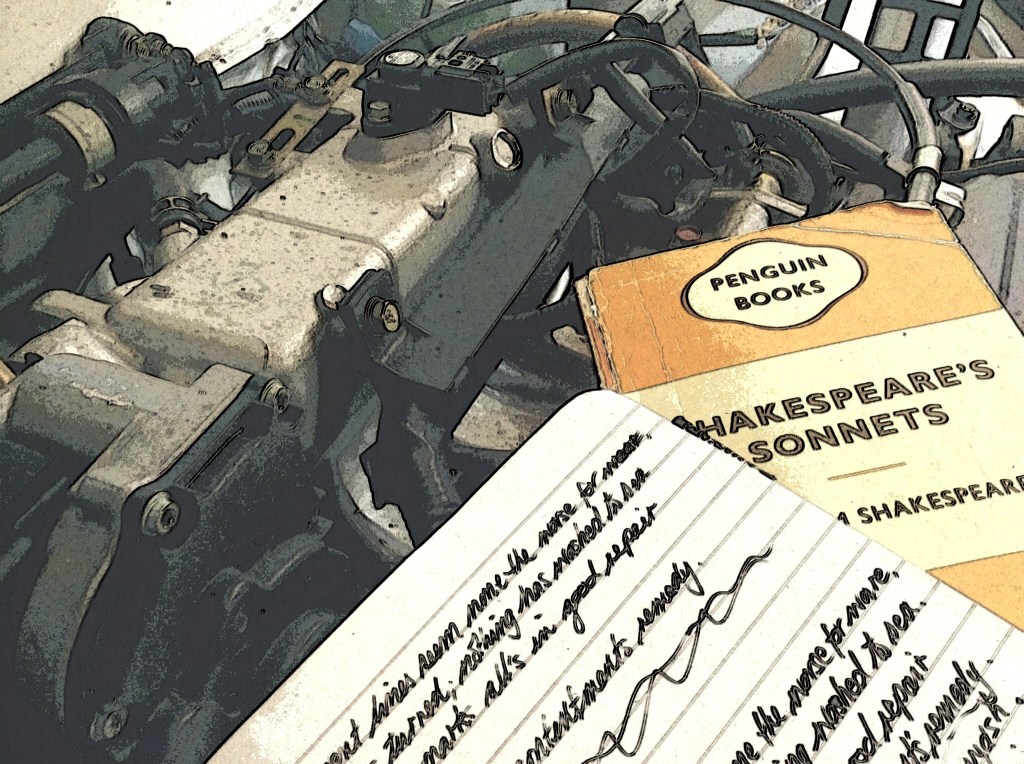
    To the poet: Once in a while a poet needs to take stock. Sonnets (under bonnets) need a service; a check of mechanical and electrical systems; to synchronise pistons and calibrate sparks. In the process, it doesn’t hurt to check that lubricants are clean and viscous; mediating flow and modifying friction. Fuel lines and coolants need attention to ensure isolated function. With tolerance, the system allows for wonderful variation… the sonneteer’s journey continues.


    Diddle-Dee-Dum Diddle-Dee-Dum


  • Friends – not lovers

    Friends – not lovers

    Friends, not lovers, protect us from ourselves.
    They can hold us steady, disentangle
    emotional strings, retrieve he who delves
    too deep; ungrip the hand that would strangle
    from life all good reason to continue
    the good fight (for a good cause warranted).
    Such is the good friend, with every sinew,
    a good connection, a well-cemented
    source of truth; a solid anchor of sorts,
    a fixed point of reference, not to be moved
    by whim or fancy (such as love contorts);
    so admired, esteemed, and much approved.
    . Such is the friend who through life endures,
    . promises nothing …. simply reassures.

    © Tim Grace, 23 June 2012


    To the reader: Love, besotted love, is emotionally vulnerable. Through devotion, tender love is unable to detach itself from heartfelt entanglements. The bond of friendship, however, has commitment without the surrender of proximity. Through distance a friend maintains objectivity; sometimes critical in the heat of emotional turmoil. The lover will tend to move towards the fire; the friend one-step back. A lover will sacrifice; a friend will rescue.

    To the poet: The continuity of rhythm and meter delivers flow; but, the principles of design apply to poetry … too much of a good thing detracts from character and diminishes interest. The deliberate disturbance of flow is part of a writer’s craft. Displacement is an effective ploy in attracting attention; but overplayed the strategy loses impact – predictability is the pitfall.


    Friends - not lovers
    Friends – not lovers
    Picture Source:
    http://youtu.be/SuUrG4Y29do
  • Like-For-Like

    Like-For-Like

    What of mimicry that honours the past?
    It’s somewhat amazing that like-for-like
    replacements have the talents to recast
    an event – so true, a match would strike!
    True, as in truth; so believably real.
    Real, as in genuine; a copy good.
    Good, as in that with the best to reveal.
    All things being equal it’s understood
    we appreciate a ‘genuine fake’
    as long as it’s ‘true, real, and good’ in shape.
    We value the effort that it must take
    to resemble, mimic, copy and ape.
    . True, real and good – the marks of excellence,
    . altogether bound – without pretence.

    © Tim Grace, 10 June 2012


    To the reader: Of love, Shakespeare unpacked its elements as fair, kind and true. Time and time again he returns to this theme. There’s a sense he’s not fully satisfied with previous attempts; and so, has another go at getting it right. Sometimes the approach is quite subtle, on other occasions he’s openly deliberate in assemblage. Sonnet 105, is a prime example; one in which poetry is out-played by structural mechanics… it’s as much a riddle as it is a rhyme.

    To the poet: Imitation is the sincerest form of flattery (according to Charles Colton). On that basis, I had a go at describing ‘excellence’ with its elements being true, real and good. The first task is to establish purpose and, then as Shakespeare did, sequentially assemble its elements into a plausible list of contributing factors. From purposeful to plausible is two-thirds finished; the final third requires polish… it’s as much a puzzle as it is a poem.


    like-for-like like-for-like
    Picture Source:
    http://cp91279.biography.com/1000509261001/1000509261001_2013980530001_William-Shakespeare-The-Life-of-the-Bard.jpg


  • One More

    One More

    One more than many. One amongst the crowd.
    Of all amassed, of all assembled,
    you are the one of all who’s most endowed
    with the touch of difference; unresembled:
    uncopied, unmatched, unequalled; unique.
    You are the diamond in a crown of jewels.
    You are the highest mount; a lover’s peak.
    You are the exception that breaks all rules.
    You are the singular presence, where dwells
    perfection, where at one point all things meet.
    Within you perfect love is made, where swells
    affection; through your oneness all things complete.
    . At one with love you have tamed love’s thunder,
    . you have brought to heel cupid’s brand of wonder.

    © Tim Grace, 10 February 2012


    To the reader: Being the chosen one is flattering. It’s nice to be given attention; to be drawn out of the crowd as something special. But quite a perverse honour if you’re an admirer’s anonymous obsession. More so, if you are the one that through compare is beyond compare. Do you actually exist, or are you an imagined tool that consummates desire? Is the relationship unrequited? No matter, the infatuation delivers a brand of private climax. (WS – Sonnet 154)

    To the poet: Depending on emphasis, the meaning of “one more lovely” is quite different to “one more lover”. And there’s the invitation to play with words. In both senses the expressions are literal but have a figurative overlay that creates room for interpretation. So “one more – than many” can be a numerical statement offering infinite potential. Or, “one – more than many” can be a flattering statement offering distinction beyond the norm. Both interpretations are at one with my “one more” intent … (TG – Sonnet 155)


    image

  • Beyond Finished

    Beyond Finished

    To say that all is finished, all is spent,
    means nothing in the greater scheme of things.
    For in that scheme there is but one intent:
    “waste nothing” – as from compost new life springs.
    What of that old house that the ground recalls?
    What of that empire in its fallen state?
    What of that fashion that today appals?
    What of good reason wasted in debate?
    All of these might be finished, done with use,
    stripped of cause, drained of substance; as conceived
    they might be buried dead or dangling loose;
    but as time shall choose – they shall be retrieved.
    . Beyond finished there lies a new frontier,
    . furnished in the garb of a golden year.

    © Tim Grace, 14 March 2012


    To the reader: Mistakenly, finished can be considered a terminal point of arrival. A statement of completion that declares an ending. In reality, nothing ends its course; nothing is divorced from what’s to come. Next, is the consequence of an expanding universe; until Time contracts there shall always be a new beginning… a next time to come. And so, in conclusion, consider this sum … there’ll always be “one more sonnet” to come.

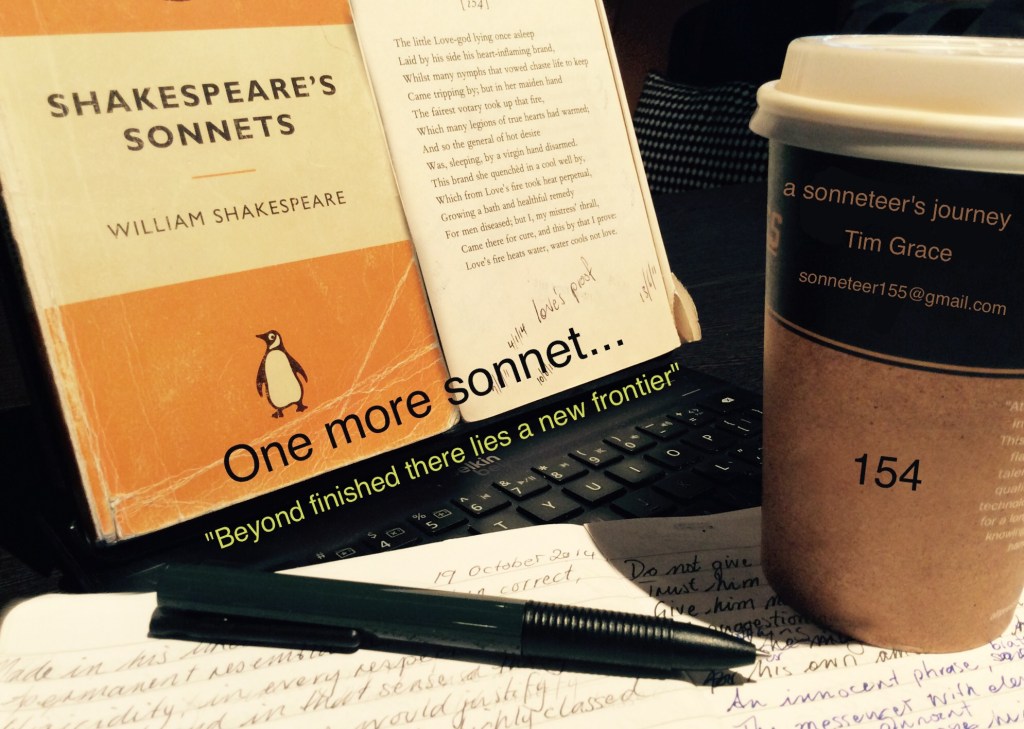
    To the poet: Almost done. I know what it’s like to write 154 sonnets; one more and I’ve achieved my goal; one more sonnet and I’m finished? The challenge was self-imposed and given a few rules the disciplined process was fairly painless. The two-year rule was gruelling but necessary. The minimal use of “like” as a tool for metaphor kept me anchored to a direct narrative. The sonnet is an endlessly adaptable form both generous and forgiving. The sonnet (and my readers) suffered some mutilation along the way but with considerable credit stayed the course.


    beyond finished
    beyond finished