Tag: Poetry

  • Selfless in Sacrifice

    Selfless in Sacrifice

    We do not know this young Australian’s name.
    We do not know his age or circumstance.
    He lived not for glory, died not for fame.
    Selfless in sacrifice, we owe him thanks.
    He’s just one of many who died at war;
    gave away his everything – for our sake.
    One of many who rests forever more.
    In his pursuit of peace we too partake.
    He is all of them, and he is one of us.
    He’s the collective spirit of our dead.
    He’s the me, the you, the voice, the chorus,
    the sacrifice; the ‘he’ who died instead.
    . He laid down his life, surely not in vain.
    . Let him remind us not of loss but gain.

    © Tim Grace, 7 December 2013


    To the reader: It’s Rememberance Day 1993, and Australia’s Prime Minster (Paul Keating) delivers a beautifully crafted eulogy honouring the Unknown Soldier. The speech ends with: “It is not too much to hope, therefore, that this Unknown Australian Soldier might continue to serve his country – he might enshrine a nation’s love of peace and remind us that in the sacrifice of the men and women whose names are recorded here there is faith enough for all of us…”

    To the poet: Paul Keating and his speech writer (Don Watson) stripped back the ceremonial metaphors to highlight a much stronger message about the power of ordinary people doing extraordinary deeds on behalf of others. Free of pomp, sincerity speaks with integrity … through remembrance peace becomes our future vision. I hope my conversion of the speech does it no injustice.


    Selfless in Sacrifice
    Selfless in Sacrifice
    Picture Sources:
    1 – http://youtu.be/tGh0HdG9ViA
    2 – http://youtu.be/YRkH1X9tBVU
  • Business as usual

    Business as usual

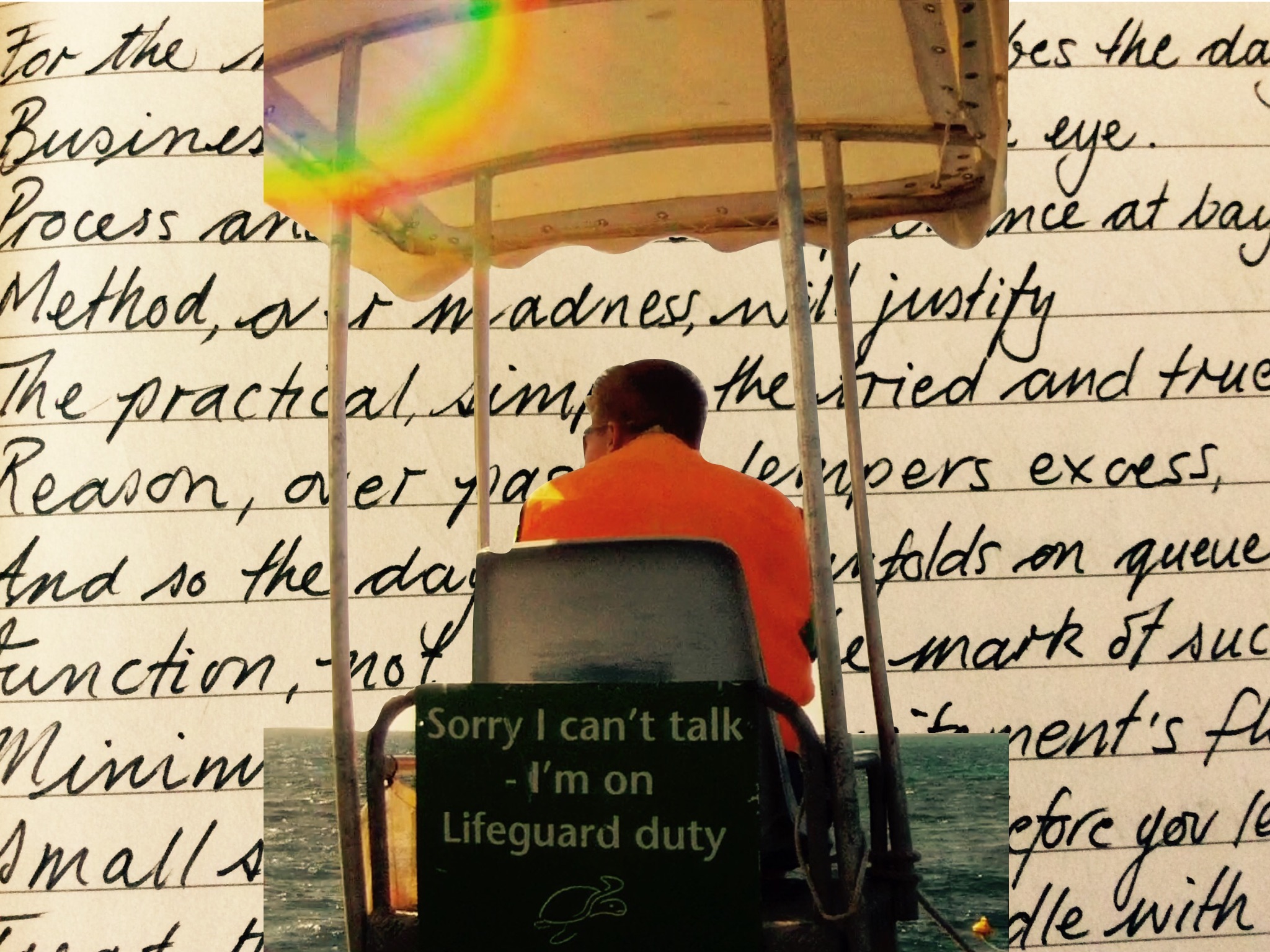
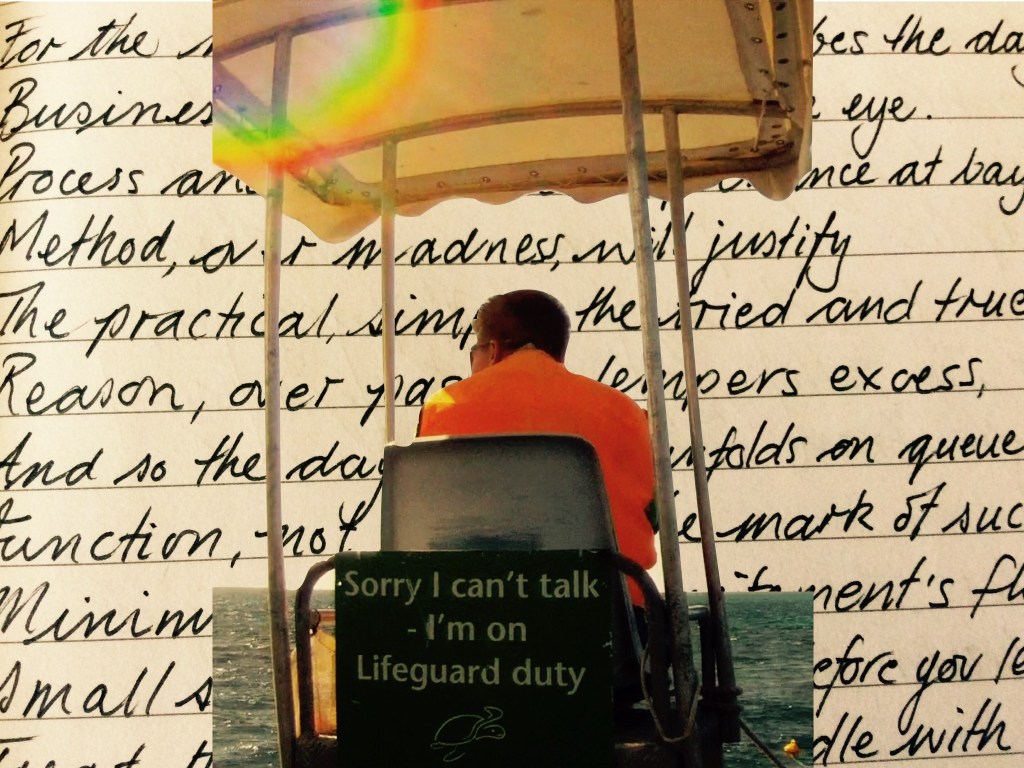
    For the most part, routine describes the day.
    Business as usual distracts the eye.
    Process and procedure keep chance at bay.
    Method over madness will justify:
    the practical, simple, the tried and true,
    reason over passion, temper’s excess;
    and so, the day proceeds, unfolds on cue.
    Function, not fanfare, the mark of success.
    Minimise the risk of excitement’s flare:
    small steps, not large, and look before you leap!
    Treat the day as hostile, handle with care.
    Treat mole-hills as mountains; as far too steep!
    . Today’s containment is alive and well,
    . With fires to dampen and seas to quell.

    © Tim Grace, 20 October 2013


    To the reader: Work has an inflated ego. This self-appointed, self-anointed, arbiter of time’s worth is a small-minded accountant. Given a badge, this officious miser of minutes scrapes from employment every last morsel of production. The yard-stick is a poorly calibrated measure of busy-ness; units of labour; toil and drudgery. The accountant’s grip on work-for-work’s sake strengthens and with throttling effect motivation is all but exhausted.

    To the poet: I’m working on a holiday… aren’t we all? Work’s relationship with rest and play doesn’t have to be adversarial. If work is a drudgery, then the distinction is probably convenient; as in, I’m ‘going to work’ suggesting a dislocation from other creative pursuits. Ideally, work, rest and play are a natural integration of life’s energies; with each contributing to an overall sense of wellbeing.


    Business as usual
    Business as usual
  • Refletions in Silicate

    Refletions in Silicate

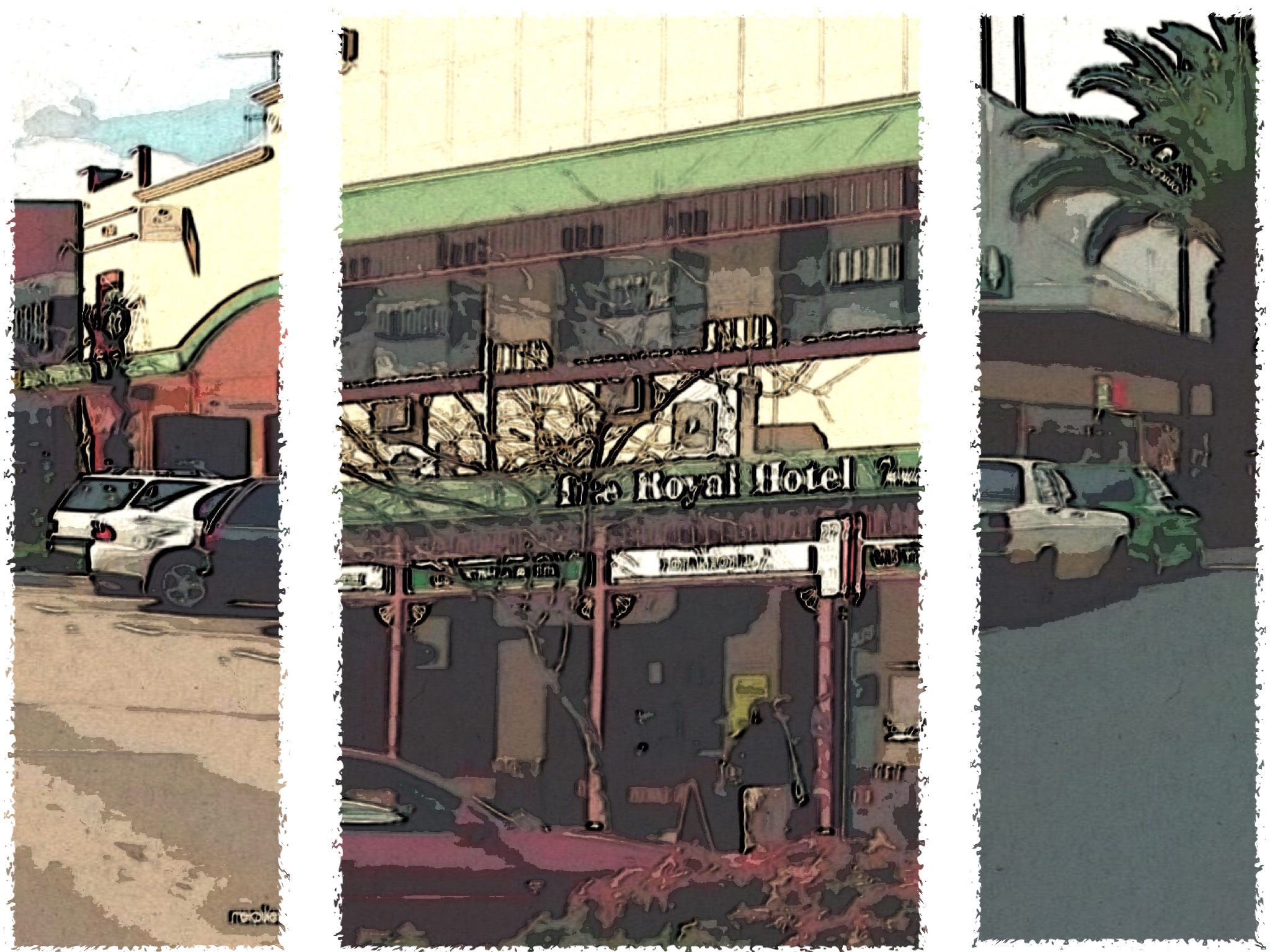
    Both sides of me – glass. Across the street – glass.
    A township’s reflection in silicate.
    I watch a car, I see it three times pass.
    Gleditsia – a sunburst in triplicate.
    Waitress serves coffee, delivers it thrice.
    A school bus on route to three destinations.
    Thread of pedestrians – a three-way splice.
    Parked vans in parallel situations.
    An over-weight figure stretches and shrinks.
    From the pavement’s perspective, three lines switch.
    A chain of clients making awkward links.
    Three panels of distortion – a triptych.
    . The arcade – a see-through kaleidoscope.
    . A visual illusion of words in trope.

    © Tim Grace, 15 October 2013


    To the reader: Taree is a small town on the central coast of eastern Australia. Over three mornings, I found myself in a coffee-spot, positioned in a neat and tidy arcade, overlooking a sleepy main-street. With glass all about me, I peered out from within my squared-off telescope and captured a kaleidoscope of reflections; as the town began its business: in country towns the streets are wide, with rows of trees on either side.

    To the poet: As a stranger in town, you are invisible on the first and second day. By day-three, however, your regular habits have been revealed and noted by the observant local. The guy behind the counter knows your coffee-preference, the waitress works around your table-setting of books and pens. There’s a polite expectation, not quite an obligation, that you explain your purpose. Towns, just like people, are a little suspicious of strangers with pad and paper.


    Reflections in Silicate Reflections in Silicate
    Picture Source:
    http://youtu.be/uQB68AaFLtk
  • Scenery at large

    Scenery at large

    The scenery at large is much the same.
    Division of the canvas is at scale.
    My chair’s vista, its aspect, holds its frame.
    Too much of the same; how soon the fresh goes stale.
    And so, in search of interest, I observe
    the nuance, the difference, at closer range.
    The ant upon the banister, the curve
    of filagree, the butterfly’s exchange,
    the magpie’s meanderings, the sun’s glint
    brightening my pen, sharpening its edge.
    Dislocate from distance a fine-grained hint
    of interest; extract one leaf from its hedge.
    . Beneath a broad brush there sits a fine stroke.
    . Fire finds new flame from an ambers poke.

    © Tim Grace, 9 October 2013


    To the reader: Big picture spaces have big dimensions, sized to fit larger than life characters committing acts of great courage or crimes of deep passion. Scaled-down, the miniature world has its equivalent perspectives. With the lens in macro we can watch nature’s smallest surveyors staking-out territories; acting-out tragedies… eking-out existences. All creatures great and small have a frame of reference.

    To the poet: The poet’s lens is endlessly variable. From a static vantage point, characters move in and out of fields of interest and intrigue. A single character can occupy layers of landscape; moving in and out of focus. Poets select their foreground, and from within that loose-boundary construct a depth of field. The narrative’s success relies on how convincingly a curiosity emerges and then interacts with the imagery… context is everything.


    Scenery at large Scenery at large
  • Break of Day

    Break of Day

    This new morning plays a still symphony.
    A soft blue haze gives the sun its fresh start.
    ‘Kookaburra sings in the old gum tree’
    Birds of the woodwind harmonise in part.
    Sounds of colour, yellow-tipped greenery.
    A black crow caws, disturbs the wafting lilt.
    ‘Morning has broken’ splits the scenery.
    The shadow of a cat’s meow casts its tilt.
    The full-bloomed sun begins its daily chores.
    Instruments of song re-billed to forage;
    to business; the sound-track of sliding doors,
    ‘Good morning’ and the day’s gone to porridge.
    . The morning’s pleasure is to softly seize;
    . so handled with care and treated with ease.

    © Tim Grace, 5 October 2013


    To the reader: There are ‘good mornings’ … they come with suggestive pleasantry. The suggestive component provides for just a touch of the unexpected; ‘good mornings’ must be interesting affairs. And as for pleasantry, that’s a collective measure of surrounding comforts. Although simple, ‘good mornings’ are also very fragile events; easily damaged by the squawk of overt rudeness; the cat’s claw and the crow’s caw both shaft and cut in one fell-swoop.

    To the poet: The creative zone is bound to time and place. For me, this temporal location is at its best in the couple of golden hours that launch the sun into its full ascent. That lifting can be strenuous if not approached in the right frame of mind; and made all the more difficult if disrupted by an intrusive influence. The frustration of a shattered morning is creatively crippling; truly the break of day!


    Break of Day Break of Day
  • Five Starlings

    Five Starlings

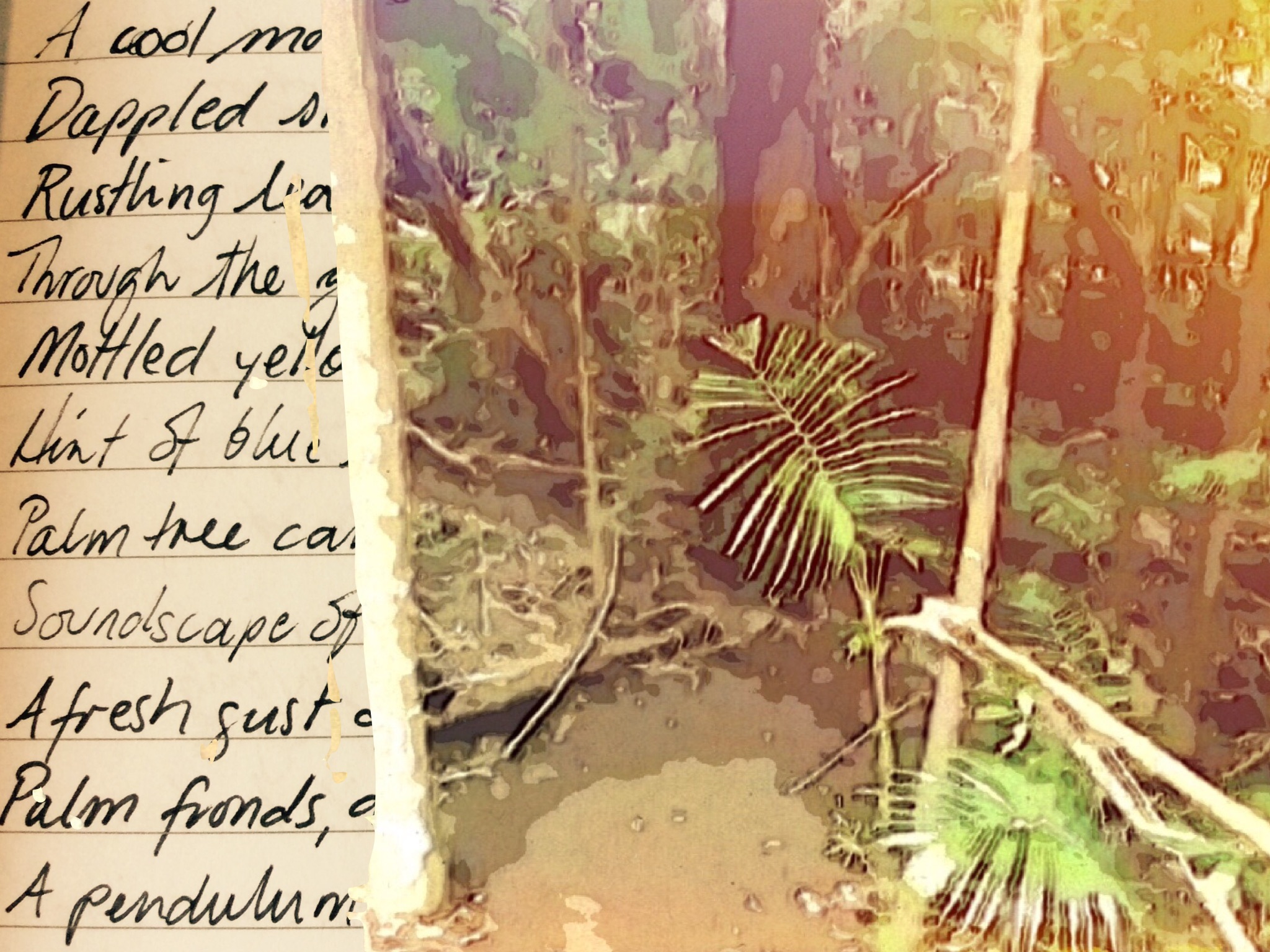
    A cool morning breeze, whispers crisp and sharp.
    Dappled shadows scattered in commotion.
    Rustling leaves give voice to a scratching harp.
    Splash of mauve begins the day’s devotion.
    Mottled yellow, wattled gold, rusted bark.
    The hint of blue horizon, just a glimpse.
    Canopied layers flicker; light and dark.
    A symphony of birds in soundscape scrimps.
    A fresh gust agitates a squawk of wing.
    Palm fronds, dry with age, hang-glide to landing.
    Metronome branches in pendulum swing.
    . Five starlings make an oddly mark in time.
    . Give cause for notice of the sun in climb.

    © Tim Grace, 4 October 2013


    To the reader: A fresh scene triggers interest. And so with heightened sensitivity, the watchful mind becomes alert to novel observations. The play of light and colour, along with the sound of movement interact to become a new definition of time and place. Small characters emerge from the static scene; branches swing and swish; birds flit and flirt; a mauve cloud is tickled by a golden ray of morning light; the sun lifts the curtain on a new day.

    To the poet: If you listen, visual landscapes are also aural soundscapes. Together, sight and sound form the focal points of this situational sonnet. Considered as one layer, the visual element has been receded to bring forward the sounds of nature waking to a new dawn. The first version of this sonnet was simply a list of of fourteen observations, which I later over-dubbed with rhythm and rhyme; to satisfying effect. I like this sonnet.


    Five Starlings
    Five Starlings
    Picture Source:
    http://youtu.be/dcyzz-UKg4I