Tag: Poetry

  • Now and Then

    Now and Then

    Now and then, a stop-start
    Turn of phrase; periodic.
    Dash becomes a dart,
    Comfortably chaotic.
    Come and go, ebb and flow,
    A phase that’s episodic.
    Much the same as to and fro,
    Naturally melodic.
    Period, teaches us to wait;
    Pause and let things rest,
    Episode, helps us calculate
    the extent that we’ve progressed.
    . We manage flow with punctuation,
    . Then let it go with syncopation.

    © Tim Grace, 23 January 2011


    To the reader: Time, an infinite resource, so scarce of understanding; humanities worst invention. In the short term a niggling nuisance; impatient, full of expectation. In the long term, an ominous, foreboding presence that hangs heavy with anticipation. Understood in seconds or millennia, time resists the patient pause. Those who can manage time, craft it into shape and trick it into submission. They let the big hand turn, the little one stop; without notice … all of a sudden.

    To the poet: Possibly deliberate, this sonnet’s meter is chaotic. Lines are broken, punctuation is contrived; structures are stressed. It’s a poem that invites an editor’s stroke of pen. And yet, that’s the nature of time; a shapeless mess. Some’times’ we just have to make-do, draw upon what’s available and celebrate the compromise. The poem’s not perfect, but it’s of its time … rushed.


    now and then now and then


  • Inundated

    Inundated

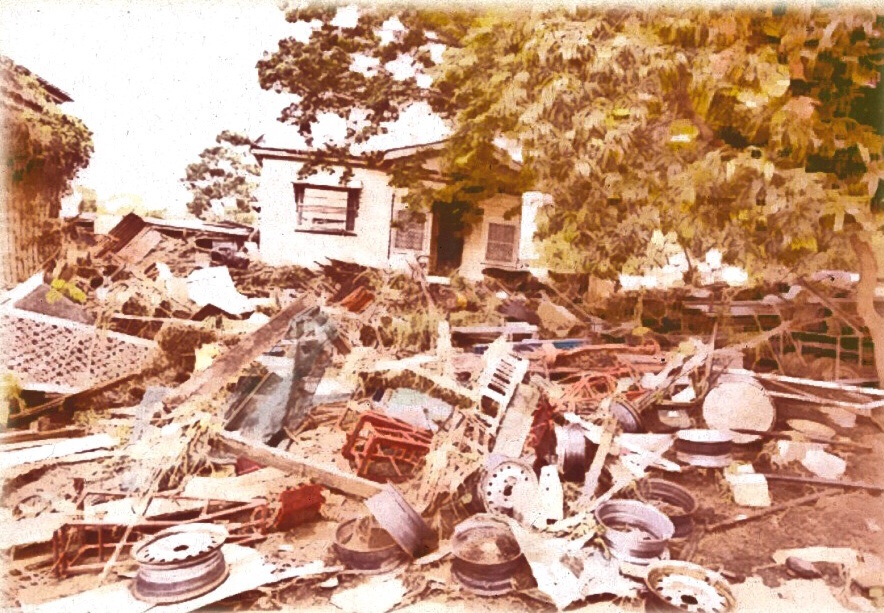
    Overwhelmed. Swamped by a deluge
    of cascading abundance.
    Engulfed; swallowed by a huge
    and raging expanse
    of turmoil. A torrent unleashed.
    Swollen by a backwash; pressing
    itself into spaces diminished
    of capacity. Structures stressing,
    crushed beyond identity. Ripped,
    flipped – agitated – broken debris.
    Strewn remains; a carcass stripped
    of shape … and what might be.
    . Sodden and soaked – saturated.
    . Clogged and choked – inundated.

    © Tim Grace, 16 January 2011


    To the reader: When enraged, the elements devour what lays before them; fire consumes and water engulfs. Flood victims are utterly inundated. The rising intrusion is unstoppable. The creeping thief, enters without welcome, invades every crevice; leaves behind a crime-scene of muddied mayhem. The forlorn victim, sodden and soaked, has no recompense; can expect no apology; the thief has come and gone… more than escaped, evaporated!

    To the poet: In this sonnet it was pleasing to arrive at a wash of words that flowed with singular effect. The flood of words were delivered through the media, describing the devastation of a summer flood in Queensland, Australia. Capturing the graphic vocabulary of an event is important in constructing a descriptive poem. Words, with particular nuances, speak through a sonnet. Words locate a poem as real. Words give the poet a licence to authentically narrate the scene; albeit from a distance.


    inundated inundated


  • Invisible Thread

    Invisible Thread

    As attached to an invisible thread,
    We are bound to all humanity,
    Through this communion we are wed,
    To a common sense of sanity.
    When round about our strings combine,
    Care should be enlisted,
    For as with any rope or twine,
    Our threads are easily twisted.
    The unravelling reel, the looping lash,
    Beware the rope that’s rotted,
    The curling cord, the whirling sash,
    Are never far from knotted.
    . This string is neither noose nor tether,
    . It’s the thing that holds us all together.

    © Tim Grace, 14 January 2011


    To the reader: Our bond to others is invisible; thread-like. We imagine threads as social ‘ties’. Family ties are life-long; others are short-lived and useful for just a moment of interaction. Regardless of strength and character the invisible threads can tangle to a mighty mess. Attending to the health of our invisible threads is important. Frayed and worn-out threads lose their flexibility and stretch; become difficult to manage, and are far from dependable. In rope we trust.

    To the poet: The neatness of each four-lined verse helps to ‘tie’ this sonnet together; it’s well packaged, well bundled… well versed. In a later sonnet, the invisible thread is again used as the main reference-point. As an invisible subject, a thread has endless possibility for metaphorical word-play. Whether rope string or cord; it ravels, loops and twists obligingly around your topic of choice. Money for rope.


    invisible thread invisible thread


  • All Too Difficult

    All Too Difficult

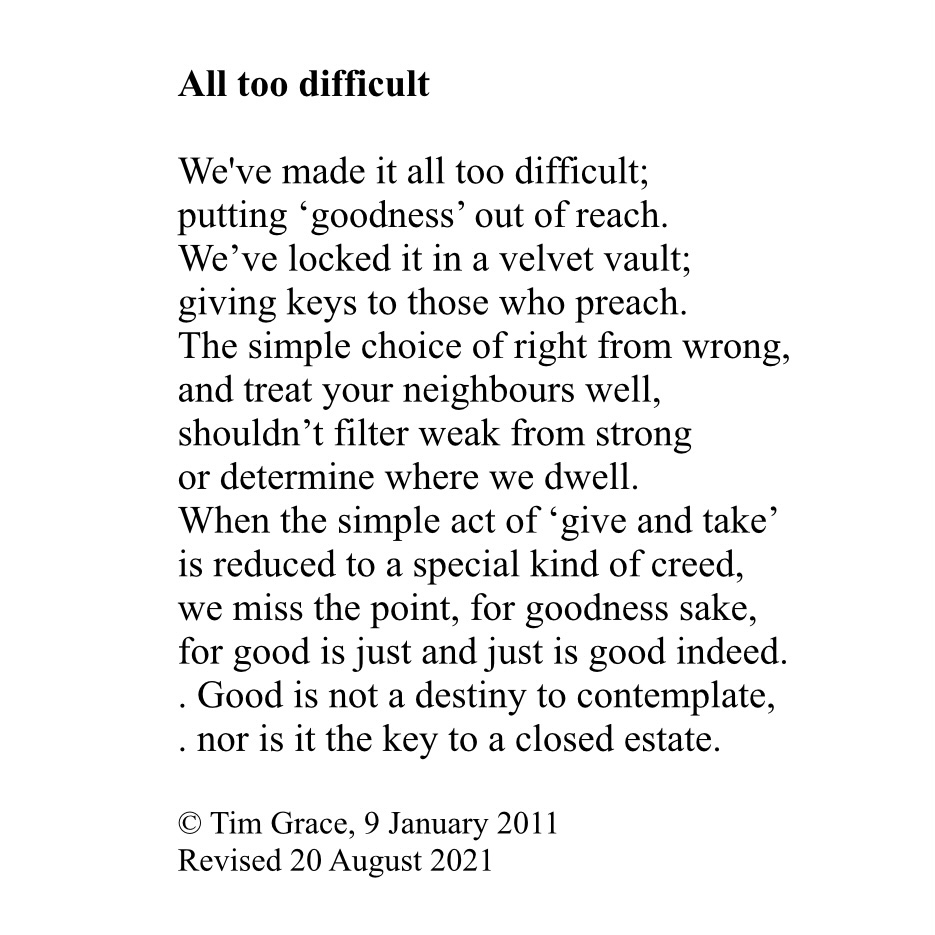
    We’ve made it all too difficult,
    … what’s good is out of reach.
    Where’s the truth, where’s the fault?
    It’s there … with those that preach.
    The simple act of give and take,
    Be kind to those who bleed,
    All of this, for goodness sake,
    A sermon does not need!
    The simple choice of right from wrong,
    And treat your neighbours well,
    Shouldn’t lead to ‘I belong’
    So protected ‘I’ can dwell.
    . Good is not a destiny, to contemplate,
    . Nor is it a key, to a closed estate..

    © Tim Grace, 9 January 2011


    To the reader: The quality of ‘goodness’ has been branded. Much like any commodity it’s been thrown to the markets. On the basis of supply and demand ‘goodness’ fluctuates in value. When poorly packaged ‘goodness’ loses its edge in the market place and recedes to a back-shelf option. In limited supply ‘goodness’ is only available through selected outlets; who for their own gain distort its features and in so doing marginalise its agency; compromise its potency… for goodness sake!

    To the poet: The first stanza establishes the problem; the second and third do their best to respond. But in the end, it’s the final couplet that dutifully fulfils its role in offering a succinct and convincing summary. Exposition and argument need a logical sequence of propositions to be worthy of pen and ink on page. A good poem, like a good sermon, needs to be plausible not dogmatic; open to all.


    all too difficult all too difficult


  • Remnants

    Remnants

    Remnants of last night, in patches,
    Rendered heavy to the pitch of black.
    An eave, being overhung, catches
    A nook that dawn is yet to crack.
    Fragments in angular spaces,
    Brutal joints, unfinished and stark,
    Stubborn nocturnal traces,
    Carved into crevices, deep and dark.
    Segments, pieces of a mute mosaic,
    Drained of narrative; story-less,
    Burdened by a daily habit; hard to break,
    Draped in the dull garb of dreariness.
    . Through a broken dawn, comes a sunrise shattered.
    . Shadows born, then torn and scattered.

    © Tim Grace, 6 January 2011


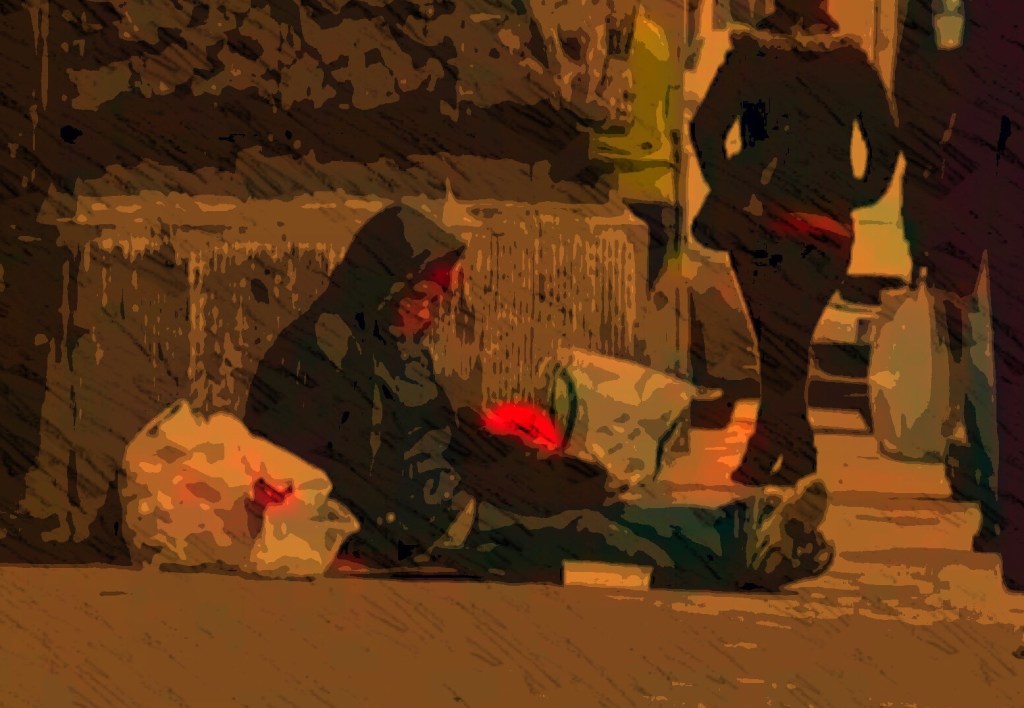
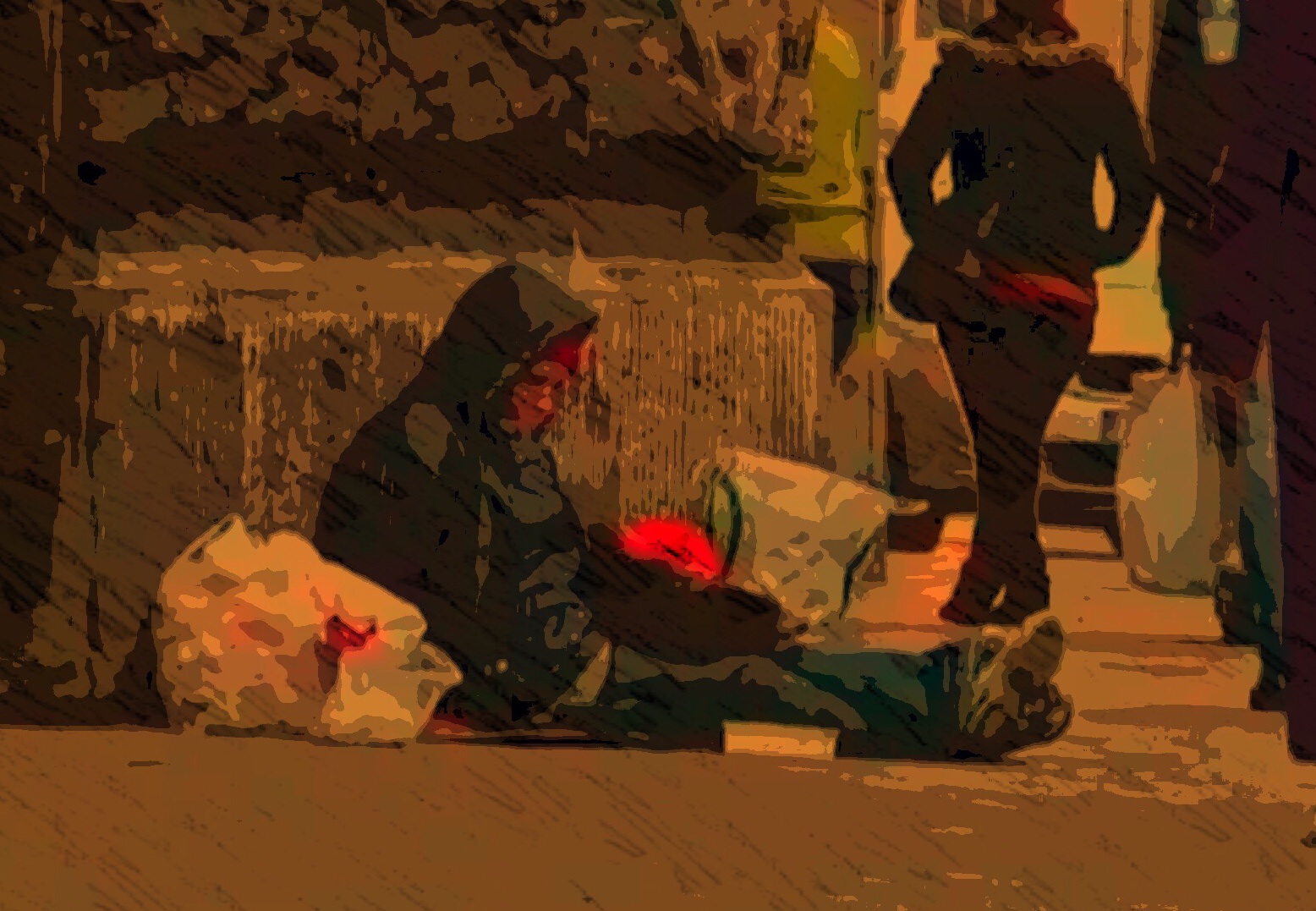
    To the reader: With dawn comes the realisation of what remains of last night; the shroud of darkness has been lifted. The homeless, cramped in corners and nestled in nooks, are slow to rise. Around them the city stirs into action. Sunlight nudges its way into cavities. And so breaks the day. The heaviness of night grips the vagrant who with reluctance shadows another day … awaiting a new night to fall.

    To the poet: This poem holds strong to its form of three distinct stanzas; blocked out as remnants, fragments, and segments of a shared theme. The continuous lines of verse ignore those breaks and seamlessly roll into a single thread of thought. It’s also a poem that plays confidently with the literary features of alliteration, assonance and consonance. While inspired by a short visual moment, I remember this poem took considerable working; days.


    remnants remnants


  • Becomes Today

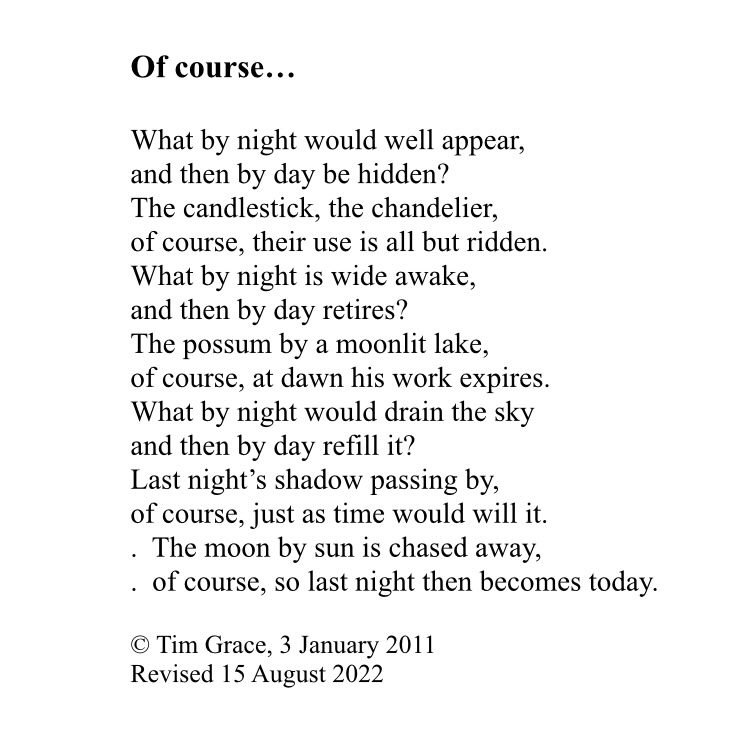
    Becomes Today

    What by night would seem adept,
    And then, by day become a blur?
    Last night’s shadows, over slept,
    Reluctantly they stir.
    What by night would well appear,
    And by day be all but hidden?
    The candlestick, the chandelier,
    Of use the two are ridden.
    What by night is wide awake,
    And then by day retires?
    The possum by a moonlit lake,
    With sun its scene expires.
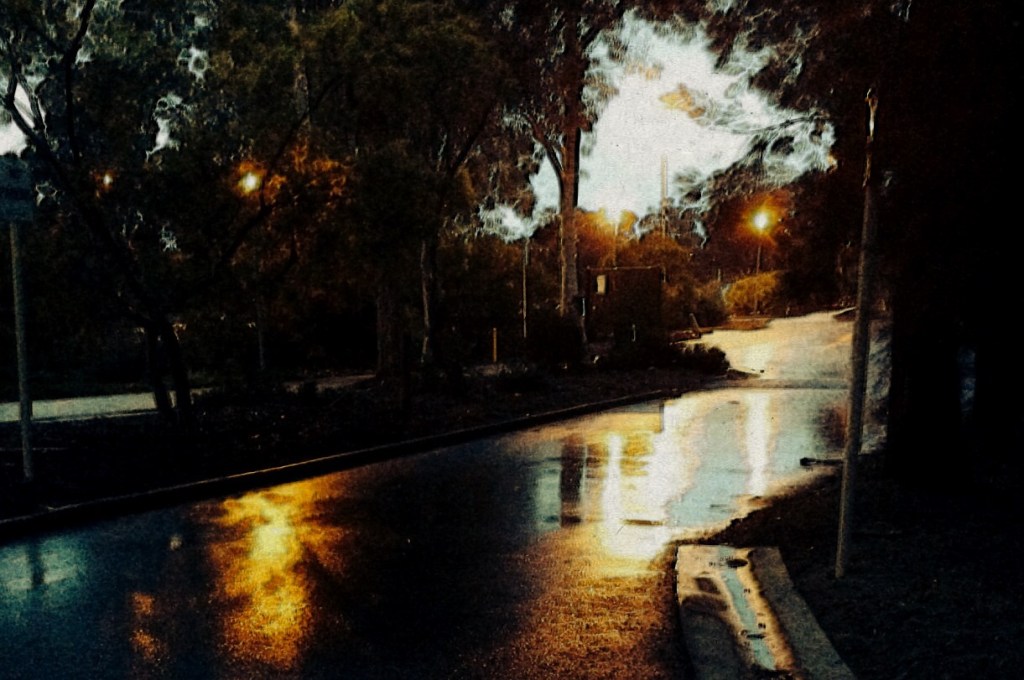
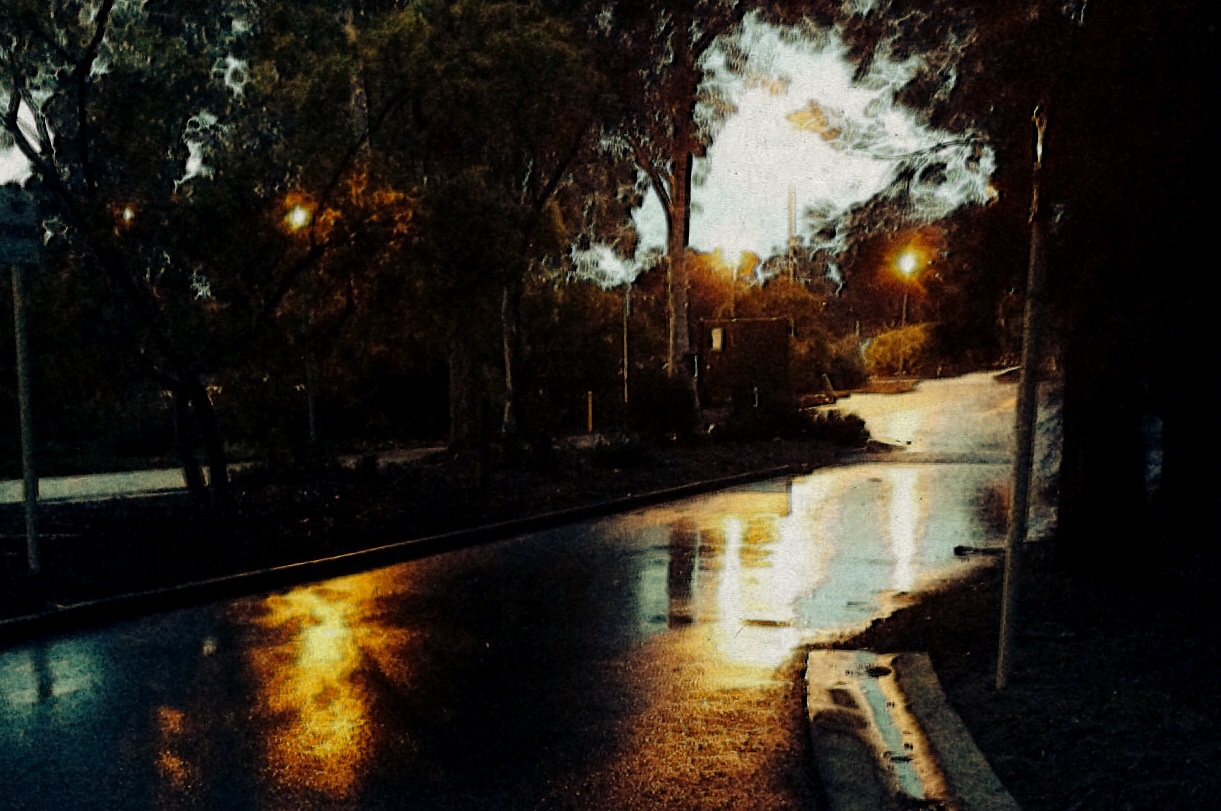
    . The moon by sun is chased away,
    . And so last night becomes today.

    © Tim Grace, 3 January 2011


    To the reader: We live in a riddle; a reasonable muddle. A right answer is often so lame with correctness it needs a little adjustment. Some creative correction is what makes good things better; and better things great. From bland to grand takes an obscure course. At arrival, having passed through the riddle, a good answer is adorned with the crazy sparkle of unexpected discovery… aha!

    To the poet: The familiar form of the riddle, with its question/answer format, frames this sonnet. The phrase “What by night?” established the seek and find enquiry. Two problems followed. Firstly, contrivance. The thought of ‘what happened over-night while I was sleeping?’ is easily outstretched; laboured to a tedious length. Secondly, miscellany. There’s little achievement in reaching into a grab-bag of ideas. Lucky-dips may write lists but not poems. What rescued this sonnet is its final couplet… an answer worthy of the question.


    becomes today becomes today