Tag: Poetry

  • Banquet of Sound

    Banquet of Sound

    A banquet of sound, black vinyl, white noise;
    orchestrated decibels, perfect pitch.
    Deconstructed platter, good taste, good poise;
    just desserts, justify a burning itch.
    A scratch which turns attention; an etude,
    a miscellaneous menu, so fresh.
    Glass onions, savoy truffles; naked; nude;
    raw numbers; rare cuts; marinated flesh.
    A selective sampling of time and place;
    a harvest of life without hunger’s haste.
    The sensibility of course not race;
    an appetite is best expressed through taste.
    . Prudence and elegant sufficiency;
    . a sprinkled modicum of decency.

    © Tim Grace, 17 August 2014


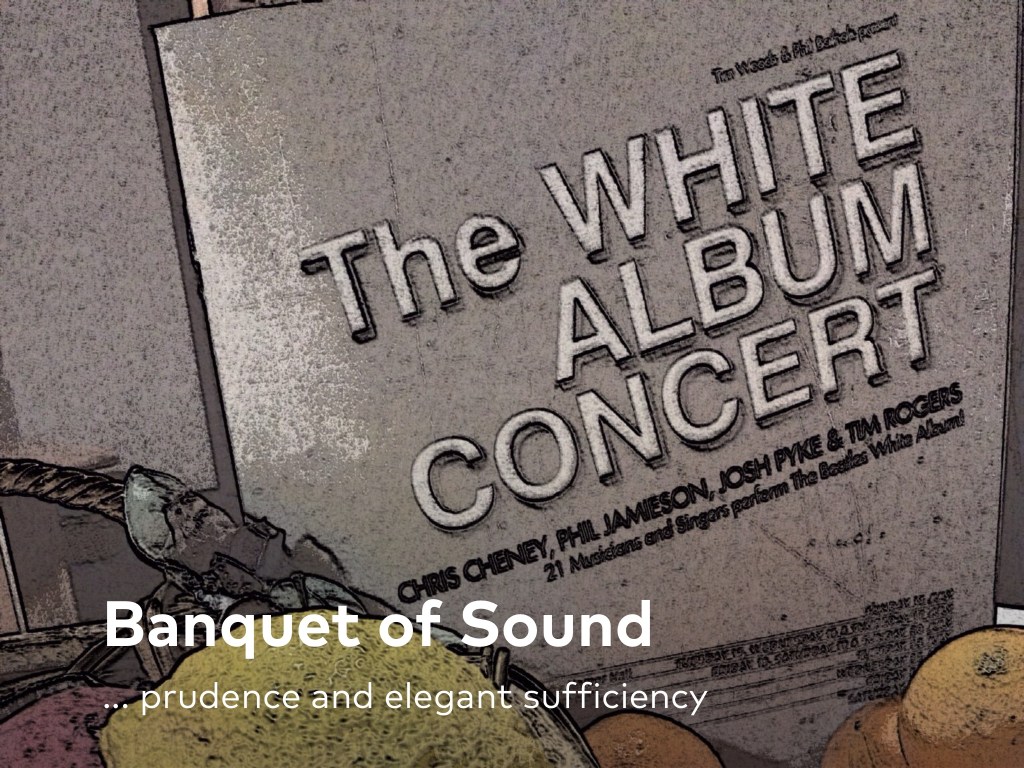
    To the reader: Upon return from India, the Beatles set about creating what was to become known as the ‘White Album’. A collection of songs representing every facet of their creative interests. The double album contains an impressive sampling of music from their vast library of interpretive styles; showcasing the Fab Four’s prodigious versatility, emphasising their status as independent ‘Apple’ artists. The album is inwardly and outwardly referential; highlighting a new level of consciousness… paving the way for new things to come.

    To the poet: The White Album Concert was an Australian initiative. Some of our most talented rock-musicians were drawn from their day-jobs to recreate the entire album; live-on-stage. The ‘project’ was dauntingly brave; the result was brilliant! Following the concert, dinner was eaten at “4Fouteen” – a Sydney restaurant specializing in ‘nose to tail’ cuisine; again, a banquet of eclectic tastes was consumed. And so, fully inspired, I wrote this sonnet…


    Banquet of Sound
    Banquet of Sound
  • A Cold Veneer

    A Cold Veneer

    Mid-Winter, where I live, is wet and cold.
    The place is bedraggled. A season spent
    of warmth. A blanket of tarnished gold
    leaves. Fallen reminders. Disappointment.
    An inclement pallet in shades of grey.
    Overcast sky, wet-washed to the streetscape.
    Sodden concrete canvases. Damp display
    of seasonal swing. Long months of cold, that shape
    the calendar with frosted panes of glass.
    Clouds, condensation, vaporous and sheer.
    A diaphanous depression; won’t pass
    without the shudder of a cold veneer.
    . Mid-Winter enjambement; more or less
    . a shift of emphasis, a change of stress.

    © Tim Grace, 18 July 2014


    To the reader: My home town is Canberra; Australia’s capital city. It was designed by Chicago’s renowned architect: Walter Burley-Griffin. He and his wife, Marion Mahony, incorporated into Canberra’s layout their social, political and environmental philosophies. One hundred years later, this small city nestles into the seasonal landscape reflecting its democratic origins; relying on thoughtful design for inspiration through social unease, political tension and Mid-Winter drudgery.

    To the poet: …and that’s the thing about poetry. It’s a built environment. Full of ideas. Full of plans that require on-site adjustment. Poetry is a social experiment. An engineered interpretation of life’s possibilities; real and imagined. Poetry describes and discovers the shape and form of itself and its subjects. In the cold, poetry shivers; it feels the bite of winter winds, the grip of frosty nights and the slap of frozen rain.


    A Cold Veneer A Cold Veneer
  • Unspoken Thoughts

    Unspoken Thoughts

    There’ll be ample time to talk of wonders;
    but for now, you have the gift of eyes and ears.
    Silence speaks as loud as lightning thunders.
    Save those unspoken thoughts for coming years.
    As for now, take note: watch the world unfold,
    watch the patterns change and the colours dance;
    watch the hand shake, the foot step, the toe hold.
    Recognise yourself in a friendly glance.
    As for now, listen: hear the change of tone;
    hear the rhythm, the pitch, the count of three;
    hear the heart beat, the ear drum, the jaw bone.
    Make yourself ready for the change of key.
    . Two eyes, two ears, but just one mouth for each.
    . There’s much to be said for the gift of …

    © Tim Grace, 22 June 2014


    To the reader: It’s not that babies can’t vocalise; it’s more the point, they can’t speak. And all for good reason. The receptive senses of hearing, seeing, touching, tasting and smelling need time to grasp the rituals of living. In this sensory world, babies communicate reactively; using spontaneous gestures that display their simple understandings of the comfort continuum. Our physical glossary precedes our emotional vocabulary.

    To the poet: Our first language belongs to the body. And I suppose through body-language we can express the sentiments of any poetic theme or form. Words are just subsequent translations of abstracted notions the brain has previously rehearsed; remnants of an internal theatre. Before speech performs its reductive act, let the first scene be one of mental gymnastics … creatively dance within …hold that thought.


    Unspoken Thoughts Unspoken Thoughts
  • The Manufactory

    The Manufactory

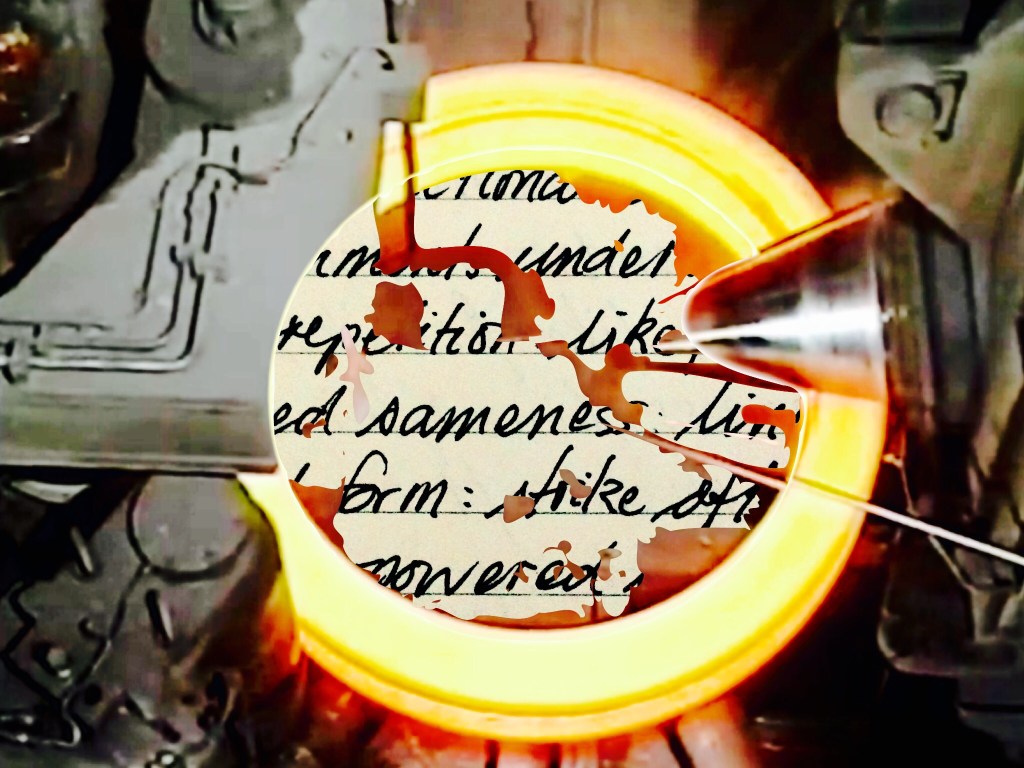
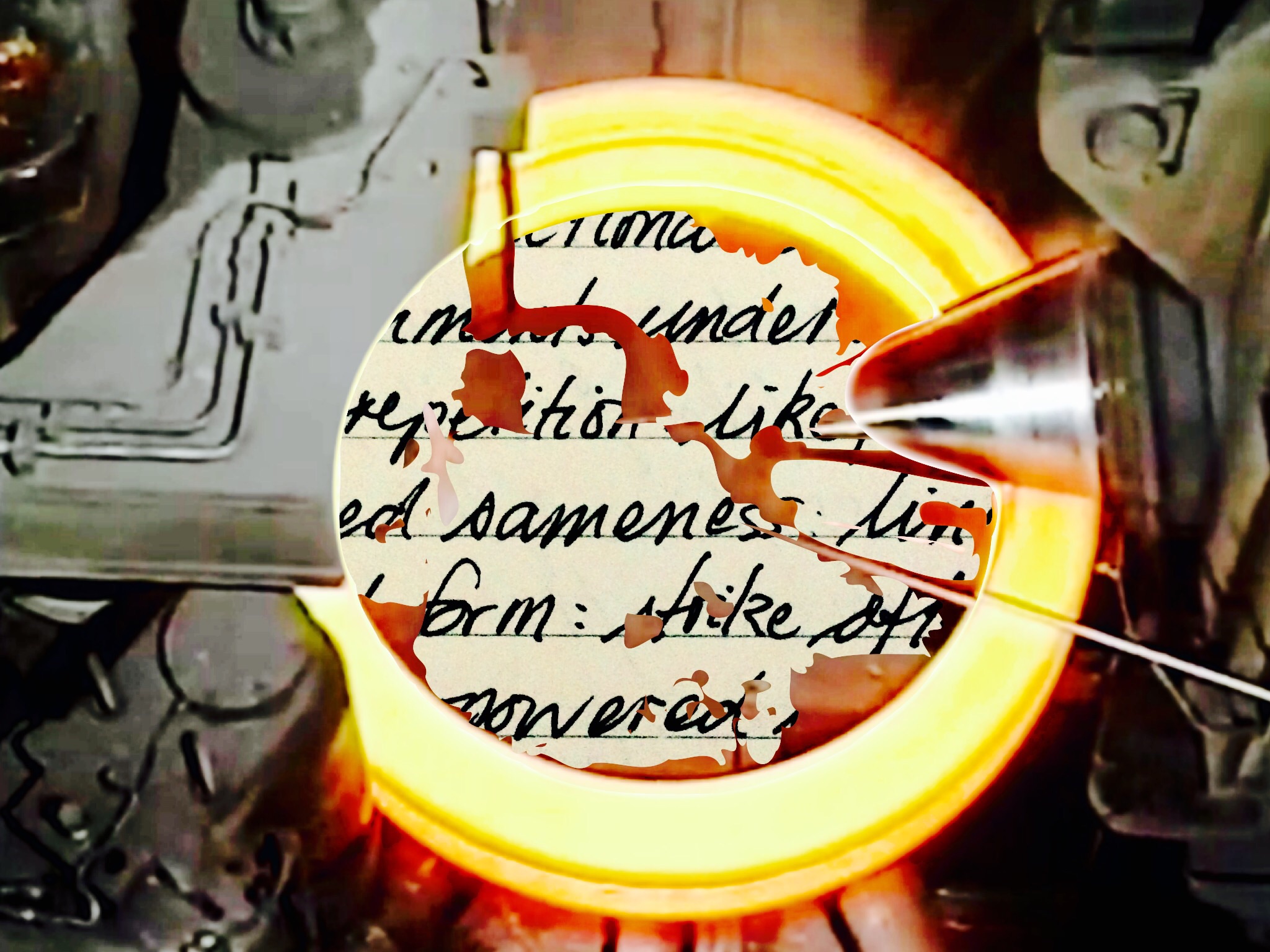
    The manufactory, factorium;
    the industrial site of production.
    Home of the functional consortium;
    built environments under construction.
    Masters of repetition: like-for-like;
    duplicated sameness, line after line.
    Fabricated forms; strike upon strike;
    Engine-uity powered by design.
    Natural systems, copied, reassembled;
    untangled, delineated, processed,
    deconstructed, contorted, stretched and pulled;
    to give new form: and so shaped; and so pressed.
    . This, a short-lived strategy – one assumes:
    . built-in obsolescence – itself consumes.

    © Tim Grace, 8 June 2014


    To the reader: In the 1550s, a ‘factory’ describe an estate manager’s office. This descriptive noun borrowed from Middle French (factorie) with much earlier Late Latin roots to ‘factorium’. The common ‘factor’ refers to a doer or a maker. Having had its use describing humble farm mills and presses, the factory had its sights on bigger industrial enterprises of the 19th Century. A production house that included machinery manufactured goods in buildings known for a short period as manufactories; later shortened to ‘factory’ – so the circle is closed.

    To the poet: Etymology sculpts a poet’s productive mind-set. The notion of a wordsmith forging meaning out of molten-sense is close to my reality. As I wrought-meaning into shape I often delve into the pedigree of words to release their poetic potential. The familiar sight and sound of words is suggestive. It’s often the case that coincidental relationships create the crux: at the heart of poetry forgery lies.


    The Manufactory
    The Manufactory
    Picture Source:
    (http://youtu.be/XTU0Z-FkhtU)
  • Ornamentalism

    Ornamentalism

    Ornamentalism: an assortment
    of collectables, domesticated
    bric-a-brac, imports from the orient;
    samplings of stuff, made sophisticated:
    the leather-bound folio, paper-backed
    penguins, specimens in formaldehyde.
    The trinket, the hand-crafted artefact;
    exotic and familiar, side-by-side.
    Foreign objects, ambassadors abroad,
    international treaties exercised.
    A continental-shelf, cross-bow and sword:
    “en garde!” – the world has been homogenised!
    . We explore the unfamiliar; enough
    . to give it status; substance over stuff.

    © Tim Grace, 24 May 2014


    To the reader: I’d been sitting beneath a decorative array of ‘exotic’ ornaments that in a moment of attention had me intrigued. The eclectic display was purely ornamental with no hint of suggested expense or value. “Ornamentalism” I thought. As it happens, the term ‘ornamentalism’ was coined by David Cannadine who expanded on the concept to describe ‘How the British Saw their Empire (~1850 to ~1950).

    To the poet: Through the appropriation of exotic customs (including artefacts) the modern Imperialists integrated non-British cultures into a homogenised new-world order. The strict interpretation of a sonnet is similarly transformed by the introduction of slightly foreign influences; and so the form adapts and retains its significance. In this way, a structure keeps its relevance and meaning. Through ‘ornamentalism’ we loosen the grip of conservative hierarchies; and so, become familiar with alternative possibilities.


    Ornamentalism
    Ornamentalism
    Acknowledgement:
    Title: Ornamentalism:
    How the British Saw their Empire
    Author: David Cannadine
    Publisher: Allen Lane (2001)
  • Precipice of Now

    Precipice of Now

    Today’s business awaits my attention.
    A loose assemblage of things still to do.
    An assortment that hangs in suspension;
    At the precipice of ‘now’ … fallen due.
    Unfinished jobs have no place on the shelf.
    And so, to that list; that drop-box of chores:
    bullet-pointed messages; notes to self;
    reminders that only a fool ignores.
    And so, to that list of missed appointments:
    that stalled project; that interrupted task;
    to all that, that is yet to commence.
    To that pending pile: “be patient” I ask!
    . All in good time, each matter’s attended.
    . It’s at that point, the file is suspended.

    © Tim Grace, 9 May 2014


    To the reader: Two weeks after retiring, I started my next job. The plan was to down-size expectation and workload; get things back to a manageable perspective. To some extent that was the reality but the fundamentals of paper warfare move from job-to-job and desk-to-desk. Projects are the enemy of state. They form the territory upon which office activities spiral out of control in the name productivity. Projects – front-line battles that draw upon scarce resources and redirect energies towards hot-spots of disputed service.

    To the poet: As a single-minded sonneteer, I manage my own poetry project – an anthology of sorts. As far as I know “One More Sonnet” has no project-plan; nothing to coordinate its resources and deliver its services. With hindsight, I could back-engineer a plausible plan that makes what I’ve done look organised; but in fact, the whole project grows like topsy. From one idea to the next I lunge and lurch … help wanted; must be good with pen and caper!


    Precipice of Now
    Precipice of Now