Tag: philosophy

  • So Little To Be Said


    From a banquet of words my daily bread

    is spread with a thin layer of gratitude.

    And so well fed, there’s little to be said

    for a life of privilege. So construed:


    I’m the un-urban dictionary of verse;

    I’m the un-listed house that’s up for sale;

    the under-valued penny in a purse

    of golden coins. How easy they regale:


    their newly minted trophies: their new wealth

    of fresh anecdotes, decorated claims;

    attesting to their contemporary stealth

    and fitness in a world of modern games.


    . All ready to abandon reason’s rhyme;

    . already, I am stale before my prime.


    © Tim Grace, 27 November 2024

    To the Reader: Truth is, in a purse full of coins the shiny-coin will always attract attention. Freshly minted with a contemporary motif, the new coin is given preference over what’s become familiar and mundane. Buffing-up an old coin is one way of attracting attention to its continued worth; but alas, acceptance of receding notoriety is a hallmark of growing old with grace and dignity.

    To the Poet: Working within the outer structures of a rhyming-poem adds an extra layer of internal puzzlement to what I see as a playful word game. This sonnet is bursting with internal connections designed to grip the reader to a sticky-relationship – “said the spider to the fly”.

  • Thoughts Condensed

    Thoughts Condensed

    … used to write observational ditties.
    Sunrise anecdotes, as they rose to view.
    High-rise moments that could tickle and tease.
    Bric-a-brac messages from me to you.
    Kept them in a folder, tattered and torn:
    My Complete Book of Unfinished Works.
    A mixed anthology of statements, sworn
    to the master of truth; where danger lurks.
    It’s a people watcher’s compendium,
    an unbound collection of clever quips:
    “slivers of silver – soft as cerium.”
    “the tighter one grips – the faster one slips.”
    . Life is just a series of thoughts condensed,
    . cryptic adages, over days dispensed.

    © Tim Grace, 21 December 2014


    To the reader: Snapshots of life in passing are soon lost to memory. Short-term moments that catch your interest but quickly fade from view. These are the ingredients of doodles and ditties. My notebooks are full of sketchy lines and idle jots; half capturing a fleeting thought. And there’s the problem; at some point, do these bits and pieces make collective sense? Unlike entries in a diary or journal these snippets have a weak relationship with a string of time.

    To the poet: Side-by-side two poems will often reflect a shared relationship with the poet’s current experience. As often as not they might also reflect the poet’s quick shift of focus. Some poems make reference to past or recurring interests and therefore resemble poems written in a distant period. In poetry chronology and sequence are quite separate issues… two threads; one rope.


    Thoughts Condensed
    Thoughts Condensed

  • Just a poet

    Just a poet

    Do not give that poet licence to print.
    Trust him with nothing more than a bent quill.
    Give him no room to manoeuvre, no hint
    of suggestion; no modicum of thrill;
    nothing to spill upon a naked page.
    Just for his own amusement, he’ll distort
    an innocent phrase; blatantly upstage
    the messenger with elevated haught.
    He’ll brazenly award himself credit
    beyond his due; without hesitation,
    he’ll tag himself as first to have said it…
    Man of Words … with big imagination.
    . This ‘Man of Words’ is just a dictionary,
    . just a parrot, well-skilled at mimicry.

    © Tim Grace, 23 November 2014


    To the reader: It’s not words that commit the crime; it’s the choice of those words in combination with intent to harm or damage reputation. And so, the shady area of exploitation is encircled by interpretation. The cunning ‘poet’ will cleverly disguise his ambiguous message with layers of obfuscated connotation. Using every trick in the book, he’ll burden the reader with responsibility for word association.

    To the poet: The parrot might be able to argue his words should not be taken literally. But, as a poet, you do have to take responsibility for the syntax and semantics of your artistic expression. Your deliberate acts of subtle word-play can cause a mischief that requires remediation; or at least, explanation. Blaming the reader for his/her sensitive interpretation is hardly the act of a chivalrous sonneteer.


    Just a Poet Just a Poet
    Picture Source:
    (http://youtu.be/IqRrvdJMvlk)
  • In His Likeness

    In His Likeness

    Made in his likeness. More true than correct.
    A permanent resemblance, confirming
    his rigidity. In every respect
    a replica; and in that sense, a thing
    to be admired. As would justify
    impressive compliment: so highly classed,
    so desirable to this maiden’s eye.
    Thus, besotted by his enduring cast,
    she would praise upon him commendation.
    Wonder at the depth of his conviction.
    Absorb his strength, ride his motivation;
    ’til resolved of Cupid’s contradiction.
    . Conviction is not a measure of length,
    . without substance we have no strength.

    © Tim Grace, 19 October 2014


    To the reader: Stature has less to do with shape and form; more to do with conviction and substance. While the proportion of a figure provides insight into its mechanical advantages, the nature of its pose and posture suggest its depth of character. Poise and style are features of an impressive presence; something to be admired.

    To the poet: Shakespeare enjoyed a little naughtiness. Sprinkled throughout his sonnets are references to all manner of subtle titillations. His last two sonnets (153 and 154) provide the most obvious examples of his brand of bawdiness. Never salacious or explicit just suggestive of something a little spicy. Could that be … surely not?


    In His Likeness In His Likeness
    Picture Source:
    (http://youtu.be/OOO1mffekkw)
  • True to word

    True to word

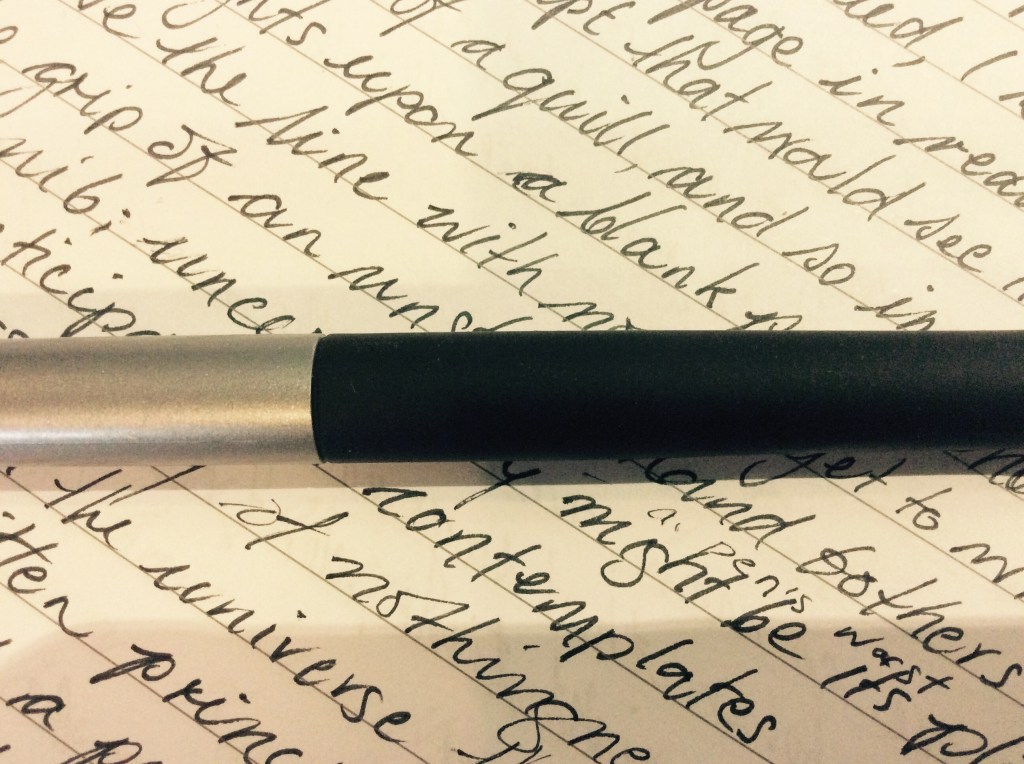
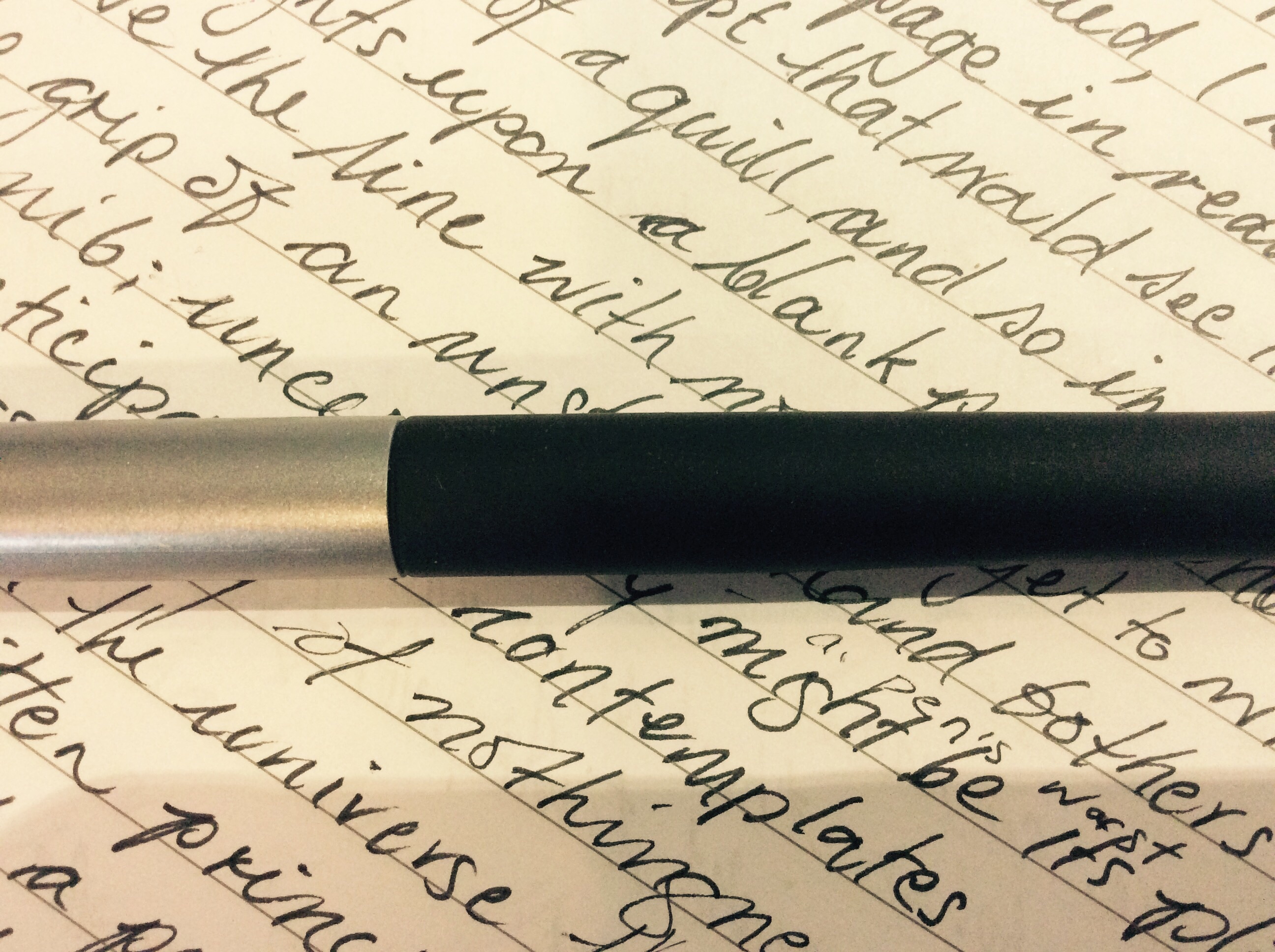
    With my attention divided, I sit…
    Pen, poised above the page in readiness;
    hopeful of a script that would see it fit
    the purpose of a quill; and so, impress
    its thoughts upon a blank page. It hovers
    above the line with nothing yet to write;
    the grip of an unsteady hand bothers
    the nib; uncertainty – in pensive flight.
    In anticipation it contemplates
    the possibility of nothingness;
    a void in the universe that equates
    to unwritten principles – more or less.
    . True to word: a pen without instruction,
    . finds absurd the point of its production.

    © Tim Grace, 9 March 2014


    To the reader: The physical translation of my poetic thoughts onto paper is through a pen; obviously, a free-flowing versatile pen is preferred. It needs to be an ergonomic pen that sits comfortably in my hand; happy to be twiddled, over-worked and under-paid! All the better, if that pen is well-weighted; designed to manoeuvre and embellish as it imprints letter onto line.

    To the poet: Those fancy ostentatious pens that ooze with opulence are far too pretentious to be of any use in drafting. I’ve given them a try. Their notable features demand attention; they want to finish with a flourish and leave indelible marks. Signature pens are dressed for occasion; singular in purpose, unready for sustained action. As a medium, the perfect pen must neither interrupt nor distract from the creative process.


    True to Word True to Word
  • In Loose Contort

    In Loose Contort

    From that which lies about us we construct
    plausible solutions; scenarios
    that help explain what life, by chance, has plucked
    as this day’s harvest of ripe curios:
    people, events, time and place alongside
    those artefacts, those things that decorate
    this impromptu muddle; unqualified
    mess – by chance an entanglement of state.
    What lies about us is about us strewn.
    A momentary arrangement that becomes
    itself revealed as a glimpse; and so soon
    becomes the fresh source of infinite sums.
    . We are in pieces, patched together, wrought
    . of all things about us; in loose contort.

    © Tim Grace, 14 January 2014


    To the reader: I’m a constructivist; intrigued as I watch organic plasticity contend with constant adaptation to non-organic obstacles. Without adaptive agility, existence is a fragile and brittle proposition. At the centre of my own survival guide is a stoic statement of resilience: things change and people adapt. Every heart-beat, every breath, is designed to extend or improve engagement with time and place.

    To the poet: Poetry and fluid mechanics have a lot in common. Both seek to understand and/or harness the nature of flow. Fluids, just like poems, derive their character from internal and external forces that influence their dynamic state. The 1960’s hit-song ‘Poetry in Motion’ is a great example of syllabically static lyrics interacting to create the effect of a constantly rolling wave.


    In Loose Contort
    In Loose Contort
    Picture Source:
    http://youtu.be/EjjMH_PdCvI