Tag: literature

  • Space to Crawl

    Space to Crawl

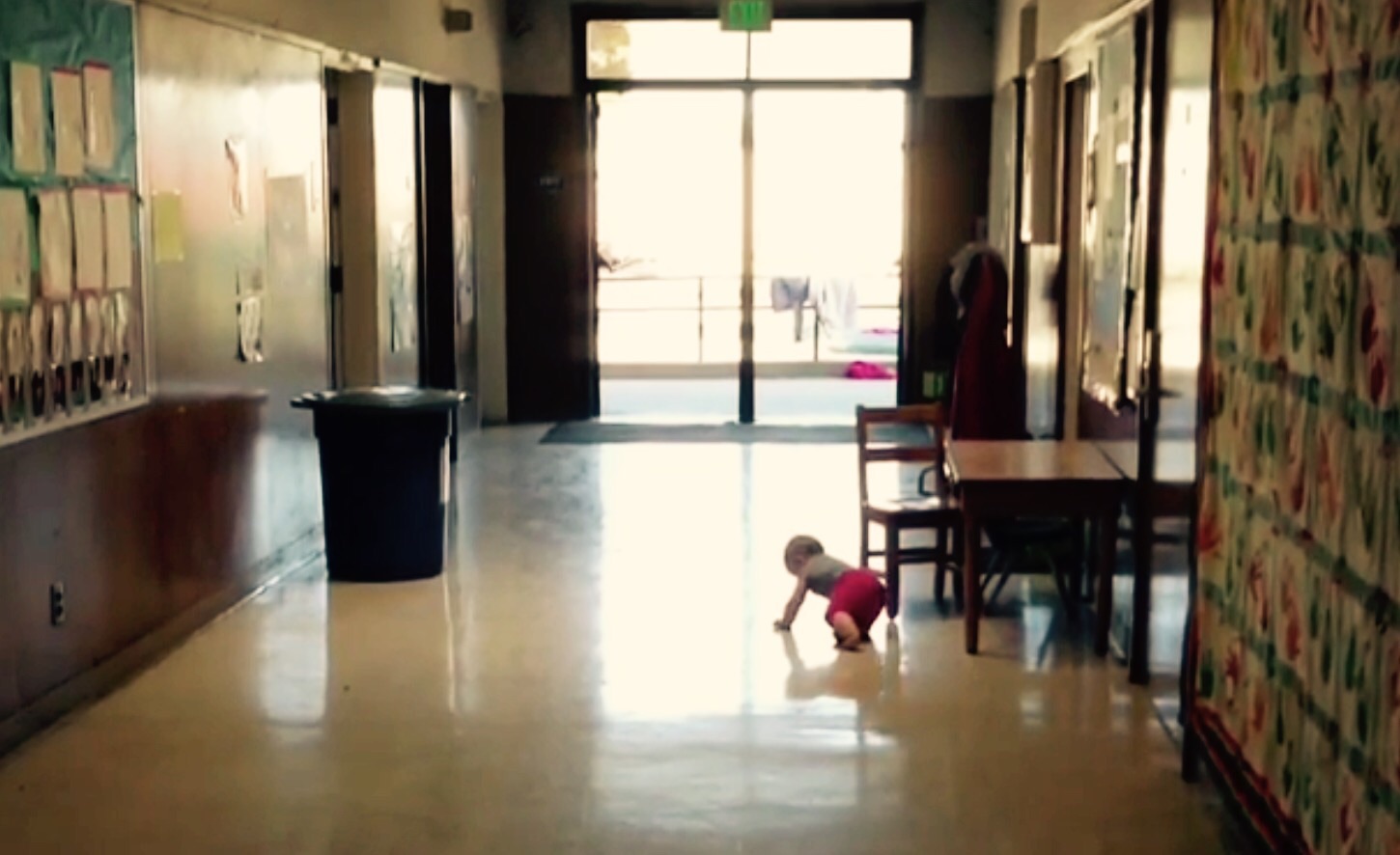
    Yesterday, I watched a boy crawling
    commando-style across a carpet-rug.
    Giggling and chortling, rising and falling,
    pushing and pulling with a hauling tug.
    In jungle-greens he scampered, head down low.
    He moved in spits and spurts. He paused a while.
    He reset direction, then off he’d go.
    With syncopated skim and cherub’s smile;
    through a forest of legs, he spied a light:
    a destination worthy of pursuit.
    But, when almost there, with his goal in sight,
    down came the arms of love: “Aren’t you cute!”
    . His mission is to walk, stand proud and tall;
    . give the boy some freedom, some space to crawl.

    © Tim Grace, 31 January 2012


    To the reader: The school-day is all but done. Here comes a troop of toddlers and their yet-to-walk entourage in pushers and prams. They are the freedom fighters, come to release their brothers and sisters from the tyranny of school. One in particular catches my eye; he’s a rug-rat, escaped surveillance and making good ground … but like so many before him, his noble pursuit is thwarted; he is lifted to higher ground by the doting arms of mum… another man down, or up as the case may be.

    To the poet: A photograph might have captured the scene more faithfully; but not the story. The story is in the poem which is a figment of my imagination. No-one else, on the day, had any idea of my interpretation. In a fleeting moment I captured a metaphor… two thoughts combined; and so began my sonnet. Metaphors, like butterflies, are at their best in flight; pressed to the page they may lose their colour.


    Space to Crawl Space to Crawl
    Picture Source:
    http://youtu.be/XGbfqM0ToM8


  • Angling

    Angling

    All I did was drop a line, nothing more
    than simply give you cause to contemplate.
    It was not my chin that dropped, not my jaw
    that took umbrage; not me who bit the bait.
    You could have let it go, let it dangle.
    Instead, you gave it a tug, you tested
    the line; turned what was slack into tangle.
    It was you who floundered, then protested.
    Nonetheless, you did nothing to resist
    it’s ascorbic tang; and so, there you hang,
    dangling from a string of words, a long list
    of ponderings that promulgated pang.
    . What lures fish from the safety of rocks?
    . It’s the slightly plausible paradox.

    © Tim Grace, 21 January 2012


    To the reader: It doesn’t take much to create a fuss over a line of words. Retracting that string of thought is difficult; it gets snagged so easily. On a good day a contentious thought might be openly aired; on a bad day it becomes a most enticing deep-water bait. As it sinks a small school of fish nibbles its edges; but then, along comes a shark with far bigger intentions. Discretion being the better part of valour decrees the warranted loss of hook, line and sinker… one should never angle for a fight.

    To the poet: This sonnet did follow an argument over the previous sonnet regarding silos. Why two people would choose to angrily debate the virtues of a silo I don’t know. Nonetheless, it spawned a good piece of purgative poetry. The poem has some satisfying sub-elements that I enjoyed merging into its deeper layers of construction; for later in depth analysis.


    angling Angling
    Picture Source: http://youtu.be/rG1xOUIykhY


  • Beyond Finished

    Beyond Finished

    To say that all is finished, all is spent,
    means nothing in the greater scheme of things.
    For in that scheme there is but one intent:
    “waste nothing” – as from compost new life springs.
    What of that old house that the ground recalls?
    What of that empire in its fallen state?
    What of that fashion that today appals?
    What of good reason wasted in debate?
    All of these might be finished, done with use,
    stripped of cause, drained of substance; as conceived
    they might be buried dead or dangling loose;
    but as time shall choose – they shall be retrieved.
    . Beyond finished there lies a new frontier,
    . furnished in the garb of a golden year.

    © Tim Grace, 14 March 2012


    To the reader: Mistakenly, finished can be considered a terminal point of arrival. A statement of completion that declares an ending. In reality, nothing ends its course; nothing is divorced from what’s to come. Next, is the consequence of an expanding universe; until Time contracts there shall always be a new beginning… a next time to come. And so, in conclusion, consider this sum … there’ll always be “one more sonnet” to come.

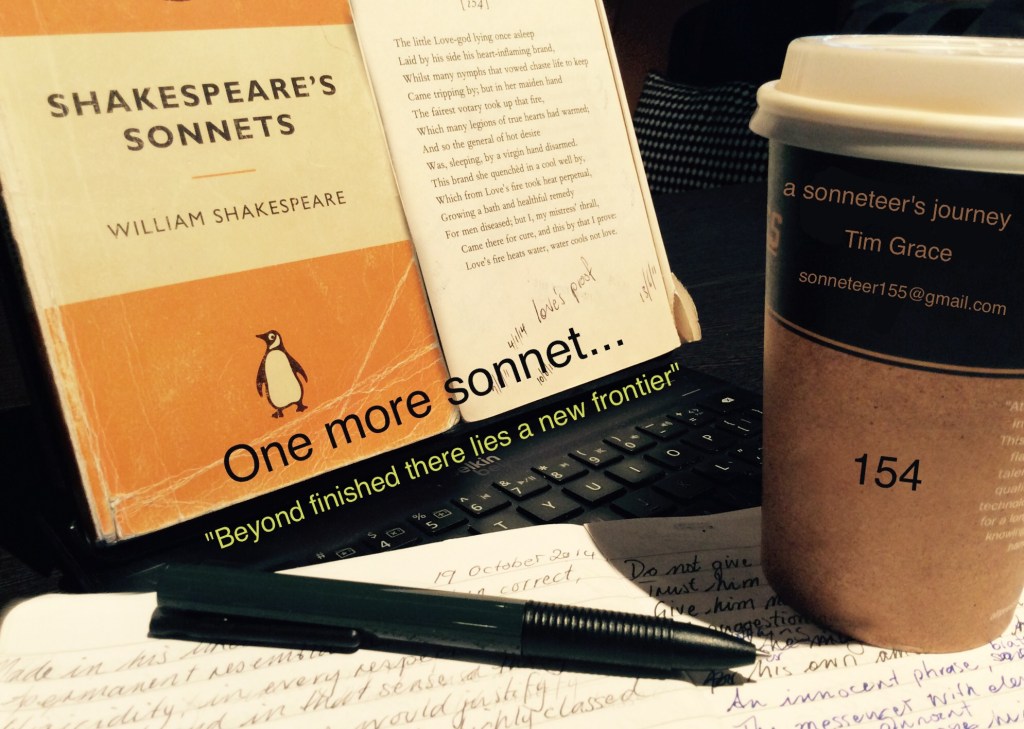
    To the poet: Almost done. I know what it’s like to write 154 sonnets; one more and I’ve achieved my goal; one more sonnet and I’m finished? The challenge was self-imposed and given a few rules the disciplined process was fairly painless. The two-year rule was gruelling but necessary. The minimal use of “like” as a tool for metaphor kept me anchored to a direct narrative. The sonnet is an endlessly adaptable form both generous and forgiving. The sonnet (and my readers) suffered some mutilation along the way but with considerable credit stayed the course.


    beyond finished
    beyond finished


  • Fine Lines

    Fine Lines

    By the end of childhood I learned to draw
    fine lines (with keen eyes and measured skill).
    I learned to draw what mattered; to ignore
    the distractions (there were no marks for frill).
    How to overcome the errors of sight?
    How to foreshorten an odd perspective?
    These were the problems you had to get right:
    minimal tolerance for technical give.
    All things became parallel, rightly squared;
    they had to marry-well to plot or grid;
    they had to tally-well or be repaired;
    they had to mirror what the real world did.
    . After childhood there are no wonky lines;
    . they neatly straighten and become designs.

    © Tim Grace, 6 January 2012


    To the reader: At school I enjoyed technical drawing classes, they appealed to my style of measured sketch; where objects take shape according to long-held principles of linear geometry. Tools of the trade were important and taking care of them was critical to achieving a clean result. Of all the lessons I learned at school it was through technical drawing I best understood myself. I freely gave away my naive interpretation of the visual world and adopted rules that enabled me to draw what I see.

    To the poet: Between naivety and mastery lies frustration. It’s unfortunate that we abandon our fresh expression of life through naive art… but understandable. Expression, in all its forms, is a social tool that evolves to meet expanding needs. The licence to communicate has rules that can be stretched and personalised but ultimately an audience will accept or reject the value of art. Selecting an appreciative audience is one solution… avoid criticism; create your own applause.


    fine lines
    fine lines
  • Dark Lady?

    Dark Lady?

    Is she the dark lady that last night claimed
    she knew the provenance of broken dreams?
    Is she the same woman who last night aimed
    her demons in my direction? It seems
    she holds a deep quarry of dredged-up digs;
    a deep pit of misery; a pack of black cards
    that she plays to her advantage; reneges
    at will… cheats … and then with honour guards
    her dignity; a thin veil of powder;
    a dusting, a coating, sheer nonsense;
    more transparent as the voice gets louder:
    more desperate, more dismal, more dark and dense.
    . Who is this lady that delights in black?
    . What shady memories does she welcome back?

    Tim Grace, 23 December 2011


    To the reader: Temper fuelled rage is an ugly and primitive demeanour that rises from the brain’s deeper recesses. For most of us we learn to control that ‘cantankerous monster’ as we outgrow the deployment of two-year old tantrums. For some, that taming was not so complete; producing an unpredictable and cranky adult temperament. In the grown-up world, there’s a social contract that demands a rational mind. Keeping an ‘even keel’ through stormy weather is not easy. Managing frustration and torment without resorting to anger is a prized habit of mind; well worth the effort in the preservation of long-lasting relationships.

    To the poet: The angry tirade, often delivered in a single passage of free-flowing vitriol, is intended to over-ride the calm response. Throughout an angry exchange the tarry is designed to be quick and the verbal blows are short and sharp. The aggressor in an angry exchange will escalate the intensity… their ploy is to attack not defend. Any attempt to de-escalate will meet with hostility. This sonnet is bookmarked by two sets of questions… the answer lies within.


    dark lady? dark lady?

    Picture Source: http://youtu.be/0sqMBOjrUeg


  • Reason’s Reference

    Reason’s Reference

    For millennia we have scribed our thoughts;
    put pen to paper and as such preserved
    all manner of inspiration… all sorts
    of wonder. So conscripted, we’ve conserved
    in good faith the font of reason’s reference.
    Forever more attached, writ and listed:
    sentenced, word-by-word, the very essence
    of a flourish: styled but never twisted.
    Written as to permeate our culture,
    bold-stroked messages indelibly inked
    to imitate form, or shape a future
    world; built upon words, most beautifully linked.
    . It’s the cursive script of pen or quill,
    . that reveals the hand of a writer’s will.

    Tim Grace, 14 December 2011


    To the reader: I was wondering… were the Egyptians able to turn a poetic phrase in hieroglyphic form? In search of an answer, I stumbled on the ‘Lettrist Movement’ led by Isidore Isou; post the second world war. Lettrism’s Manifesto rallied against the atomised letter and the destructive power of the word. Far from enabling freedom of thought, lettrists perceived letters and words as insidious links in a constricting chain; manipulated by the literati. According to Lettrism, the hieroglyph does less damage in transporting and translating an experience across a thoughtful medium such as poetry. I’m still wondering…

    To the poet: Letterism aside, preservation of a word-based poem requires a script that will authentically transport a message through time and space; so that some time later… the distant reader can retrieve their own uniquely crafted assembly of ideas. In scripting a poem, the skill is in the crafted management of its future impact on the reader. Used too functionally, too literally, the script can lack fertile nuance and starve the text of ambiguous translation; for at the heart of reading and writing poetry is creative interpretation.


    reason's reference
    reason’s reference