Tag: english

  • Partial Interests

    Partial Interests

    To all things my interest cannot attend.
    I am responsive to movement, colours
    and the scent of life; all things so contend
    for my attention; distinct of others.
    One thing for the moment will steal my gaze.
    I take note of that which sways and swishes.
    That which has rhythm to my interest plays,
    so becomes the pick of many wishes.
    I’m partial to soft tones that glow; that blush
    the dull canvas with a rose-coloured tint.
    I’m partial to that which is full and lush;
    that which brings love to life with perfumed hint.
    . I cannot attend to all things in sight;
    . instead, I seek what gives my eyes delight.

    © Tim Grace, 24 January 2013


    To the reader: Programmed to attend to life’s rhythm; we literally seek and appreciate animation. Some movements have particular powers of attraction. The effortless ‘sway and swish’ of a wiggling-walk makes alluring theatre. The long-stride of confidence without pretence or contrivance draws attention. The nonchalant amble of a carefree character entertains our imagination. Powers of observation energise our interest; sharpen our focus.

    To the poet: Infatuation lacks restraint. To ogle is obsessive. Admiration construes a connection. Polite interest requires distance, it respects the dignity of a shared space; eye-contact is confirmed not consumated. From a poet’s vantage point there’s a code of practice that applies to people watching. As subjects of interest ‘the observed’ will tolerate a casual glance; not so an intrusive gaze.

    Eyes' Delight

  • Best at Dawn

    Best at Dawn

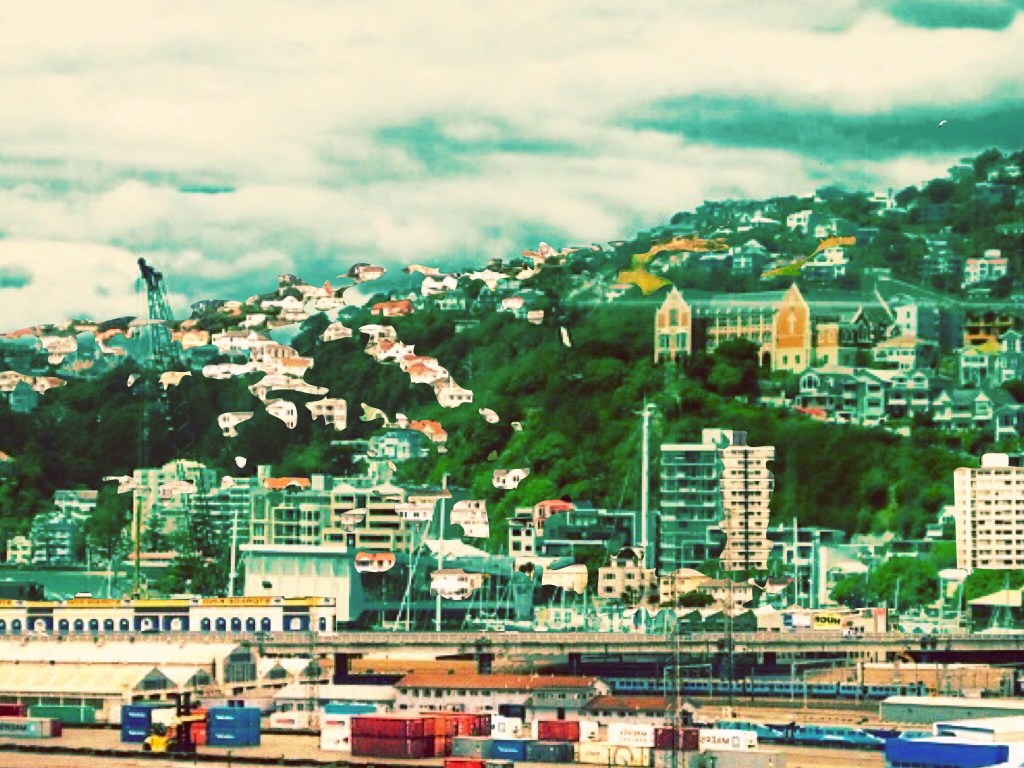
    To a hillside, a crop of houses cling,
    overlook a harbour; a city-port.
    White-washed walls absorb a sunlit morning.
    Train-tracks and traffic underline a thought.
    Birds, gulls and terns, etch the sky with traces
    of a coastal breeze; pelicans are drifting.
    There’s a long wharf with cargo in cases.
    Cranes begin a day of heavy-lifting.
    Yellow bus gives way to a staggered start;
    the zig-zag pattern of a day takes shape.
    A city’s plan runs the way of nature’s art;
    suburban portrait draws a cityscape.
    . From the suburbs a cityscape is drawn;
    . sunshine (as the artist) draws best at dawn.

    © Tim Grace, 21 January 2013


    To the reader: A new day deserves a fresh dawn. The shadows of yesterday cast aside. And so it was in New Zealand when I woke to a brand new vista. The harbour was already abuzz with import/export activity; an intermingling of nature and business trading terms of interests. The hillside-suburbs, slow to wake, were beginning to stir. Life resembling art…

    To the poet: … and who was the artist? The sun. In every respect, this consummate colourist was controlling the medium. The pallet was crisp, not saturated, with cool blues and deep greens. A yellow hue was attending to dark remnants of lingering night. The solid canvas of horizontal swatches became animated with small features of meandering life … drifting, sifting; lifting the day on its way to a zenith noon.


    Best at Dawn
    Best at Dawn
  • Persistent Wind

    Persistent Wind

    A persistent wind, agitating dust;
    careless intruder, unwelcome entry.
    Full of bravado, a blustering gust;
    unsettling a layer of certainty.
    A persistent wind, feeding fuel to fire;
    craving attention and demanding note.
    Temperamental breeze, a funeral pyre;
    no whimsy whistle works as antidote.
    A persistent wind, a buffering blow;
    cuts across the bow and ruffles feathers.
    Strips a tree of foliage and Autumn’s glow;
    this resistant fiend smites all endeavours.
    . An ill-wind, the likes we all must suffer;
    . should be endured with brunt or buffer.

    © Tim Grace, 17 January 2013


    To the reader: A cutting breeze strips a day of comfort. Each of the senses responds with agitation. In defence, we can either face the challenge or turn our back. To face the challenge requires head-on resistance; a regardless attitude that stiffens to the breeze. Turning-the-back is an obstinate show of defiance. Should we brunt or buffer? Somewhere between passive and aggressive there’s an appropriate response… ‘the answer is blowing in the wind’.

    To the poet: It wasn’t until I began writing ‘to the reader’ that I realised I had written a sonnet describing Bob Dylan… a persistent wind. He arrived in the early 1960s on a gust of rising social awareness; and decades-on, he’s still shaking trees and rustling leaves. Now identified, I re-read the sonnet with the brusk-breeze personified; I have faced the wind.


    Persistent Wind Persistent Wind
    Picture Source:
    http://youtu.be/oqEcFUW9Ai4
  • No Convenience

    No Convenience

    In constant measure, at relentless pace,
    makes meaningless: to stop, to pause, to rest.
    For every endeavour an endless chase,
    a continuous stream of life abreast.
    If not one thing, another; all things merge,
    detail is lost, rendered as a background blur.
    Not something new, not a modern scourge,
    simply this day prepared for life ‘du jour’.
    Living alongside what has come and gone,
    as to be repeated then multiplied.
    Think of it as ‘de ja vous’, think upon
    all things as one, where time and space collide.
    . If time portrays no obedience,
    . it qualifies as no convenience.

    © Tim Grace, 5 January 2013


    To the reader: In some respects, time is a container; a higgledy-piggledy box of events. Each day I select a sample of interests that I add to my biographical anthology. Unlike most boxes, this one is endlessly expandable; made of a curious material that responds to its content. It’s a durable, self-repairing material: water-proof, fire-proof, and wind-proof. It’s a permeable membrane, it’s an impervious membrane; it’s a membrane that forgets and remembers.

    To the poet: This box is not a trap. When writing poetry, there’s an endless choice of material; content. Your sources are infinite; beyond experience, the only limit is the extent of your imagination. The poem (seen as a membrane) represents time: “it’s a permeable membrane, it’s an impervious membrane; it’s a membrane that forgets and remembers.”


    No Convenience
    No Convenience
  • Today I’m late

    Today I’m late

    Usually, one of the early risers;
    from sun-up, noting texture of the day.
    Mostly ready, for the day’s surprises;
    well-prepared, well-postured, for come what may.
    But today I’m late, I’ve lost advantage;
    just one of many, recently arrived.
    Left to share a script on a crowded stage;
    just one of the collective, so contrived.
    Late… my expansive day has been confined.
    I’m now a post-script that time has stolen;
    an after-thought, yet to be assigned.
    I’m a conscript, a left-over colon.
    . With an early start, you design your day,
    . Leave it too late, and to a script you’ll play.

    © Tim Grace, 1 January 2013


    To the reader: As routine activities become more general they acquire a network of dependencies. My morning routine is like that. It might appear that I’m up early and out the door to do some writing. Not so, it seems. Small changes to parts of my morning mission can torpedo the enterprise. With a small series of delays, I find myself cornered in a crowded café. No words can describe my…

    To the poet: Writing about writing is an introspective task; somewhat therapeutic, slightly poignant. A metacognitive indulgence that’s occasionally excused by a patient reader; one with a forgiving nature. Unpacking this sonnet, reveals its block-like construction. Inevitably, piece-by-piece, the puzzle is connected; rules are followed and so it lazily meets its final couplet… late to arrive at its conclusion.


    Today I'm Late
    Today I’m Late
  • Words Have Accents

    Words Have Accents

    Words have accents, some subtle, some severe.
    The urban banter of a rough-cut brogue.
    The soft rounded lilt that lovers revere.
    Words are responsive to fashion and vogue.
    They’re tandem partners in a common phrase,
    They’re crude expletives in a colourful verse,
    They’re gushing gaffs in superlative praise.
    They can mumble, grumble; be short and terse.
    Words can shatter dreams, mend a broken heart,
    Words have expression, and so resemble
    the whispering wind and the dashing dart,
    the babbling brook and the leaves atremble
    . Words have accents, some are rich and refined,
    . others more guttural, milled in a grind.

    © Tim Grace, 26 December 2012


    To the reader: For such little things words can pack a powerful punch. The expletive works well alone; but on the whole words are social creatures. In pairs they hyphenate easily; in threes and fours they craft a competent phrase; beyond that their assemblage constitutes a sentence. In the world of words context is everything, for without association words are reduced to meaningless sounds; mere babble vibrating through space.

    To the poet: In poetry, the word is a versatile instrument; adaptable and flexible. Adaptive in a syntactic sense, it transitions from active to descriptive modes with ease. As a flexible element, the word’s semantic nuances are powerful attachments to emotional strings. Between the right and wrong choice of word there’s a world of difference. A bit like chemistry … where a combination of elements can be volatile; evaporative and explosive.


    Words Have Accents
    Words Have Accents
    Picture Source:
    http://youtu.be/JHLMGBwAbhA