Category: Uncategorized

  • Days in Succession

    Days in Succession

    Already this month’s days are racing by.
    Their natural habit is to rally.
    They are the gatherers that occupy
    tomorrow’s list; their business is to tally.
    Ever restless with ill-content, afraid
    of stoppage, fearful of its consequence.
    They are the marching troop in sevens made.
    They are the breeding ground of incidents.
    Days in succession and weeks in review;
    a bundle of rolling commitments, dates
    in waiting: schedules, rosters, time in lieu;
    such is the tune that chaos orchestrates.
    . Tomorrow comes as once did yesterday.
    . To run this race: ‘respondez s’il vous plait’

    © Tim Grace, 6 November 2011


    To the reader: It might have taken science a millennia to realise time is relative; common sense could have shortened the period of inquiry by some centuries. Nonetheless, we now have some concordance: our perception of time changes according to circumstance; speed and compression do us no favours. The stretchability of time reaches snapping point as the calendar draws to its annual climax.

    To the poet: I have no idea how to speak French or any language other than English. A smattering of high school German has remnant effect but effectively I’m monolingual. Any use of non-English terms and expressions is just a reflection of how my language borrows snippets for nothing more than effect. No doubt the various phrases creep into our day-to-day chatter through the media; phrases become fashionable (trendy) and then lose their currency. I seem to eat in Italian and regulate my time in French.


     

    days in succession
    days in succession


  • Breakfast

    Breakfast

    Does breakfast make a universal theme?
    Is the smell of toast too sentimental?
    Is one man’s milk just another man’s cream?
    Is it all too light and continental?
    Does breakfast brew the day with full intense?
    What substance from its richness can be drawn?
    What crescendo, what marvel, what essence?
    What potential, what message does it spawn?
    Does breakfast have the fibre, the backbone,
    the spine, the fundamental fortitude
    to steady the course of a rolling stone;
    to sculpt the shape of this day’s attitude?
    . More so than any meal, let breakfast shine,
    . let it feed the spirit and brace the spine.

    © Tim Grace, 7 October 2011


    To the reader: Breakfast is an event as much as it is sustenance. For those who rush the day’s first meal they miss the ritual. The breakfast-room is an old-fashioned concept with enough merit to still exist in the hotel industry. Standards and price differ greatly but in general there are three options: tea & toast; continental; and the full banquet. The occasional ‘big breakfast’ might be warranted but for a poet’s purpose tea & toast is more than sufficient.

    To the poet: Editing poetry requires a thoughtful space, somewhere comfortable and reflective. Re-drafting ‘on the go’ runs the risk of demolishing the poem’s original essence. This sonnet (not a good example) required considerable re-working to pull it into shape. As part of a long sequence it will have to hold its place but it’s hardly delivering the morning-reader much nourishing sustenance; for that I apologise.


    breakfast 1
    breakfast 1


  • Afterwards

    Afterwards

    Afterwards, when there’s nothing of him left
    but a bag of bones in compounded clay,
    he asks that we not mourn, or moan bereft,
    as if scripted tight to a tragic play.
    We are not to revisit memories
    that through dredging would have our grief resumed.
    We are not to resurrect miseries,
    not to raise from earth all his bones exhumed.
    Let his body go, let it rot in peace;
    it wasn’t love got buried in this soil.
    Love shall not perish, decay or decrease;
    be content that all things but love will spoil.
    . Love can not be buried six foot under;
    . likewise, decomposed or split asunder.

    © Tim Grace, 23 August 2011


    To the reader: Everlasting love; enduring love; love forever more. The possibility of remembrance beyond now. Appreciation as a welcome after thought that heartens the spirit of forgotten souls. Love, an essence so delicate in life, so enduring beyond the grave. In loving memory, we release the body of its burden and for eternity seek ever-lasting peace and resolution.

    To the poet: There is a passage of Shakespeare’s sonnets (about 64 to 78) devoted to the potential of endless love. Afterwards – beyond images and artefacts; beyond graveyards and compounded clay ‘my spirit is thine, the better part of me’ (Sonnet 74). After words – ‘remember not the hand that writ it’ (Sonnet 71) for I am gone in all but spirit and soul. In his instructions to the living he implores release: let me go, let me pass… let me free.


    afterwards
    afterwards
  • Act of Compare

    Act of Compare

    Love writ more lovely than a summer’s day,
    less ruffled, less blemished, less deeply scarred,
    less the sullied victim of Time’s decay;
    alas, the figment of a love-bit bard.
    Dreamed far more perfect than is Nature’s deal,
    more radiant than any daisy’s blush,
    more precious than a gift from Fortune’s wheel;
    beyond the beauty of a painter’s brush.
    Love so beguiling, takes grip of each breath…
    Love so intriguing, bemuses his heart…
    Love so enduring, makes nonsense of death…
    Love so endearing, it tears him apart…
    . Contentment makes most of love’s sweet affair,
    . nothing is gained by the act of compare.

    © Tim Grace, 27 August 2011


    To the reader: We learn to measure through comparison and through this determine our tastes and preferences. We discriminate good from bad on the basis of quality; an intangible sense of excellence. That incomparable ‘youthful beauty’ might outlive the ravages of time, through ‘eternal lines’ is a romantic notion; an admirable claim: ‘Yet do thy worst, old Time; despite thy wrong, my love shall in my verse ever live young.’

    To the poet: Alas… the torment of describing Love’s beauteous youthful perfection, with skill enough to defeat the tyranny of Time is nothing less than torturous. Between Sonnet 18 and Sonnet 65, Shakespeare pens every word in beauty’s defence until distracted (sleepless and exhausted) he declares in Sonnet 66 his defeat: ‘Tired of all these, for restful, death I cry (from these would I be gone) … save that to die, I leave my love alone.


    act of compare act of compare


  • Ever more

    Ever more

    “Evermore will time stand still,
    for ‘now’ has been extended.
    Through turn of phrase and stroke of quill,
    this moment is suspended.”
    And thus, he wrote of Time’s defeat,
    as conquered through his verse:
    “No more will youth through age retreat,
    as if struck by mortal curse.”
    He inscripted youth, at beauty’s prime,
    to best achieve his quip.
    Empowered-up, to temper time,
    he released its savage grip.
    . That form, given rhyme and verse: so beautiful.
    . That image, as of now: immutable.

    © Tim Grace, 21 July 2011


    To the reader: In reality, there is no such things as a pause in time; we can pause an activity but alas not time. Distorting our sense of time to suit our purposes is a useful skill. Being able to find a meditative moment amid a rush of urgency rejuvenates the soul. Of all the ‘arts’ it’s music that best allows us to adjust our sense of time; with musical accompaniment we recalibrate our tempo. Sometimes, in partnership with music, a lyric will further emphasise a restive refrain.

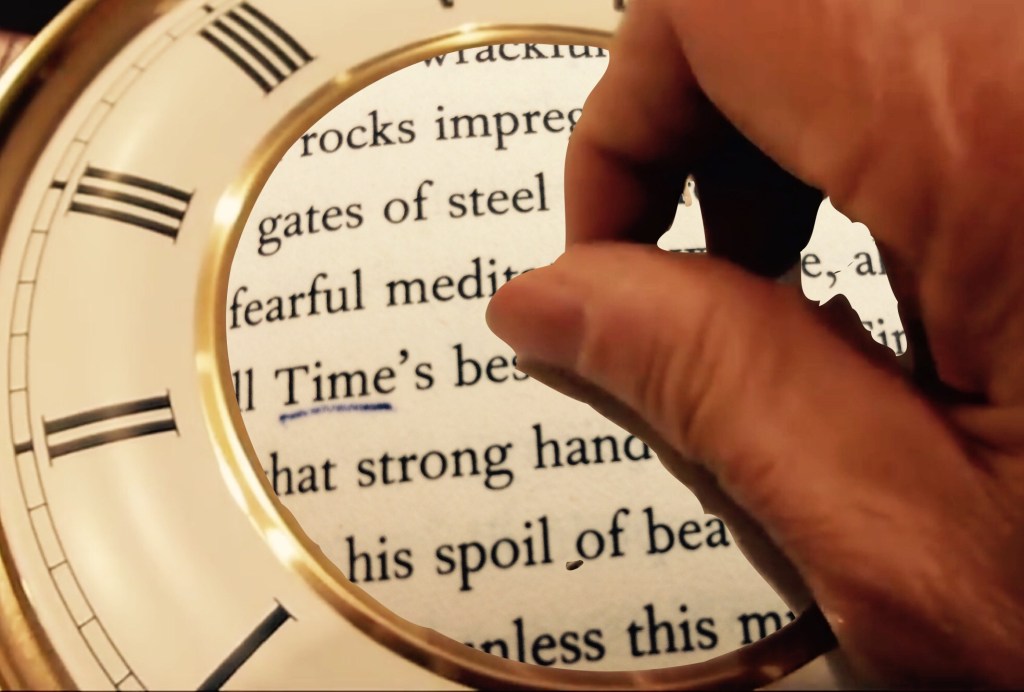
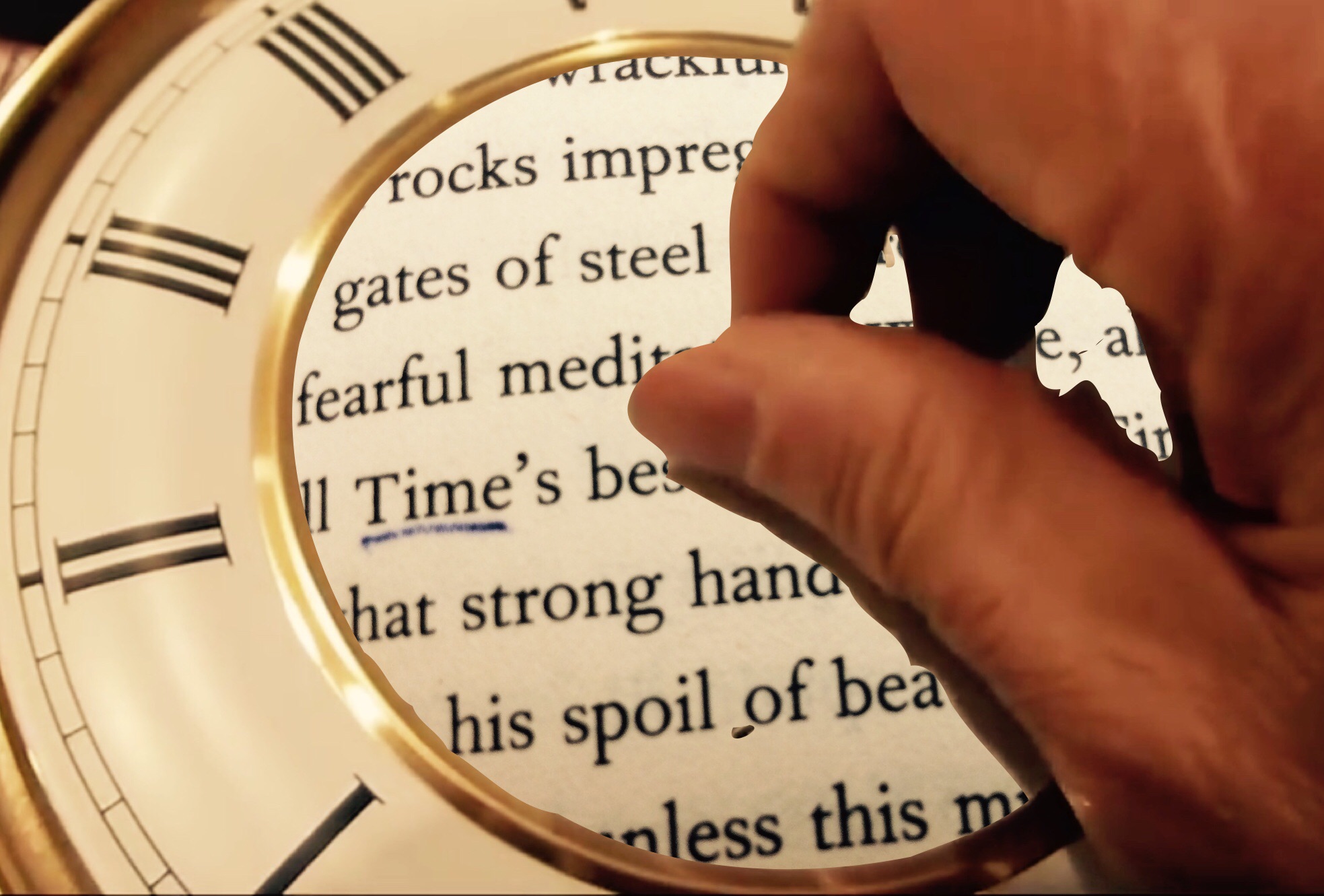
    To the poet: We can oversell our poetic powers. We can become besotted by our cleverness: wordage becomes verbiage; impact is dulled. In what becomes a brilliantly exhaustive passage of sonnets, Shakespeare openly struggles to outwit Time’s corrosive effect on the perfect patina of life; as expressed through Spring’s expression of youth. With every power, vested to a poet, Shakespeare mounts his case only to realise the futility of cause … “o, how shall summer’s honey breath hold out, against the wrackful siege of battering days… Time decays (Sonnets 64 & 65).


    evermore evermore


  • So Be Twins

    So Be Twins

    Time and nature so be twins;
    in course, they groove the one same rut.
    As one turns the other spins;
    so stems a common strut.
    Nature is but time expressed;
    the two can not be parted.
    Once in seasons we invest
    then sewn the end’s been started.
    All things, from nature bred,
    succumb to time’s rotation.
    Youthful beauty so is shed
    through weathered maturation.
    . It is with pen he inks a perfect line;
    . outwits the jinx of self-design.

    © Tim Grace, 17 July 2011


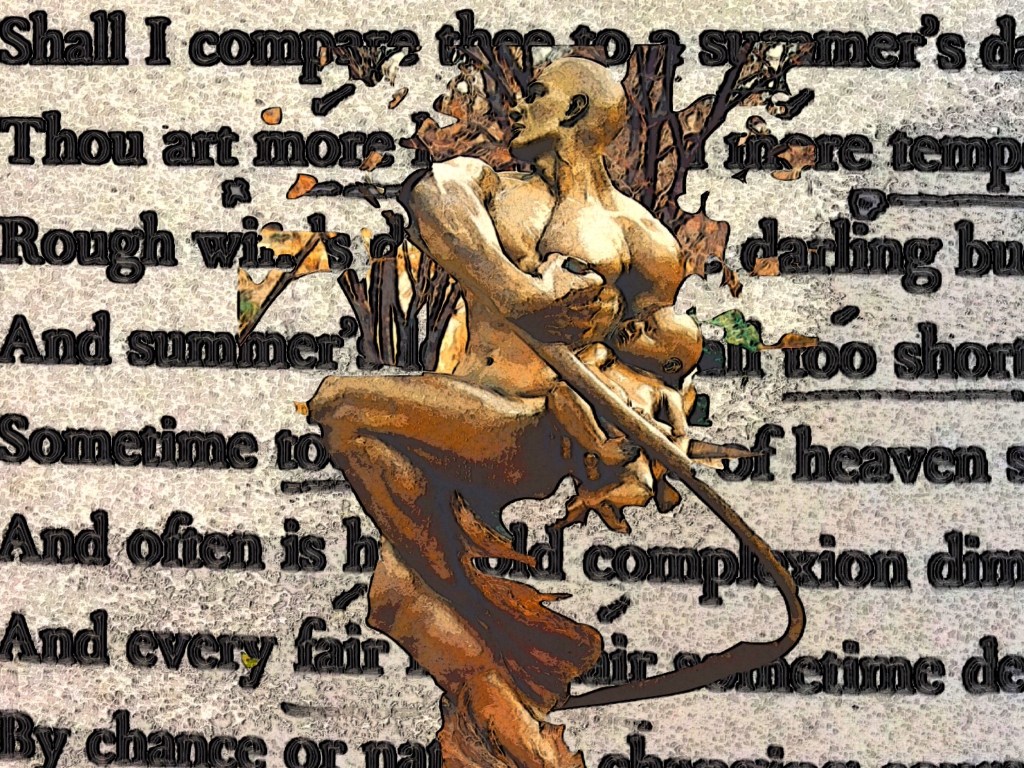
    To the reader: Nature and time are inseparable not interchangeable. Nature is the producer: ever ready to compromise; endlessly adapting as circumstances change. Time is the consumer: demanding and impatient; in one hand a scythe the other a sickle. Seen together (as in reap the harvest) there appears a partnership but this is not based on negotiation; nothing more than convenience. Without a perpetual contract nature has learnt not to resist time. Through accommodation nature extends and also yields its fleeting crop.

    To the poet: In sonnets 17 and 18, Shakespeare changes tack regarding the power of procreation. If youthful beauty stubbornly resists its duty to duplicate by means of perpetual parenting then alternative methods must be found. To a poet it seems obvious that words perfectly written can capture youth and outwit Time. With new zeal, Shakespeare takes it upon himself to write a poem that leaves the beauty of youth beyond compare; beyond Time’s destruction.


    so be twins so be twins