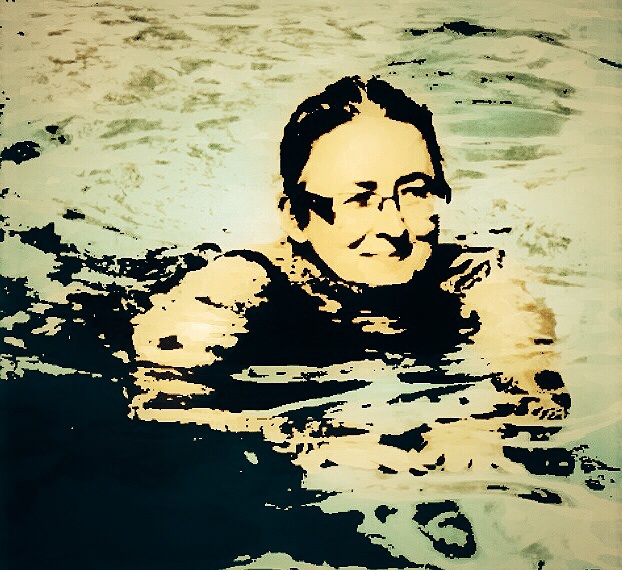
Category: People

  • Streamlined

    Streamlined

    Those who struggle can not swim,
    They meet their own resistance,
    Suffer they from heavy limb,
    That will not last the distance.
    Those who swim in part submerged,
    With half their heart committed,
    They tire soon, as poorly served,
    By shallow breaths acquitted.
    Those who swim with buoyant ease,
    They suffer not fatigue,
    They ride the water’s gentle squeeze,
    And thus they swim in league.
    . Lapse not in to heavy thinking,
    . Burdened … to the point of sinking.

    © Tim Grace, 20 February 2011


    To the reader: The art of swimming. Going with the flow. Immersed in a liquid moment. At one with your surroundings. If you watch the experts, the trick seems to be a combination of style and technique; together, delivering a confident stamina. Swift buoyancy. There is no struggle. A great swimmer gives more meaning to ‘stroke’ than any dictionary could offer.

    To the poet: Loose in its sonnet structure this poem divides into three verse-like quatrains. As with lanes in a pool the quatrains mark out meaning. In this case, the first two sets of four define the struggle of a non-swimmer in competition with water. The next four lines refer to the swimmer in league with water. Natural swimmers work in partnership with water, they are fluid and streamlined; poetry in motion.


    streamlined streamlined

     

  • With Due Regard

    With Due Regard

    As much as work describes me,
    I resist its total claim,
    It’s one book in the library,
    With others in the frame.
    It’s not that I resent my work,
    Or treat it with disdain,
    I do my best, try not to shirk,
    I tolerate its strain.
    The daily grind, I grin and bare,
    There’s value in its fibre,
    But I keep in mind, that without care,
    I’m swallowed by this tiger.
    . With due regard and balanced ration,
    . Labor hard and toil with passion.

    © Tim Grace, 14 February 2011


    To the reader: Time off work, an extended break, triggers the benefits of rest and reveals another side of me. The weight of expectation lifts, the daily grind softens, and the pace of life eases. How much of myself is defined by me at work; not at rest or play. Me at my most industrious; that busy highly driven self, is that the best of me. The non-working part of me is just as creative, just as inspirational but so rarely applied as my description.

    To the poet: An investigation of self. A matter of I-dentification. How much ‘I’ will a reader tolerate. A poet is responsible for sharing ‘I’ statements that can be generalised. To extract any mention of self from a poem constructs an aloof voice Too much introspection reads like self-indulgent therapy. At some point there’ll be a happy ‘me’dium.


    due regard due regard


  • Loosely Sketched

    Loosely Sketched

    An old man, reads old books,
    On a digital screen…
    While the poet looks,
    At the passing scene…
    Nice man turns to menace,
    Table tennis, with a Chinese grip…
    No crowd of words to pen this,
    Nor would one word equip…
    They walk the promenade, twice,
    They loop the pool, backwards…
    He thinks to himself, quite nice,
    But at best a set of hack words.
    .    Some scenes are easily sketched,
    .    Freely fetched, and loosely stretched.

    © Tim Grace, 10 February 2011


    To the reader: Apparently, functional networks extend to about 150 people. Beyond that, it’s difficult to maintain anything but a virtual relationship. And so, by far, most people we see are strangers. As often as not we are their observers. In a closed community, such as a cruise ship, the strangers become familiar but not known. These familiar strangers become predictable; their routines are normalised, and shared circumstance they are attached to backdrop sceneries.

    To the poet: I once tried writing a poem using the advertising text plastered to passing trucks on a highway. What resulted was a random accumulation of words… a traffic jam. As we watch life in passing it has its logical sequence; there is a sense of connection. Place and time give people and events their context. Take away that context and the subject loses its objective frame; might as well write about things.


    loosely sketched loosely sketched
  • Day of Rest

    Day of Rest

    I speak to you (who came before us),
    Not by name selective,
    I speak to you (and your same chorus),
    The common man’s collective.
    To those of you who bore a child,
    Gave birth to inspiration,
    Still we have not reconciled,
    The gap in generation.
    To those of you who laboured hard,
    Who life-long sought a quest,
    Still we treat with disregard,
    Your well-earned day of rest.
    . Still it is our destiny, so to be ignored,
    . Later rediscovered, then to be restored.

    © Tim Grace, 8 February 2011


    To the reader: The wisdom of past customs is lost over time. As relics they become quaintly revered. So the day of rest. Past generations recall Sundays spent in contemplation ‘of God’s good work’. All semblance of labour’s toil replaced by a more sombre duty; heaven’s dedication. Not such a bad idea, the notion of dropping tools and turning our attention to the more spiritual side of existence. Come a day, someone will resurrect the day of rest; rest assured.

    To the poet: The speech, in this case a contemplative monologue, needs particular thought given to phrasing. It’s the natural respiration of familiar tones that resonate with the listener’s ears. Give thought to lilt, the rise and fall of intonation. Take care not to force the natural gate into a contrived trot. The neat structure of a sonnet delivers a compact form well suited to delivery. A spoken delivery requires practice; first readings are rarely the best.


    day of rest day of rest


  • Through Gilded Gums

    Through Gilded Gums

    Here she comes, a silhouette,
    She’ll dance ’til dusk is done,
    Through gilded gums, freshly wet,
    She’ll absorb the sinking sun.
    What nature here creates,
    She’ll draw upon that source,
    In looping figure-eights,
    She’ll trace the ribbon’s course.
    With feather-like finesse,
    She’ll ride the evening breeze,
    Light-footed as a princess,
    She’ll adorn this glade of trees.
    . Born to dance, she’s her mother’s child,
    . So it’s not by chance, she’s like-wise styled.

    © Tim Grace, 28 January 2011


    To the reader: Summer evenings. Warm shower wets the gums. Sun sets. Leaves turn to gold. Band plays an encore. Last note bids farewell. The day is done. The dance is done; for all but one. Free of business, a child calls her grandmother to skip. They do the last dance; as if it was their first. Two ribbons … one path home.

    To the poet: On the edge of sentimental; a soft fall from grace. There are some scenes that need a delicate treatment, they are of themselves romantic, and touched with love. What rescues the sentimental poet is technique. Not so besotted that all sense has been lost. Not so overwhelmed that control has been forsaken. I quite like the discipline of every second line beginning with ‘She’ll’ followed be a verb: dance, absorb, draw, trace, ride and adorn.


    through gilded gums through gilded gums


  • Invisible Thread

    Invisible Thread

    As attached to an invisible thread,
    We are bound to all humanity,
    Through this communion we are wed,
    To a common sense of sanity.
    When round about our strings combine,
    Care should be enlisted,
    For as with any rope or twine,
    Our threads are easily twisted.
    The unravelling reel, the looping lash,
    Beware the rope that’s rotted,
    The curling cord, the whirling sash,
    Are never far from knotted.
    . This string is neither noose nor tether,
    . It’s the thing that holds us all together.

    © Tim Grace, 14 January 2011


    To the reader: Our bond to others is invisible; thread-like. We imagine threads as social ‘ties’. Family ties are life-long; others are short-lived and useful for just a moment of interaction. Regardless of strength and character the invisible threads can tangle to a mighty mess. Attending to the health of our invisible threads is important. Frayed and worn-out threads lose their flexibility and stretch; become difficult to manage, and are far from dependable. In rope we trust.

    To the poet: The neatness of each four-lined verse helps to ‘tie’ this sonnet together; it’s well packaged, well bundled… well versed. In a later sonnet, the invisible thread is again used as the main reference-point. As an invisible subject, a thread has endless possibility for metaphorical word-play. Whether rope string or cord; it ravels, loops and twists obligingly around your topic of choice. Money for rope.


    invisible thread invisible thread