Category: geography

  • Ornamentalism

    Ornamentalism

    Ornamentalism: an assortment
    of collectables, domesticated
    bric-a-brac, imports from the orient;
    samplings of stuff, made sophisticated:
    the leather-bound folio, paper-backed
    penguins, specimens in formaldehyde.
    The trinket, the hand-crafted artefact;
    exotic and familiar, side-by-side.
    Foreign objects, ambassadors abroad,
    international treaties exercised.
    A continental-shelf, cross-bow and sword:
    “en garde!” – the world has been homogenised!
    . We explore the unfamiliar; enough
    . to give it status; substance over stuff.

    © Tim Grace, 24 May 2014


    To the reader: I’d been sitting beneath a decorative array of ‘exotic’ ornaments that in a moment of attention had me intrigued. The eclectic display was purely ornamental with no hint of suggested expense or value. “Ornamentalism” I thought. As it happens, the term ‘ornamentalism’ was coined by David Cannadine who expanded on the concept to describe ‘How the British Saw their Empire (~1850 to ~1950).

    To the poet: Through the appropriation of exotic customs (including artefacts) the modern Imperialists integrated non-British cultures into a homogenised new-world order. The strict interpretation of a sonnet is similarly transformed by the introduction of slightly foreign influences; and so the form adapts and retains its significance. In this way, a structure keeps its relevance and meaning. Through ‘ornamentalism’ we loosen the grip of conservative hierarchies; and so, become familiar with alternative possibilities.


    Ornamentalism
    Ornamentalism
    Acknowledgement:
    Title: Ornamentalism:
    How the British Saw their Empire
    Author: David Cannadine
    Publisher: Allen Lane (2001)
  • Refletions in Silicate

    Refletions in Silicate

    Both sides of me – glass. Across the street – glass.
    A township’s reflection in silicate.
    I watch a car, I see it three times pass.
    Gleditsia – a sunburst in triplicate.
    Waitress serves coffee, delivers it thrice.
    A school bus on route to three destinations.
    Thread of pedestrians – a three-way splice.
    Parked vans in parallel situations.
    An over-weight figure stretches and shrinks.
    From the pavement’s perspective, three lines switch.
    A chain of clients making awkward links.
    Three panels of distortion – a triptych.
    . The arcade – a see-through kaleidoscope.
    . A visual illusion of words in trope.

    © Tim Grace, 15 October 2013


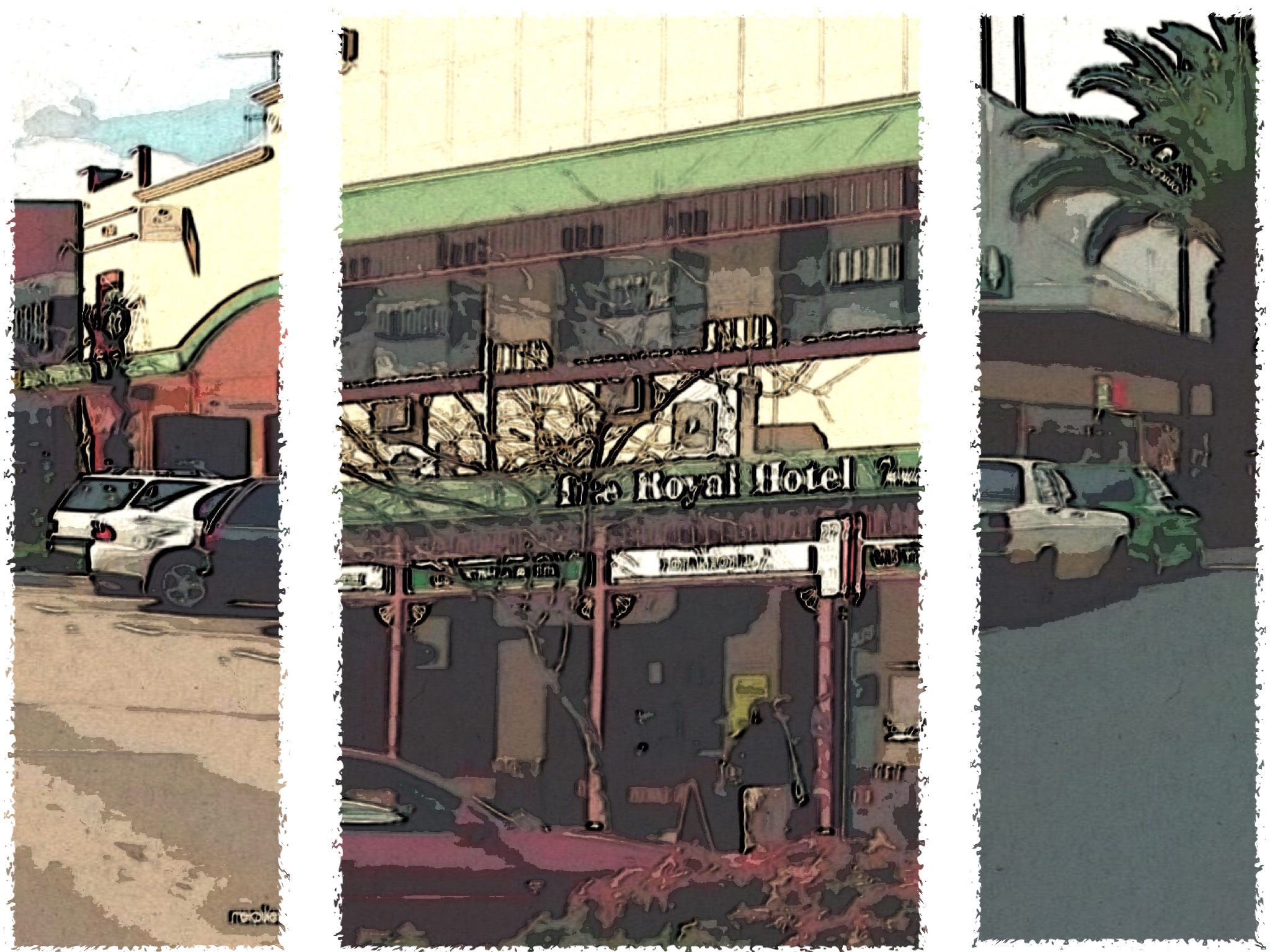
    To the reader: Taree is a small town on the central coast of eastern Australia. Over three mornings, I found myself in a coffee-spot, positioned in a neat and tidy arcade, overlooking a sleepy main-street. With glass all about me, I peered out from within my squared-off telescope and captured a kaleidoscope of reflections; as the town began its business: in country towns the streets are wide, with rows of trees on either side.

    To the poet: As a stranger in town, you are invisible on the first and second day. By day-three, however, your regular habits have been revealed and noted by the observant local. The guy behind the counter knows your coffee-preference, the waitress works around your table-setting of books and pens. There’s a polite expectation, not quite an obligation, that you explain your purpose. Towns, just like people, are a little suspicious of strangers with pad and paper.


    Reflections in Silicate Reflections in Silicate
    Picture Source:
    http://youtu.be/uQB68AaFLtk
  • Elliptical Stance

    Elliptical Stance

    An elliptical stance; a solstice night;
    remnants of Autumn; blanket of leaves;
    haiku syllables; captured sound and sight;
    severe frost; white footsteps; icicled eaves.
    Snippets, half-formed, in the absence of heat;
    cold-fusion; liquid air; saturated;
    frozen to a frame; cameos compete.
    A fragile balance, equally weighted;
    naked trees strike a pose in silhouette;
    ghostly shadows dance to a druid’s drum;
    the pendulum must pause to pirouette;
    for that which passes tells of that to come.
    . That which tilters must surrender to time;
    . so be the season, the reason and rhyme.

    © Tim Grace, 22 June 2013


    To the reader: In temperate zones seasons swing with a contrast of moods. With reduced hours, Winter days make-do with what little warmth the sun has to offer. Long-nights, without a store of heat, settle quickly into a frigid chill. In the cold depths of night a frozen moment rearranges water particles into crystals of ice. The dark-theatre is austere, stripped of animation; made still.

    To the poet: A lifeless sonnet, descriptive of a cold suburban landscape. As much imagined as it is observed. Small snippets of observation, transitions, staggered frames; brittle connections. The relationship of water and ice in-part describes the sonnet’s internal structure as crystallised. There’s a fractured feel to the poem, which at any moment could shatter in to parts.


    Elliptical Stance
    Elliptical Stance
    Picture Source:
    http://youtu.be/a-N-DGM2XIU