Category: Life

  • Why Do Some Things?

    Why Do Some Things?

    Why do we fear what we don’t understand?
    What makes ignorance the beast that it is?
    Why do we crush what we cannot command?
    How does good reason make sense of all this?
    Does logic lend favour to a good cause?
    Does logic distinguish fiction from fact?
    Does logic consider the pregnant pause?
    Does logic rationalise the random act?
    Sadly, the answer is ‘no it does not’.
    Some things defy logic; leave us confused.
    Some things are awkward, contentious and hot.
    Some things intrigue us, and leave us bemused.
    . A reasonable logic is common sense.
    . A logical reason is consequence.

    © Tim Grace, 28 December 2013


    To the reader: Common sense contributes to the real-life application of experience in the face of new circumstances. In a logical sense, taking a ‘common’ approach to problem solving is a bit hit and miss. Logical approaches reduce the impact of bias and error; distancing head-strong habits from heart felt emotions; favouring the cool calculation. All very-well, but hardly suited to the quirky-nature of human behaviour. We do what we do often to deliberately defy logic, to be unpredictable … don’t ask me why!

    To the poet: The challenge was to defend common sense. Over logic; which at best, questions irrational sentiments and contributes to good judgement. To address the challenge, the sonnet’s three stanzas rally to explore “Why… Do… Some things …” Ironically, through logical entanglements, the final couplet struggles with the delivery of a summative punch.


    Why Do Some Things? Why Do Some Things?
    Picture Source:
    http://youtu.be/LQoAg49NgMo
  • Business as usual

    Business as usual

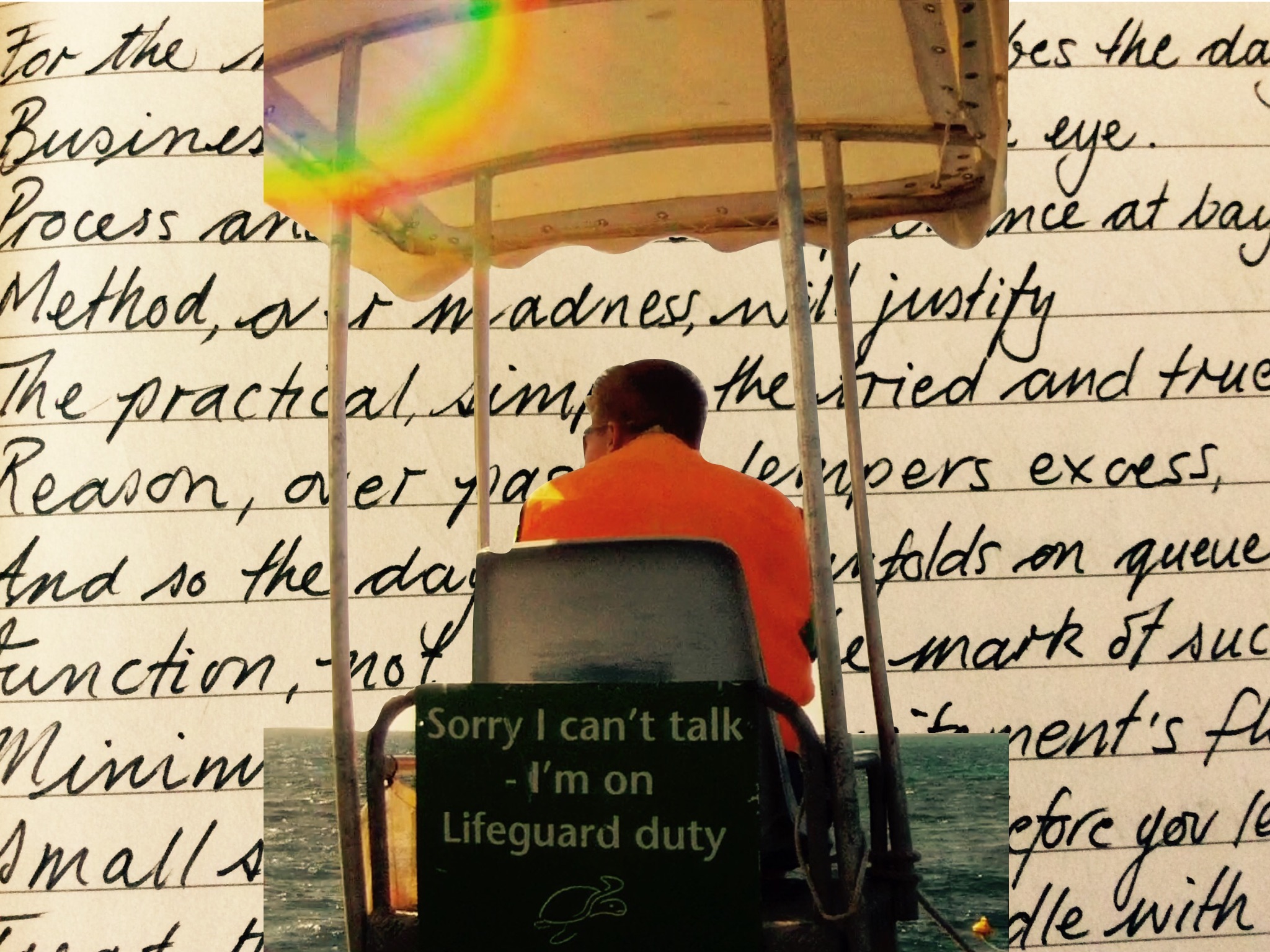
    For the most part, routine describes the day.
    Business as usual distracts the eye.
    Process and procedure keep chance at bay.
    Method over madness will justify:
    the practical, simple, the tried and true,
    reason over passion, temper’s excess;
    and so, the day proceeds, unfolds on cue.
    Function, not fanfare, the mark of success.
    Minimise the risk of excitement’s flare:
    small steps, not large, and look before you leap!
    Treat the day as hostile, handle with care.
    Treat mole-hills as mountains; as far too steep!
    . Today’s containment is alive and well,
    . With fires to dampen and seas to quell.

    © Tim Grace, 20 October 2013


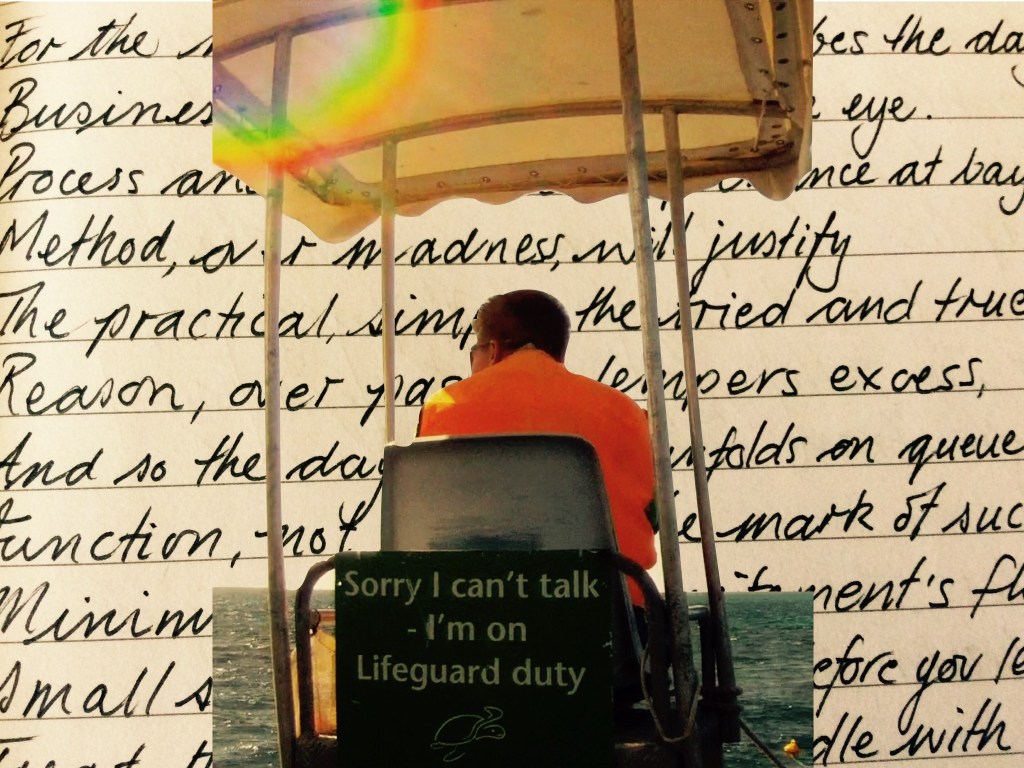
    To the reader: Work has an inflated ego. This self-appointed, self-anointed, arbiter of time’s worth is a small-minded accountant. Given a badge, this officious miser of minutes scrapes from employment every last morsel of production. The yard-stick is a poorly calibrated measure of busy-ness; units of labour; toil and drudgery. The accountant’s grip on work-for-work’s sake strengthens and with throttling effect motivation is all but exhausted.

    To the poet: I’m working on a holiday… aren’t we all? Work’s relationship with rest and play doesn’t have to be adversarial. If work is a drudgery, then the distinction is probably convenient; as in, I’m ‘going to work’ suggesting a dislocation from other creative pursuits. Ideally, work, rest and play are a natural integration of life’s energies; with each contributing to an overall sense of wellbeing.


    Business as usual
    Business as usual
  • Refletions in Silicate

    Refletions in Silicate

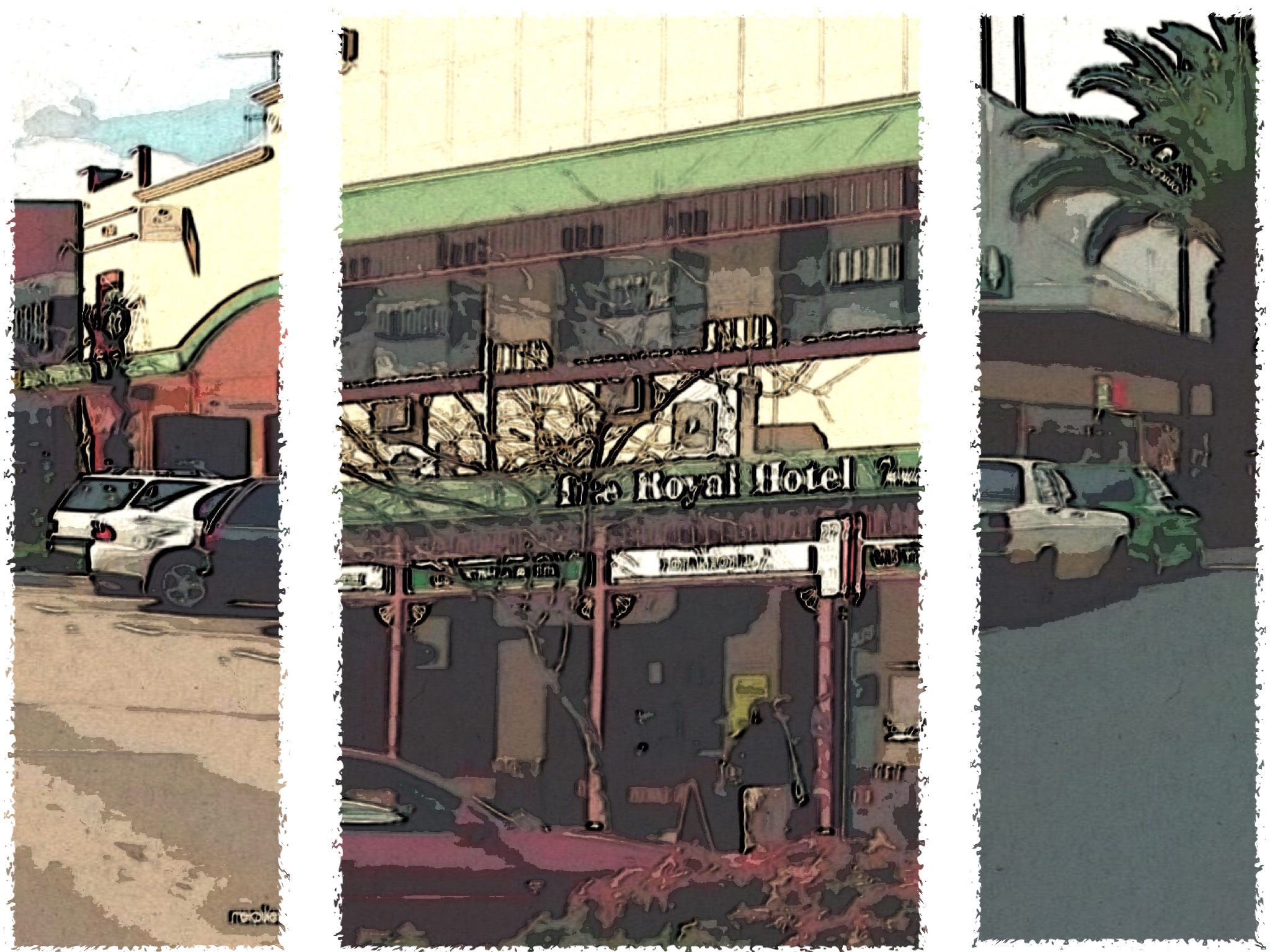
    Both sides of me – glass. Across the street – glass.
    A township’s reflection in silicate.
    I watch a car, I see it three times pass.
    Gleditsia – a sunburst in triplicate.
    Waitress serves coffee, delivers it thrice.
    A school bus on route to three destinations.
    Thread of pedestrians – a three-way splice.
    Parked vans in parallel situations.
    An over-weight figure stretches and shrinks.
    From the pavement’s perspective, three lines switch.
    A chain of clients making awkward links.
    Three panels of distortion – a triptych.
    . The arcade – a see-through kaleidoscope.
    . A visual illusion of words in trope.

    © Tim Grace, 15 October 2013


    To the reader: Taree is a small town on the central coast of eastern Australia. Over three mornings, I found myself in a coffee-spot, positioned in a neat and tidy arcade, overlooking a sleepy main-street. With glass all about me, I peered out from within my squared-off telescope and captured a kaleidoscope of reflections; as the town began its business: in country towns the streets are wide, with rows of trees on either side.

    To the poet: As a stranger in town, you are invisible on the first and second day. By day-three, however, your regular habits have been revealed and noted by the observant local. The guy behind the counter knows your coffee-preference, the waitress works around your table-setting of books and pens. There’s a polite expectation, not quite an obligation, that you explain your purpose. Towns, just like people, are a little suspicious of strangers with pad and paper.


    Reflections in Silicate Reflections in Silicate
    Picture Source:
    http://youtu.be/uQB68AaFLtk
  • Failing Forward

    Failing Forward

    The young talk in terms of ‘failing forward’.
    They have swallowed an implausible pill.
    ‘Failure’s now an option’ – one they applaud:
    ‘Why fear failure? An innovator’s thrill!’
    Let’s stop, let’s pause, let’s think on this a bit.
    ‘To err is human’ let us grant them that.
    But ‘what’s broke is broke’ there’s no place for it.
    For it has dependencies: tit-for-tat
    consequences, poor measures of success.
    Poor excuses; a paucity of thought.
    Backroom mistakes, it’s those we can bless.
    But failure in practice is no good sport.
    . Discoveries by accident are rare,
    . not to be mistaken for failure’s flare.

    © Tim Grace, 3 October 2013


    To the reader: Playfulness has been appropriated, reduced to a game; and in this gamified world ‘failing forward’ is encouraged as a tactful strategy. This notion of risk-free failure suits a programmed environment where the variables have been given bounds of tolerance. Within set-bounds, the game itself looks after potential disaster; that pretended consequence has been programmatically eliminated. To game is not to play…

    To the poet: To learn from your mistakes was the maxim of my generation. Poetry is an open-ended puzzle, and as a playful pursuit it resists any ‘gamed solution’. A poet that plays ingenuous games with his reader will soon be discovered. There’s an expectation of meeting real-risk head-on; over-coming failure (outside the pretence of a game) with intrepid audacity.


    Failing Forward
    Failing Forward
  • Without Condition

    Without Condition

    He stakes his claim and demands position,
    stipulates his terms and fixes his spot.
    We watch askance, this crude exhibition
    of stubbornness; will he, or will he not?
    Those around him, about his axel spin,
    infantile argument, circular shape,
    centrifugal anger fuelled from within.
    A storm’s eye, vortex, that’s hard to escape.
    He grips tight, pin-points his agitation.
    He asserts his temperament; taciturn.
    Imploding mood centres his rotation.
    With spiralling momentum, so things churn.
    . Stubbornness grips to a fixed position,
    . and so gives no ground without condition.

    © Tim Grace, 24 August 2013

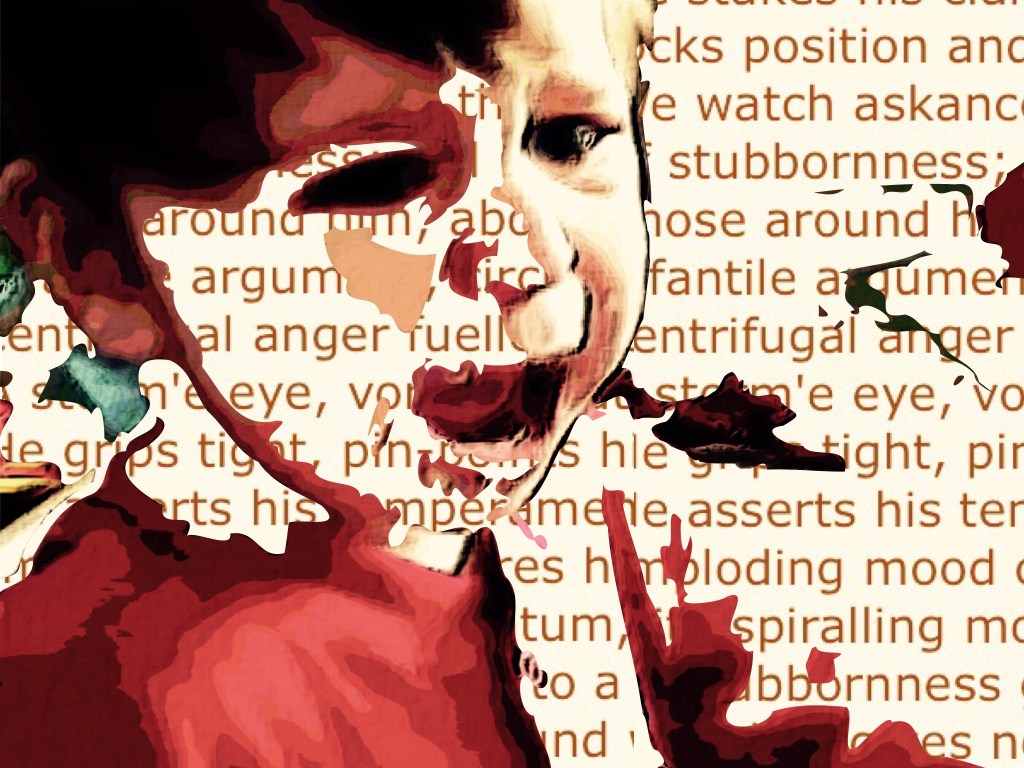
    To the reader: A child’s public tantrum makes an unpleasant scene; psycho-drama writ-large! With crudely-crafted powers of persuasion the toddler tests the strength of new-found tactics; claiming more independent territory with each event. The assertive-aggressive personality matures into an effective form of attention seeking; one that loses its stamp-of-approval with years beyond five or six. The storm quickly brews, tension builds; fury is released – damage is repaired and peace restored… the toddler is tamed!

    To the poet: The public tantrum is no rare occurrence. Little bundles of dynamite regularly ignite; catching those in close-proximity by surprise. With short-wicks these volatile miscreants can derail a train of thought with devastating effect. The passenger-poet is one of many hapless victims. As the wreckage is surveyed, for post-crash forensics, there’s often an unaccounted empty seat … a surrendered supposition.

    Without Condition
    Without Condition
    Picture Source:
    http://youtu.be/OZkRWnXo6YU
  • There Are Moments

    There Are Moments

    There are moments when everything makes sense.
    For just a second nothing is at odds.
    Simplicity abounds, becomes immense;
    earns the approval of a thousand gods.
    It’s at that moment, between wake and dream,
    that all things become imaginable;
    all things at once adopt a common theme.
    One point of truth becomes conceivable.
    Clarity of thought is clean-cut and crisp;
    vagaries sharpen so ‘that’ becomes ‘this’;
    images emerge, give shape to a wisp;
    that which is simple, more beautiful is.
    . Where stems the answer to “why is it so?”
    . From the essence … in the presence of flow.

    © Tim Grace, 18 July 2013


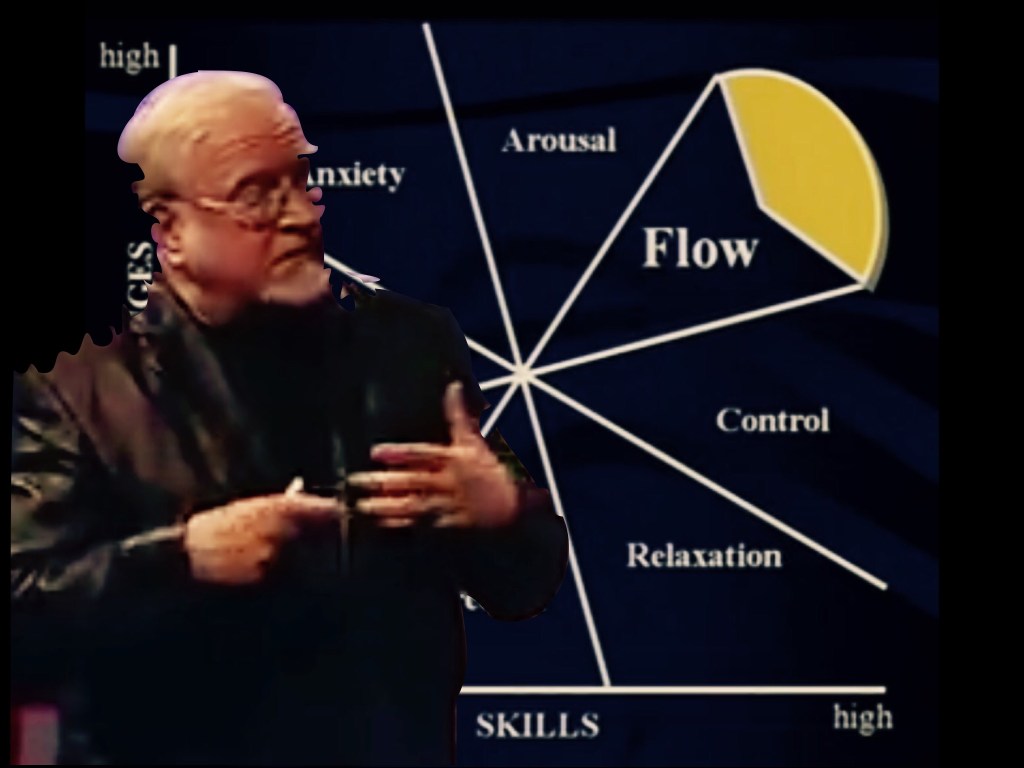
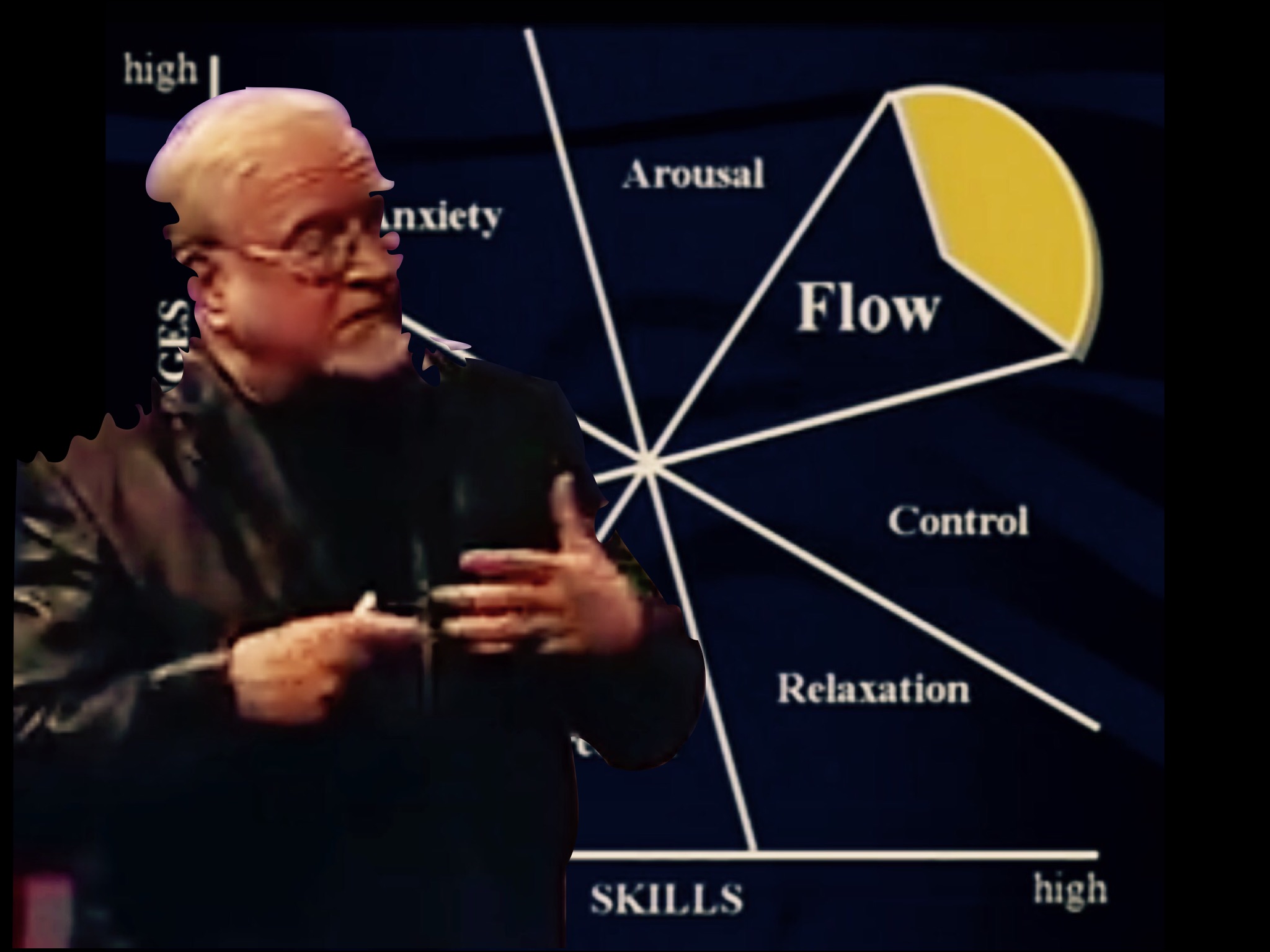
    To the reader: If you haven’t had your introduction to the works of Dr Mihaly Csikszentmihalyi (chick sent me high) you owe it to yourself to make that connection. Through this acquaintance you’ll meet yourself at your potential best. As the theory goes, there are deliberate steps you can take on the way to achieving flow; an essence you learn to channel from within a zone of intense satisfaction with your own condition of contentment… in pursuit of happiness.

    To the poet: You can’t bottle flow; it’s a meditative energy, that through active absorption describes a form of fulfilment. My gateway to ‘flow’ is through the comfortable challenge of poetry. Effort, along with challenge, is a necessary ingredient. And so, in the right mix, these energies combine to create a state of self-contained purpose. Flow, by definition, is a dynamic stream of consciousness, coursing its way through mind and soul… in pursuit of happiness.


    There Are Moments There Are Moments
    Picture Source:
    http://www.ted.com/talks/mihaly_csikszentmihalyi_on_flow?language=en#t-33296