Category: Arts

  • Grain of Truth

    Grain of Truth

    There’s not a grain of truth in what they’ve claimed.
    They have cultivated a nonsense, so
    much so, the silo has been besmirched, defamed.
    It’s been compared to a Balkan State, no
    more so will I let this grievance pass
    untested, unquestioned; taken as read.
    What they have reasoned is simply a farce;
    a mischievous lie, it has to be said:
    The silo is nothing like a locked vault;
    has nothing to do with isolation.
    Through misinterpretation comes this fault:
    silos are hubs in communication.
    . Break not the silo, more strengthen its link.
    . It is through the silo that systems think.

    © Tim Grace, 18 January 2012


    To the reader: The history of grain-silos is interesting. They date back to storage pits in Greece around the 8th Century BC. In a modern sense, they took their vertical stance in the 1800s; significantly, attached to a transport system. Understood as critical components of flow in an agricultural system, their virtual counterparts are much maligned in dysfunctional bureaucracies. An office that stores but does not distribute its information is mistakenly labelled a silo; it does nothing to deserve that label.

    To the poet: Mounting a comprehensive argument in fourteen lines is problematic. Without much room for justification the point can be interpreted as a poke. Diatribes tend to be like that; one way polemics. In some ways a static container disconnected from further adaptation – a Balkan State! As much as you might disagree with my defence of the silo; there’s little likelihood of me responding to your rational alternative. You could, of course, leave a comment…


    grain of truth grain of truth


  • One More

    One More

    One more than many. One amongst the crowd.
    Of all amassed, of all assembled,
    you are the one of all who’s most endowed
    with the touch of difference; unresembled:
    uncopied, unmatched, unequalled; unique.
    You are the diamond in a crown of jewels.
    You are the highest mount; a lover’s peak.
    You are the exception that breaks all rules.
    You are the singular presence, where dwells
    perfection, where at one point all things meet.
    Within you perfect love is made, where swells
    affection; through your oneness all things complete.
    . At one with love you have tamed love’s thunder,
    . you have brought to heel cupid’s brand of wonder.

    © Tim Grace, 10 February 2012


    To the reader: Being the chosen one is flattering. It’s nice to be given attention; to be drawn out of the crowd as something special. But quite a perverse honour if you’re an admirer’s anonymous obsession. More so, if you are the one that through compare is beyond compare. Do you actually exist, or are you an imagined tool that consummates desire? Is the relationship unrequited? No matter, the infatuation delivers a brand of private climax. (WS – Sonnet 154)

    To the poet: Depending on emphasis, the meaning of “one more lovely” is quite different to “one more lover”. And there’s the invitation to play with words. In both senses the expressions are literal but have a figurative overlay that creates room for interpretation. So “one more – than many” can be a numerical statement offering infinite potential. Or, “one – more than many” can be a flattering statement offering distinction beyond the norm. Both interpretations are at one with my “one more” intent … (TG – Sonnet 155)


    image

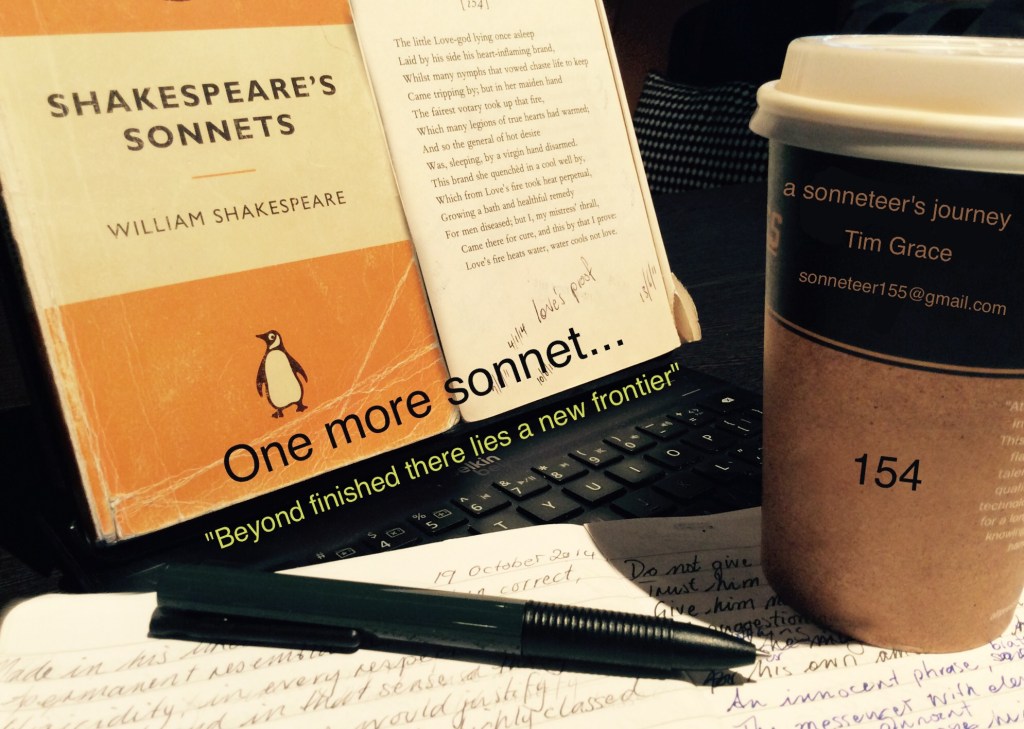
  • Beyond Finished

    Beyond Finished

    To say that all is finished, all is spent,
    means nothing in the greater scheme of things.
    For in that scheme there is but one intent:
    “waste nothing” – as from compost new life springs.
    What of that old house that the ground recalls?
    What of that empire in its fallen state?
    What of that fashion that today appals?
    What of good reason wasted in debate?
    All of these might be finished, done with use,
    stripped of cause, drained of substance; as conceived
    they might be buried dead or dangling loose;
    but as time shall choose – they shall be retrieved.
    . Beyond finished there lies a new frontier,
    . furnished in the garb of a golden year.

    © Tim Grace, 14 March 2012


    To the reader: Mistakenly, finished can be considered a terminal point of arrival. A statement of completion that declares an ending. In reality, nothing ends its course; nothing is divorced from what’s to come. Next, is the consequence of an expanding universe; until Time contracts there shall always be a new beginning… a next time to come. And so, in conclusion, consider this sum … there’ll always be “one more sonnet” to come.

    To the poet: Almost done. I know what it’s like to write 154 sonnets; one more and I’ve achieved my goal; one more sonnet and I’m finished? The challenge was self-imposed and given a few rules the disciplined process was fairly painless. The two-year rule was gruelling but necessary. The minimal use of “like” as a tool for metaphor kept me anchored to a direct narrative. The sonnet is an endlessly adaptable form both generous and forgiving. The sonnet (and my readers) suffered some mutilation along the way but with considerable credit stayed the course.


    beyond finished
    beyond finished


  • Inspiration 1 – Enthusiasm

    Inspiration 1 – Enthusiasm

    We all seek that spark of inspiration.
    We crave its challenge, relish its rewards,
    welcome its trigger; its motivation;
    its promise of profit … as such affords.
    Inspiration is an essence; of sorts,
    an energy, a fine spirit at best.
    It’s a shapeless elixir that contorts
    the grip of reason with a dose of zest.
    It’s the will of conviction with fresh claim
    to a stale idea, it’s the modern twist,
    the contemporary spin; it’s the vim, the flame
    that fires-up passion … it’s stamina’s grist.
    . Inspiration is that breath of fresh air
    . that fuels a flicker to generate flare.

    © Tim Grace, 20 January 2012


    To the reader: Inspiration is something more than motivation. Both nouns describe an action. We can be motivated to do all manner of tasks that are hardly inspiring; the reverse is harder to imagine. Unlike motivation, inspiration finds its source beyond basic needs; and further more, is not dependent upon base rewards to maintain an interest. The mark of genuine inspiration is enthusiasm.

    To the poet: Another sonnet that took some stubborn shaping; thought pieces are like that. The poem’s theme is inspiration and should have been delivered through the guise of enthusiasm; instead, it reads like a cerebral exercise. The final couplet once read: “Welcome inspiration with open arms… it’s the antidote to worrisome qualms”. A nice couplet, but the sonnet wasn’t about worry’s antidote; it was about the spirit of inspiration.


    image.jpeg

  • Fine Lines

    Fine Lines

    By the end of childhood I learned to draw
    fine lines (with keen eyes and measured skill).
    I learned to draw what mattered; to ignore
    the distractions (there were no marks for frill).
    How to overcome the errors of sight?
    How to foreshorten an odd perspective?
    These were the problems you had to get right:
    minimal tolerance for technical give.
    All things became parallel, rightly squared;
    they had to marry-well to plot or grid;
    they had to tally-well or be repaired;
    they had to mirror what the real world did.
    . After childhood there are no wonky lines;
    . they neatly straighten and become designs.

    © Tim Grace, 6 January 2012


    To the reader: At school I enjoyed technical drawing classes, they appealed to my style of measured sketch; where objects take shape according to long-held principles of linear geometry. Tools of the trade were important and taking care of them was critical to achieving a clean result. Of all the lessons I learned at school it was through technical drawing I best understood myself. I freely gave away my naive interpretation of the visual world and adopted rules that enabled me to draw what I see.

    To the poet: Between naivety and mastery lies frustration. It’s unfortunate that we abandon our fresh expression of life through naive art… but understandable. Expression, in all its forms, is a social tool that evolves to meet expanding needs. The licence to communicate has rules that can be stretched and personalised but ultimately an audience will accept or reject the value of art. Selecting an appreciative audience is one solution… avoid criticism; create your own applause.


    fine lines
    fine lines
  • Pallet of Paint

    Pallet of Paint

    A child’s painting is made without restraint:
    it’s vivid and vibrant, it’s bold and bright.
    A child’s canvas holds a pallet of paint:
    a bucket of brilliance and sheer delight.
    She paints a garden under sunny skies;
    dabbles the brush over petal and stem.
    She gently strokes the wings of butterflies;
    and so imagines she is one of them.
    She paints her world on a borderless page;
    with abundance her landscapes grow and stretch;
    colours explode, shapes expand; there’s no cage
    that can contain the wonders of her sketch.
    . In a child’s garden there’s room for belief,
    . a world of wonders for adult relief.

    © Tim Grace, 5 January 2012


    To the reader: We out-teach the artistic instinct in children and then hanker for its return throughout our adult years. A child’s interpretation of the world is a fairly spontaneous imitation of experience; translated using naive means. The young artist (untrained in tricks and tools of the perceptive trade) makes-do. Without mastery, a child is free of restrictions; free to draw upon raw imagination. This medium has no separation; this medium is the closest we get to living art.

    To the poet: The irony of this sonnet is its tight control over the thematic centrepiece – naive liberty. It’s an adult’s carefully scripted celebration of a child’s artistic freedom. Unfortunately, there’s a trade-off that comes with age and mastery: skill becomes an interpretative filter. The more skilled I become the more capable I am of manipulating my experiences; consequently, inspiration is overwhelmed by technique. The redeeming feature is freshness … did inspiration survive the productive ordeal?


    Pallet of Paint – Picture Source: http://youtu.be/RfOOAUiKFew